Track your nutrition and health goals

Low-Calorie Food Swaps: Lighter Versions of Everyday Foods (With Calorie Savings)
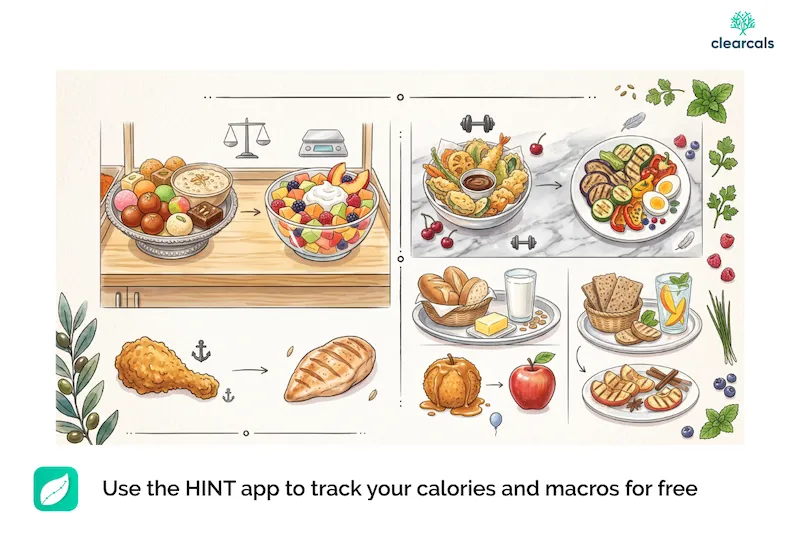
Low-Calorie Food Swaps: Lighter Versions of Everyday Foods (With Calorie Savings)
Why Small Swaps Add Up
You don't need to overhaul your whole diet to eat fewer calories — often the easiest wins come from swapping one everyday ingredient for a lighter version of the same thing, without changing what you're actually eating. A few swaps like this, repeated daily, can save 200-400 kcal without feeling like a diet at all.
Cooking Oil
Oil is one of the most calorie-dense things in an Indian kitchen at ~900 kcal per 100ml (roughly 120 kcal per tablespoon) — and it's also one of the easiest places to cut without changing taste much.
- Use a measuring spoon instead of pouring freehand. Most home cooks use 2-3x more oil than a recipe needs simply by pouring straight from the bottle.
- Switch to an oil spray or brush for tempering (tadka) — you get the same flavour with a fraction of the oil.
- Use a non-stick pan to cook sabzis with less oil overall.
Savings: cutting 1 tablespoon of oil per dish saves ~120 kcal — across 2-3 dishes a day, that's 250-350 kcal saved without noticing a difference in taste.
Rice
A cup of cooked white rice runs ~200 kcal. You don't need to eliminate rice — portion and preparation matter more:
- Measure your portion rather than eyeballing it — it's easy to serve 1.5-2 cups without realizing it.
- Cooked-and-cooled rice (even reheated) has somewhat more resistant starch, which digests differently and can help with fullness, though the calorie count itself doesn't change much.
- Mix in cauliflower rice for part of the portion if you want more volume for fewer calories.
Bread and Roti
- Multigrain or whole wheat roti isn't dramatically lower in calories than a plain wheat roti, but it's more filling per calorie due to fibre — for more on fibre-rich swaps generally, see our guide to eating more fibre.
- Watch the ghee/butter, not just the bread itself — a roti brushed generously with ghee can add 50-80 kcal on top of the bread's own ~70-90 kcal.
- For sandwiches, a thinner slice of bread or one slice instead of two is a simple, unnoticeable cut.
Cheese and Paneer
- Low-fat paneer runs roughly 180-200 kcal per 100g versus 260-300+ kcal for full-fat — a meaningful difference if paneer is a regular part of your diet.
- Grate cheese instead of using thick slices — you use visibly less for the same flavour coverage on a dish.
- Cottage cheese is a lower-calorie stand-in for cream cheese or paneer in some preparations, at roughly a third of the calories.
Sauces, Chutneys, and Dressings
This is one of the sneakiest calorie sources, since sauces are added in "just a spoon" amounts that add up fast:
- Mayonnaise-based sauces and dressings run 80-100 kcal per tablespoon — swapping to a yogurt-based dressing or a thinner tomato-based sauce cuts that significantly.
- Schezwan and other oil-based sauces are calorie-dense — using them as a light coating rather than a soaking sauce keeps the flavour without the full calorie load.
- Curd-based dips (raita-style) are a lighter alternative to cream- or mayo-based dips for snacks.
Chips, Namkeen, and Other Junk Food
- Baked or roasted versions of chips and namkeen typically run 30-50% fewer calories than deep-fried versions for the same portion.
- Portion into a bowl instead of eating from the packet — it's the single easiest way to avoid the "just a little more" pattern that doubles or triples an intended portion.
- Roasted makhana or roasted chana (see our low-calorie snacks guide) are strong lower-calorie stand-ins for the same crunchy craving.
- You don't have to give up junk food entirely to lose weight — swapping the fried version for a baked one, or simply eating a smaller, pre-portioned amount of the same snack, usually gets you most of the benefit without the all-or-nothing feeling that makes cutting it out completely hard to sustain.
Desserts and Sweets
- Angel food cake is a genuinely useful swap if you want cake — it's made without butter or egg yolks, which puts it at roughly a third of the calories of a typical butter- or cream-based cake for a similar-sized slice.
- Fruit-based desserts (fruit chaat, grilled or baked fruit) are a lower-calorie stand-in for cream- or sugar-heavy desserts while still satisfying a sweet craving.
- For a fuller list of lower-calorie Indian and Western dessert swaps, see our low-calorie desserts and sweets guide.
Swap for High-Volume, Filling Foods
Calorie-dense, low-volume foods (a small handful of nuts, a rich curry, a slice of cake) can leave you wanting more, while high-water-content foods fill the same stomach space for far fewer calories. Starting a meal with a salad, a clear soup, or a bowl of cucumber and watermelon before the main dish is a simple swap that reduces how much of the denser food you eat afterward, without any specific food being off-limits.
Noodles and Pasta
- Portion control matters more than the noodle type itself for most instant and regular noodles/pasta.
- Load up on vegetables in the same dish to increase volume without meaningfully increasing calories — this naturally reduces how much noodle/pasta you eat for the same fullness.
- Watch the accompanying sauce or tadka, which often adds more calories than the noodles or pasta itself.
Milk
- Toned or skimmed milk runs roughly 45-60 kcal per 100ml versus ~65-80 kcal for full-cream milk — a small but consistent saving if you drink milk or use it in tea/coffee daily.
Track Your Swaps With Hint
The calorie difference between the "regular" and "lighter" version of a food is often invisible unless you're actually logging it — the Hint app's food database makes it easy to see the real gap between, say, full-fat paneer and low-fat paneer, so you know which swaps are actually worth making for you.
FAQs
What are the easiest low-calorie food swaps to make? Measuring cooking oil instead of pouring freely, switching to low-fat paneer, using a yogurt-based dressing instead of mayonnaise, and portioning chips/namkeen into a bowl are among the easiest swaps with real calorie impact.
Does whole wheat bread have fewer calories than white bread? Not dramatically — the calorie difference is usually small. The bigger benefit of whole wheat is fibre content, which helps with fullness, not a large calorie reduction on its own.
How much oil should I use for weight loss? There's no fixed universal number, but measuring rather than free-pouring typically cuts oil use by half without a noticeable difference in taste — that alone can save 100-200+ kcal per day.
Is low-fat paneer as good as regular paneer for protein? Yes — protein content is similar between low-fat and full-fat paneer; the calorie difference mostly comes from the fat content, not the protein.
What's a lower-calorie alternative to mayonnaise-based sauces? Yogurt-based dressings or dips are a common lower-calorie substitute, typically saving 40-60 kcal per tablespoon compared to mayonnaise.
What's a good low-calorie dessert swap? Angel food cake is one of the most effective — it's made without butter or egg yolks, putting it at roughly a third of the calories of a typical cake for a similar slice. Fruit-based desserts are another good lower-calorie option that still feels indulgent.
Can I still eat junk food and lose weight? Yes — swapping fried versions for baked ones, or simply pre-portioning a smaller amount of the same snack, usually captures most of the benefit without needing to cut it out completely.
How can I make a meal feel more filling without adding calories? Lead with high-volume, high-water foods — a salad, a clear soup, or cucumber and watermelon — before the denser part of the meal. It's a simple swap in eating order that reduces how much of the higher-calorie food you eat afterward.
About the Author
Asfia Fatima is the Chief Dietitian at Clearcals, with a Master's Degree in Dietetics and Clinical Nutrition and over a decade of experience in clinical nutrition and lifestyle management. She specialises in evidence-based diet planning for weight loss, diabetes, and metabolic health, and leads the nutrition strategy behind the Hint app.
Connect with Asfia on LinkedIn