Track your nutrition and health goals

Puffed Rice Calories: 355 kcal per 100g | Murmura Nutrition & Benefits
By Asfia Fatima, Chief Dietitian at Clearcals
Puffed rice — called murmura in Hindi, muri in Bengali, mandakki in Kannada, and pori in Tamil — is one of India's most universal snacks. It's the base of bhel puri, murmura chaat, jhal muri, and a staple evening snack in millions of Indian homes.
Most people assume murmura is very low in calories because it's so light and airy. The reality is more nuanced: puffed rice has 355 kcal per 100g by weight — but because it's so light, a realistic serving (one small bowl, 25–30g) is only about 90–107 kcal.
TL;DR
- Puffed rice: 355 kcal per 100g
- Typical 1 small bowl (katori, ~25g): ~89 kcal
- Typical 1 medium bowl (~40g): ~142 kcal
- Bhel puri serving (50g murmura + accompaniments): 200–350 kcal total
- High glycaemic index (GI ~82) — causes fast blood sugar rise; pair with protein/fat
- Good for digestion, gluten-free, very low in fat
- Not a weight-gain food in normal servings — but easy to overeat at street stalls
- Track with the Hint app — murmura is in the Indian food database
Puffed Rice Calories — Per 100g and by Serving Size
Puffed rice is very light. A heaped cup of dry murmura weighs only about 15–30g depending on how loosely it's filled. This means per-gram calorie data is more misleading than helpful — what matters is the actual weight of your serving.
| Serving | Weight | Calories | Carbs | Protein | Fat |
|---|---|---|---|---|---|
| 1 small katori / handful | 25g | 89 kcal | 19.4g | 1.9g | 0.4g |
| 1 medium bowl | 40g | 142 kcal | 31.1g | 3.0g | 0.6g |
| 50g (bhel puri base) | 50g | 178 kcal | 38.9g | 3.7g | 0.8g |
| 100g | 100g | 355 kcal | 77.7g | 7.5g | 1.6g |
| 1 large cup (loosely filled, ~30g) | 30g | 107 kcal | 23.3g | 2.2g | 0.5g |
Practical note: A standard murmura packet in India is 200g. Eating the full packet = 710 kcal. But in a normal serving — one bowl for chaat or bhel — you're using 30–50g, which is 107–178 kcal. The per-100g number only becomes relevant when you're weighing portions on a scale.
Murmura Calories — Same Food, Same Numbers
Murmura = puffed rice. The calorie content is identical regardless of the regional name used.
| Serving | Murmura Calories |
|---|---|
| 1 small katori (25g) | 89 kcal |
| 1 medium bowl (40g) | 142 kcal |
| 50g | 178 kcal |
| 100g | 355 kcal |
| 1 bowl murmura (30g typical) | 107 kcal |
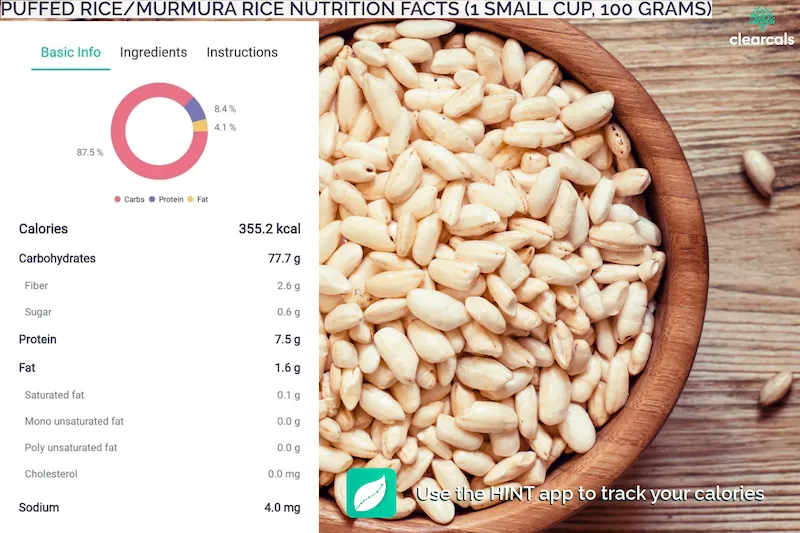
Puffed Rice Nutrition Facts — Complete Breakdown
Macronutrients (Per 100g)
| Nutrient | Amount | % Daily Value* |
|---|---|---|
| Calories | 355 kcal | 17.5% |
| Carbohydrates | 77.7g | 26% |
| Dietary Fibre | 2.55g | 9% |
| Sugars | 0.65g | 1% |
| Protein | 7.45g | 15% |
| Total Fat | 1.6g | 2% |
| Saturated Fat | 0.4g | 2% |
| Sodium | 4mg | 0% |
*Based on a 2000 kcal diet
Macronutrient split: Puffed rice is almost entirely carbohydrate (87.6% of calories), with minimal fat (4%) and low protein (8.4%). It is not a protein food or a fat source — it is purely an energy/carbohydrate source.
Vitamins and Minerals (Per 100g)
| Vitamin/Mineral | Amount per 100g | % Daily Value |
|---|---|---|
| Iron | 2.5–3.0mg | 14–17% |
| Thiamin (B1) | 0.4–0.5mg | 30–35% |
| Niacin (B3) | 3.4–3.6mg | 21–22% |
| Folate (B9) | 240–260 mcg (fortified) | 60–65% |
| Magnesium | 28–32mg | 7–8% |
| Phosphorus | 115–120mg | 9–10% |
| Potassium | 110–120mg | 2–3% |
| Calcium | 8–10mg | 1% |
Fortified varieties contain higher B vitamin and iron levels
Puffed Rice Protein
At 7.45g protein per 100g, puffed rice has reasonable protein for a grain. However, a typical 30–40g serving provides only 2.2–3g of protein — not enough to meaningfully contribute to daily protein targets. For muscle gain or weight loss, combine murmura with protein-rich foods: roasted chana, peanuts, curd, or a boiled egg alongside.
Puffed Rice Glycemic Index
Puffed rice has a high glycaemic index (GI) of approximately 82 — placing it firmly in the high-GI category (above 70).
| Food | GI Value | Classification |
|---|---|---|
| Puffed rice (murmura) | ~82 | High GI |
| White rice (cooked) | ~64–72 | Medium–High GI |
| Brown rice (cooked) | ~50–55 | Medium GI |
| Poha (flattened rice, cooked) | ~70 | Medium–High GI |
| Oats (rolled, cooked) | ~55 | Medium GI |
| White bread | ~75 | High GI |
What high GI means practically:
- Blood sugar rises quickly after eating murmura, then falls
- The rapid rise → fall cycle can increase hunger within 1–2 hours
- For people without diabetes, this is manageable with portion control
- For people with diabetes or prediabetes, keep portions small (25g) and always combine with protein or fat to blunt the glycaemic response
Murmura glycemic index vs other snacks: Despite its high GI, murmura's glycaemic load (GL) per typical serving is moderate because the serving size is small. A 30g serving has a GL of approximately 19 — similar to a medium-sized banana.
Is Puffed Rice Good for Weight Loss?
Yes — in controlled portions. No — if you're eating large, unweighed helpings at a street stall.
Why murmura can support weight loss:
- At 107 kcal for a 30g bowl, it's lower in calories than most Indian snack alternatives (bhujia, chips, namkeen)
- Very low in fat (1.6g/100g) — no hidden fat calories in plain murmura
- Light texture means you can eat a visually large bowl for relatively few calories
- Easy to combine with low-calorie, high-volume vegetables (cucumber, tomato, onion) to increase satiety
Why murmura can hinder weight loss:
- High GI causes a rapid blood sugar spike and fall — increasing hunger 1–2 hours later
- Low protein content means it doesn't keep you full for long
- Extremely easy to overconsume — a "handful" at a street bhel stall may be 100–150g (355–533 kcal)
- Once fried sev, sweet chutney, and potato are added for bhel, calories climb quickly
For weight loss — practical guidelines:
- Stick to 25–40g as a snack (89–142 kcal)
- Weigh it — don't estimate by volume; puffed rice is deceptive because it looks like more than it weighs
- Always pair with protein: roasted chana, curd, peanuts, or sprouted moong
- Load with vegetables: cucumber, tomato, onion, raw mango — adds volume and fibre at minimal calories
- Use the Hint app to log by weight, not by cup
How much puffed rice for weight loss per day? 50g maximum as a snack (178 kcal). Don't use it as a meal — it lacks the protein and fibre to sustain satiety.
Does Puffed Rice Increase Weight?
No, in normal serving sizes. At 89–142 kcal for a typical small-to-medium bowl, murmura eaten as an occasional snack will not cause weight gain in someone with a normal calorie budget.
Weight gain from puffed rice typically comes from:
- Bhel puri portions at street stalls: 100–150g murmura + fried sev + sweet chutney = 400–600 kcal
- Murmura chivda and namkeen: Oil, sugar, and fried ingredients added during preparation dramatically increase calories
- Large bowl portions without measuring: People underestimate how much they're eating because it looks light
Eating Puffed Rice at Night — Good or Bad?
Short answer: It's not ideal as a late-night snack, but it won't ruin your diet if portions are small.
Why puffed rice at night is less than ideal:
- High GI causes a blood sugar spike and subsequent drop — not what you want before sleep
- Low protein means it won't support overnight muscle recovery
- Easy to overeat in the evening, adding unnecessary calories
When it's acceptable at night:
- Small portion (25g, ~89 kcal) as a light snack before an early dinner
- Mixed with curd (Greek yogurt) to add protein and lower the effective GI
- Better than reaching for chips, biscuits, or fried snacks
Better night-time snack alternatives: A small bowl of curd, 1–2 boiled eggs, or a handful of roasted chana provide more protein and better satiety for the same or fewer calories.
Is Puffed Rice Good for Diabetes?
With caution. The high GI (~82) means puffed rice causes a relatively fast rise in blood glucose — making it less suitable for people managing diabetes compared to lower-GI alternatives.
If you have diabetes and want to eat murmura:
- Keep portions to 25g or less
- Always combine with protein (curd, roasted chana, peanuts) and fat to lower the combined glycaemic response
- Avoid sweet tamarind chutney — adds sugar that compounds the glucose spike
- Choose ragi murmura (see below) — ragi (finger millet) has a significantly lower GI
Is murmura good for diabetics overall? Occasional, small portions with the right accompaniments — acceptable. As a daily snack eaten alone in large quantities — not advisable.
Murmura Bhel Calories
Plain murmura is low-calorie. Bhel puri made from it is a different story — the calories depend heavily on what goes into it.
| Bhel Type | Murmura (g) | Total Calories | Key Additions |
|---|---|---|---|
| Plain murmura + lime + spices | 50g | ~180 kcal | Just seasoning |
| Simple vegetable bhel (homemade) | 50g | ~220–250 kcal | Onion, tomato, coriander |
| Bhel puri (mild, street-style) | 60g | ~300–350 kcal | + fried sev, chutneys |
| Bhel puri (loaded, sweet chutney) | 70g | ~400–450 kcal | + potato, extra sev, sweet chutney |
| Sev murmura (Balaji/packaged) | 50g | ~270–300 kcal | Oil + seasoning added |
Murmura bhel calories at home vs street: A homemade bhel with 50g murmura, lots of vegetables, minimal sev, and limited chutney stays around 200–250 kcal. Street versions with generous sev, sweet chutney, and potato routinely hit 350–450 kcal per plate.
Ragi Murmura — Healthier Alternative
Ragi murmura (puffed finger millet) is increasingly available in Indian markets and is nutritionally superior to standard rice murmura:
| Property | Puffed Rice (Murmura) | Ragi Murmura |
|---|---|---|
| Calories per 100g | 355 kcal | ~340–360 kcal |
| Protein | 7.5g | 7–8g |
| Calcium | 8–10mg | 344mg (35% DV) |
| Fibre | 2.55g | 3.5–4g |
| Iron | 2.5–3mg | 3.9–4.5mg |
| GI | ~82 (high) | ~54–65 (medium) |
| Gluten-free | Yes | Yes |
Key advantage of ragi murmura: Dramatically higher calcium (excellent for bone health, especially for women), lower GI, and more fibre. The calorie content is similar, but the nutritional profile is meaningfully better.
Ragi murmura can be used exactly like regular murmura — in chaat, bhel, trail mix, or eaten plain as a snack.
Flattened Rice vs Puffed Rice — What's the Difference?
These are two different foods that are sometimes confused:
| Property | Puffed Rice (Murmura) | Flattened Rice (Poha) |
|---|---|---|
| How made | Rice puffed under high pressure/heat | Rice flattened by pressing |
| Texture | Light, airy, crispy | Flat, soft flakes |
| Calories per 100g (dry) | 355 kcal | ~350–360 kcal |
| Common uses | Bhel puri, murmura chaat, trail mix | Poha (breakfast dish), chivda |
| GI | ~82 | ~70 |
| Hindi name | Murmura | Poha / chivda (when fried) |
| Bengali name | Muri | Chira |
Both are rice-based, similar in calories per 100g, but prepared and eaten differently. For flattened rice (poha) calories and nutrition, see our Poha Calories guide.
Puffed Rice Benefits (Murmura Ke Fayde)
1. Easy to digest: The puffing process gelatinises the starch, making murmura gentler on the digestive system than raw or even cooked rice. Good for people with sensitive stomachs.
2. Gluten-free: Made entirely from rice — safe for people with coeliac disease or gluten sensitivity.
3. Low in fat: 1.6g fat per 100g. Plain murmura without added oil or fried ingredients is one of the lowest-fat grain snacks available.
4. Low in sodium: 4mg sodium per 100g (plain). Far lower than packaged namkeen, chips, or other snacks.
5. Quick energy: High carbohydrate + high GI makes murmura a fast energy source — useful before exercise or when recovering from illness.
6. B vitamins (fortified varieties): Fortified murmura contains significant thiamin (B1), niacin (B3), and folate (B9) — supporting energy metabolism and nerve function.
7. Versatile: Works as a base for dozens of Indian recipes — chaat, bhel, upma, ladoo, trail mix — making it easy to add nutrition by combining with vegetables, proteins, and seeds.
Murmura Khane Ke Fayde — Benefits in Hindi
मुरमुरा खाने के फायदे (Murmura / Puffed Rice ke Fayde):
पाचन में मदद: मुरमुरा आसानी से पचने वाला खाना है। Puffing process से starch gelatinise हो जाती है, जिससे यह stomach के लिए gentle होता है।
Gluten-free: Rice से बना होने की वजह से यह naturally gluten-free है। जिन्हें wheat से sensitivity हो उनके लिए अच्छा विकल्प है।
वजन प्रबंधन: Plain murmura में fat बहुत कम होता है (1.6g/100g)। अगर 25–40g portion में खाया जाए, तो यह weight loss diet में fit हो सकता है।
Murmura mein kitni calorie hoti hai?
| Serving | Calories |
|---|---|
| 1 छोटी katori murmura (25g) | 89 kcal |
| 1 medium bowl (40g) | 142 kcal |
| 50g (bhel puri ke liye) | 178 kcal |
| 100g | 355 kcal |
क्या मुरमुरा वजन बढ़ाता है? नहीं, अगर normal portion में खाया जाए — 25–40g में केवल 89–142 kcal होती हैं। Weight gain तब होता है जब bhel puri में fried sev, sweet chutney, और extra portions add हों।
रात को मुरमुरा खाना सही है? छोटी मात्रा में (25g) acceptable है, लेकिन ideal नहीं — high GI की वजह से blood sugar जल्दी बढ़ता और गिरता है। रात के लिए curd या roasted chana बेहतर विकल्प हैं।
Healthy Puffed Rice Recipes
1. Light Murmura Chaat (178 kcal) 50g murmura + diced tomato, onion, cucumber, boiled chickpeas (2 tbsp), lime juice, chaat masala, fresh coriander. No oil, no fried sev — vegetables provide volume, chickpeas add protein.
2. Ragi Murmura Trail Mix (200 kcal per 50g mix) 30g ragi murmura + 10g peanuts + 5g pumpkin seeds + 5g raisins + pinch of salt and turmeric. Good pre-workout snack.
3. Greek Yogurt Puffed Rice Bowl (250 kcal) 30g plain murmura + 150g Greek yogurt + fresh berries + 1 tsp honey. Protein from yogurt lowers the effective GI of the meal.
4. Simple Murmura with Lemon and Spice (107 kcal) 30g plain murmura + squeeze of lemon + cumin powder + chilli flakes + rock salt. Zero added oil, 5 minutes.
For full recipes: Murmura Chaat | Murmura Ladoo | Plain Puffed Rice
How the Hint App Helps You Track Murmura
Puffed rice is tricky to track by volume because a "cup" can weigh anywhere from 15g to 60g depending on how tightly it's packed. The Hint app solves this:
- Log murmura by weight (in grams) for accurate tracking
- Indian food database includes plain murmura, bhel puri, murmura chaat, and packaged varieties
- Recipe builder to calculate calories in homemade bhel with your exact ingredients
Frequently Asked Questions
How many calories are in 100g of puffed rice?
100g of plain puffed rice contains 355 calories — 77.7g carbs, 7.45g protein, 1.6g fat. Note: a typical serving is 25–50g, not 100g.
How many calories are in 1 cup of puffed rice?
A loosely filled cup of dry murmura weighs approximately 25–35g, giving you 89–124 kcal. A tightly packed large cup (~50g) is 178 kcal.
How many calories are in 1 bowl of murmura?
A small katori (25g): 89 kcal. A medium bowl (40g): 142 kcal. A large bowl/plate (60g): 213 kcal.
Is puffed rice good for weight loss?
In small, weighed portions (25–40g) as a snack, yes — 89–142 kcal is low for a crunchy snack. Combine with protein and vegetables to improve satiety. Avoid large unweighed portions or loaded bhel puri preparations.
Is murmura good for weight loss?
Same food, same answer. 25–40g of plain murmura is a reasonable low-calorie snack. The issue is not the food but the portion size and what it's mixed with.
What is the glycaemic index of puffed rice?
~82 — high GI. This means it raises blood sugar quickly. Combine with protein, fat, or fibre (curd, peanuts, chickpeas) to lower the meal's overall glycaemic response.
Is puffed rice good for diabetes?
Only in very small portions (25g or less) combined with protein/fat to blunt the blood sugar response. Ragi murmura (GI ~54–65) is a better option for people with diabetes.
Does eating puffed rice at night increase weight?
Not in small portions (25g, 89 kcal). The concern is more about the high GI disrupting sleep-time blood sugar than direct weight gain from the calories at that quantity.
What is the difference between murmura and poha?
Murmura = puffed rice (airy, crispy). Poha = flattened rice (flat, soft flakes). Both are rice-based and similar in calories per 100g, but they are prepared and used differently. See our Poha Calories guide for details.
Is ragi murmura better than regular murmura?
Yes, nutritionally. Ragi murmura has 30× more calcium, lower GI (~54–65 vs ~82), and more fibre. Calories are similar. If you can find it, ragi murmura is the superior choice.
🎁 Exclusive Offer for Clearcals Store Customers
- Buy select Garmin watches → Get 1 Month FREE Hint Premium (worth ₹1,999)
- Buy Apple Watch models → Get FREE Hint Pro access
Explore More
- Poha Calories, Nutrition Facts and Health Benefits
- Rice Calories — Per Bowl, Plate & 100g
- Roasted Chana Calories
- Calorie Deficit Diet — Indian Guide
- Indian Diet for Weight Loss
References
- USDA FoodData Central. "Cereals ready-to-eat, puffed rice." U.S. Department of Agriculture. https://fdc.nal.usda.gov
- Atkinson FS, Foster-Powell K, Brand-Miller JC. International tables of glycemic index and glycemic load values: 2008. Diabetes Care. 2008;31(12):2281-2283. doi:10.2337/dc08-1239
- Slavin JL. Dietary fiber and body weight. Nutrition. 2005;21(3):411-418.
- Muthayya S et al. An overview of global rice production, supply, trade, and consumption. Ann N Y Acad Sci. 2014;1324:7-14.
- Halton TL, Hu FB. The effects of high protein diets on thermogenesis, satiety and weight loss: a critical review. J Am Coll Nutr. 2004;23(5):373-385.
About the Author
Asfia Fatima is the Chief Dietitian at Clearcals, with a Master's Degree in Dietetics and Clinical Nutrition and over a decade of experience in clinical nutrition and lifestyle management.
She specialises in evidence-based diet planning for weight loss, diabetes, and metabolic health. At Clearcals, she leads the nutrition strategy behind the Hint app, helping users achieve their goals with science-backed guidance.
🔗 Connect with Asfia on LinkedIn