Track your nutrition and health goals

Rice Calories: Per Bowl, Plate & 100g | White, Brown & Basmati | Clearcals`
Written by Asfia Fatima, Chief Dietitian at Clearcals
TL;DR
- One katori (100g) of plain cooked white rice has 87 kcal and 2.0g protein; a medium plate (250g) has 218 kcal and 5.0g protein
- A bowl of rice (200g) has approximately 175 kcal, not 87 kcal — 87 kcal is only one small katori
- Rice calorie content varies significantly by serving size, rice type, and whether oil or ghee was added during cooking
- Brown rice (87 kcal/100g) and basmati rice (85 kcal/100g) are comparable in calories to white rice — the key difference is glycaemic index, not calories
- Red rice (92 kcal/100g) has a lower GI and higher antioxidant content, making it a better choice for blood sugar management
- Track your exact portion size with the free Hint app — Indian serving sizes are built into the database
How Many Calories Are in Rice?
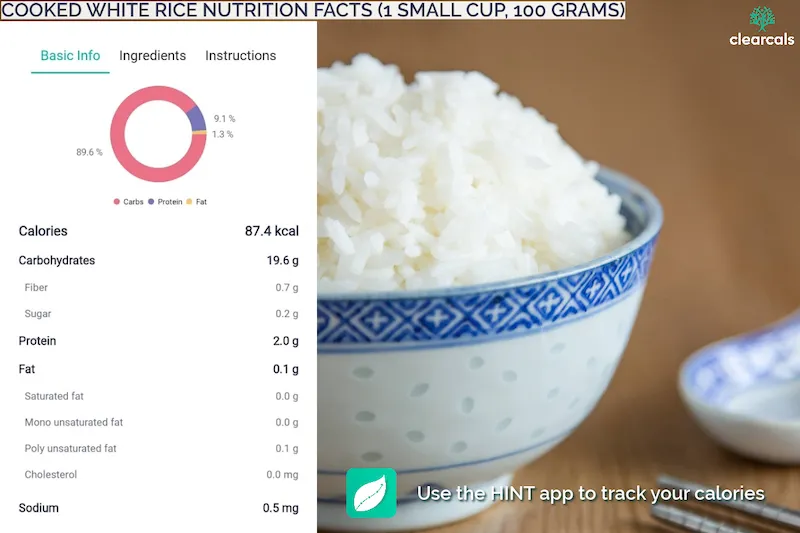
Rice calories per 100g (cooked): 87 kcal | Protein: 2.0g | Carbs: 19.6g | Fat: 0.1g
Rice calorie content depends primarily on how much you eat and what type of rice you use.
A single katori (100g of cooked plain white rice) has 87 kcal. A medium plate — a typical lunch or dinner serving — contains 250g of cooked rice and 218 kcal. A bowl of rice weighs approximately 200g and has 175 kcal.
If you are eating 2 large plates of rice per day with ghee or oil added during cooking, your total rice intake alone can easily exceed 700–800 kcal per day.
The single most common source of confusion is equating "one plate" or "one bowl" with 100g. In practice, Indian plates of rice weigh 200–300g, and home-style bowls weigh 150–200g.
1 Bowl Rice Calories and Protein
1 bowl rice calories (200g): 175 kcal | Protein: 4.0g 1 small bowl rice calories (150g): 130 kcal | Protein: 3.0g
The most searched question about rice is "1 bowl rice calories" — and the answer depends on bowl size. Indian bowls typically hold 150–200g of cooked rice. A medium bowl (200g) has 175 kcal and 4.0g protein. A smaller katori-style bowl (150g) has 130 kcal and 3.0g protein.
If you are tracking calories for weight management, the difference between a 150g and 200g bowl is 45 kcal — significant when eaten twice a day across a week.
1 Bowl of Rice Protein
1 bowl of rice protein (200g): 4.0g | Per katori (100g): 2.0g | Per large plate (300g): 6.0g
Rice is not a high-protein food — it provides roughly 2.0g protein per 100g cooked. For adequate protein intake, pair your rice with dal, curd, paneer, chicken, or eggs at every meal. A katori of dal alongside two katoris of rice can add 7–9g protein to your plate.
1 Plate Rice Calories
1 plate rice calories (250g): 218 kcal | Protein: 5.0g | Carbs: 49.0g 1 large plate rice calories (300g): 262 kcal | Protein: 6.0g
A standard Indian lunch plate of rice weighs approximately 250g. A generous restaurant plate or a South Indian thali serving typically weighs 300g or more. These estimates assume plain boiled rice with no added ghee or oil.
Rice Calories by Indian Serving Size
Indian households measure rice by the vessel — katori, bowl, or plate — rather than by grams. The table below uses realistic gram equivalents for each vessel so the calorie numbers match what you are actually eating.
Rice Calories and Protein by Indian Serving Size (Plain Cooked White Rice)
| Serving | Approx. Weight | Calories | Protein |
|---|---|---|---|
| 1 katori (small cup) | 100g | 87 kcal | 2.0g |
| Half plate | 125g | 109 kcal | 2.5g |
| 1 small bowl | 150g | 130 kcal | 3.0g |
| 1 medium bowl / small plate | 200g | 175 kcal | 4.0g |
| 1 medium plate | 250g | 218 kcal | 5.0g |
| 1 large plate | 300g | 262 kcal | 6.0g |
| 2 bowls / 2 medium plates | 400g | 349 kcal | 8.0g |
Note: These weights are estimates for cooked rice without added oil or ghee. Actual weights depend on how you measure and whether the rice is tightly or loosely packed in the vessel.
1 Katori Rice Calories
1 katori rice calories: 87 kcal | Protein: 2.0g | Carbs: 19.6g
One katori of cooked white rice weighs approximately 100g and provides 87 kcal. This is the standard single-serve size used in Indian nutrition databases, dietitian meal plans, and the Hint app's food database. If you use a larger katori, the actual weight may be 120–130g, bringing the calorie count to approximately 104–113 kcal.
Half Plate Rice Calories
Half plate rice calories: 109 kcal (125g) | Protein: 2.5g
Half a standard Indian plate of rice weighs approximately 125g and provides 109 kcal. For reference, half a medium bowl (100g) has 87 kcal — identical to one katori. The terms "half plate" and "half bowl" give different calorie results depending on the vessel size.
Rice Calories by Weight (Cooked Plain White Rice)
200g rice calories: 175 kcal | Protein: 4.0g | Carbs: 39.2g
| Weight | Calories | Protein |
|---|---|---|
| 50g | 44 kcal | 1.0g |
| 100g | 87 kcal | 2.0g |
| 150g | 130 kcal | 3.0g |
| 200g | 175 kcal | 4.0g |
| 250g | 218 kcal | 5.0g |
| 300g | 262 kcal | 6.0g |
| 500g | 437 kcal | 10.0g |
| 1 kg | 874 kcal | 20.0g |
200g Rice Calories
200g rice calories: 175 kcal | Protein: 4.0g | Carbs: 39.2g | Fat: 0.2g
200g of cooked plain white rice is a typical medium bowl or small plate serving. At 175 kcal, it accounts for approximately 9% of a 2,000 kcal daily requirement. For a weight loss goal of 1,500 kcal per day, a 200g bowl of rice accounts for 12% of total daily calories — manageable if paired with lean protein and vegetables rather than high-fat sides.
300g Rice Calories
300g rice calories: 262 kcal | 300 gm rice protein: 6.0g | Carbs: 58.8g
300g of cooked rice is a full large plate — a common restaurant portion and typical of heavy home-cooked meals in South India. Paired with a protein source like sambar, rasam, or chicken curry, the total plate calorie count reaches 400–600 kcal depending on the accompaniments.
Rice Nutrition Facts
Rice is primarily a carbohydrate food. The table below shows the complete nutritional profile for cooked white rice, with % Indian Recommended Dietary Allowance (RDA) based on ICMR 2020 guidelines for a reference adult.
Cooked White Rice Nutritional Value Per 100g (Plain, No Added Fat)
| Nutrient | Per 100g Cooked | Per 200g (1 Bowl) | % Indian RDA |
|---|---|---|---|
| Calories | 87 kcal | 175 kcal | 4% |
| Carbohydrates | 19.6g | 39.2g | 7% |
| Protein | 2.0g | 4.0g | 4% |
| Fat | 0.1g | 0.2g | <1% |
| Dietary Fibre | 0.7g | 1.4g | 3% |
| Sugar | 0.2g | 0.4g | — |
| Iron | 0.2mg | 0.4mg | 1% |
| Calcium | 10mg | 20mg | 2% |
| Phosphorus | 43mg | 86mg | 7% |
| Zinc | 0.5mg | 1.0mg | 4% |
| Potassium | 27mg | 54mg | 1% |
| Sodium | 0.5mg | 1.0mg | <1% |
| Manganese | 0.2mg | 0.4mg | 9% |
| Vitamin B5 | 0.1mg | 0.2mg | 2% |
% Indian RDA based on ICMR 2020 guidelines for a reference adult (2,000 kcal/day). Rice is primarily an energy food — it contributes meaningfully to daily phosphorus and manganese intake but should be paired with protein, vegetables, and pulses for a nutritionally complete meal.
Raw vs Cooked Rice: Why the Numbers Look So Different
100g raw rice calories: 356 kcal | 100g cooked rice calories: 87 kcal — same rice, different weights after water absorption
People are often confused by the large difference between raw and cooked rice calories. 100g of raw rice has 356 kcal, while 100g of cooked rice has only 87 kcal.
They are not different products — the difference is entirely due to water absorption during cooking. Raw rice absorbs approximately 2–3 times its weight in water when cooked.
Raw vs Cooked White Rice (per 100g)
| Nutrient | Raw White Rice (100g) | Cooked White Rice (100g) |
|---|---|---|
| Calories | 356 kcal | 87 kcal |
| Carbohydrates | 78.2g | 19.6g |
| Protein | 7.9g | 2.0g |
| Fat | 0.5g | 0.1g |
| Dietary Fibre | 2.8g | 0.7g |
| Potassium | 108mg | 27mg |
| Manganese | 0.7mg | 0.2mg |
Practical rule: 100g of raw rice produces approximately 300g of cooked rice, which contains approximately 262 kcal — not 87 kcal. Always log rice as cooked weight for accurate calorie tracking. If you measure before cooking, multiply the raw weight by 0.73 to get the cooked calorie equivalent (i.e., 100g raw × 356 kcal × 0.73 ≈ 260 kcal as cooked rice).
Rice Calories Depend on Cooking Method
The calorie values in this blog are for plain cooked rice with no added oil, ghee, or fat. In practice, most Indian cooking adds fat at some stage:
- Added ghee or oil — 1 teaspoon of ghee added while cooking adds approximately 45 kcal
- Tempering (tadka) — oil-based tadka used in curd rice, lemon rice, and sambar rice adds 30–60 kcal per serving
- Cooking method — pressure-cooked versus open-pot rice has similar calorie values; the difference lies in water quantity and final texture, not calorie content These values can vary based on rice type (e.g., parboiled, brown, basmati) and cooking technique (pressure cooking, open pot, rice cooker, etc.).
Want to know the exact calories in your rice recipe? Download the Hint app and use the "Create Your Recipe" feature to log your ingredients, adjust quantities (including water and fat additions), and get an accurate calorie count for your specific preparation.
For more insights into calories in Indian dishes, check out our Indian Food Calorie Calculator blog.
Basmati Rice Calories
Basmati rice calories (100g cooked): 85 kcal | Protein: 1.8g | GI: 50–58 Cooked basmati rice calories 100g: 85 kcal — slightly lower than regular white rice (87 kcal)
Basmati rice has 85 kcal per 100g cooked — marginally lower than standard white rice (87 kcal). The calorie difference is minimal, but the more meaningful distinction is glycaemic index: basmati rice has a GI of 50–58, compared to 64–72 for regular white rice.
This lower GI means basmati rice causes a slower, more gradual rise in blood sugar — making it a preferred choice for people managing diabetes, PCOS, or insulin resistance. It is fragrant, long-grained, and commonly used in biryanis, pulaos, and khichdi across Indian households.
Basmati Rice Calories by Serving Size (Cooked)
| Serving | Weight | Calories | Protein |
|---|---|---|---|
| 1 katori | 100g | 85 kcal | 1.8g |
| 1 medium bowl | 200g | 170 kcal | 3.6g |
| 1 plate | 250g | 213 kcal | 4.5g |
| 1 large plate | 300g | 255 kcal | 5.4g |
Read our diabetes diet guide →
Red Rice Calories
Red rice calories (100g cooked): 92 kcal | Protein: 1.8g | GI: ~55 Red rice vs white rice (100g cooked): Red rice = 92 kcal | White rice = 87 kcal — nearly same calories, but red rice has lower GI and higher antioxidants
Red rice has 92 kcal per 100g cooked — slightly higher than white rice but nutritionally denser. It is a whole grain that retains its bran layer, which contains anthocyanins — the red pigment responsible for its colour and antioxidant properties.
Despite marginally more calories than white rice, red rice has a glycaemic index of approximately 55, compared to 64–72 for white rice. It also has higher fibre content, which improves satiety and supports digestion. Popular in Kerala, Tamil Nadu, and Karnataka, red rice is increasingly used as a health-conscious substitute for white rice in daily meals.
Watch: How to Track Rice Calories on the Hint App
Rice Types and Their Calories (per 100g cooked)
Different rice varieties have similar calorie counts but very different nutritional profiles — particularly in terms of fibre, glycaemic index, and micronutrients.
Rice Variety Calories at a Glance
| Rice Type | Calories (per 100g cooked) | Protein | Key Advantage |
|---|---|---|---|
| White rice (plain) | 87 kcal | 2.0g | Versatile, easy to digest |
| Brown rice | 87 kcal | 2.3g | Higher fibre, lower GI |
| Basmati rice | 85 kcal | 1.8g | Lower GI, fragrant |
| Red rice | 92 kcal | 1.8g | High antioxidants, low GI |
| Fermented rice | 73 kcal | 2.0g | Rich in probiotics |
| Puffed rice (muri/murmura) | 355 kcal per 100g dry weight | — | Very light; a typical 20g serving = 71 kcal |
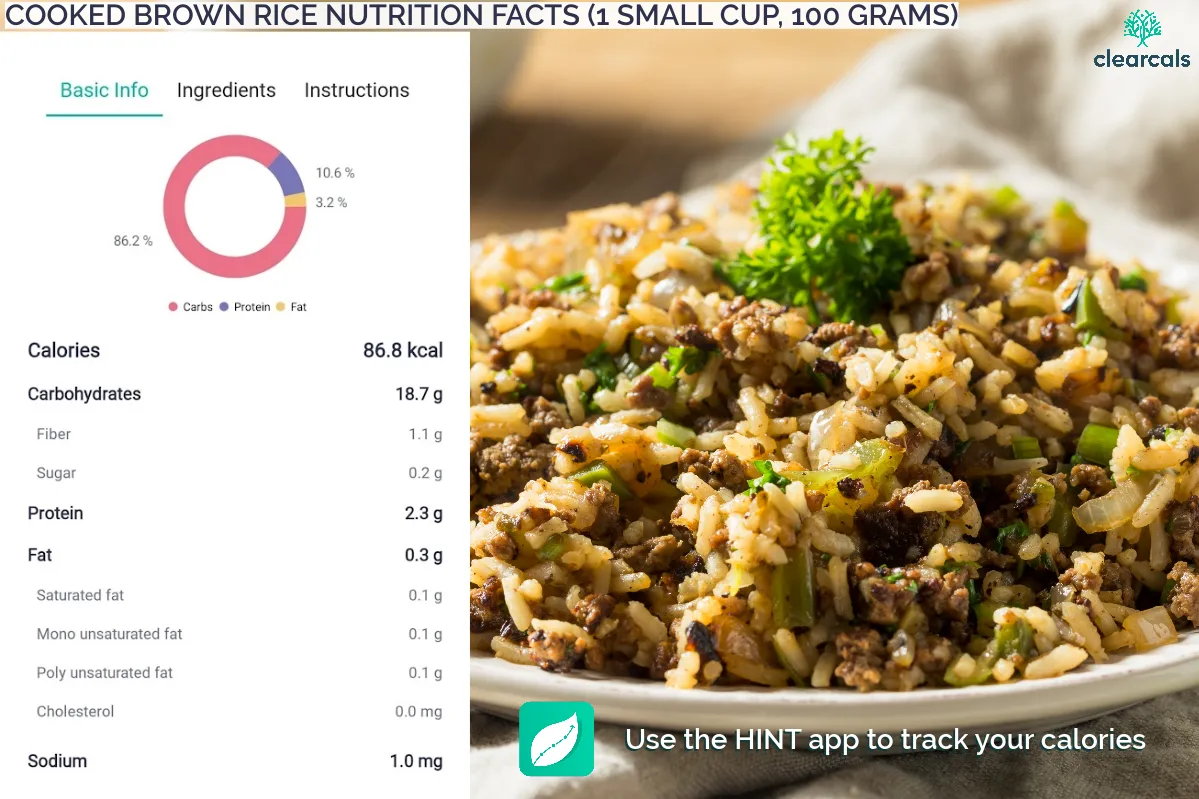
Brown Rice Brown rice (87 kcal/100g) has the same calorie count as white rice but contains more dietary fibre (1.8g vs 0.7g per 100g cooked), a lower glycaemic index, and higher levels of magnesium and potassium. It takes longer to cook and has a chewier texture, but is associated with better blood sugar control and improved satiety over time.
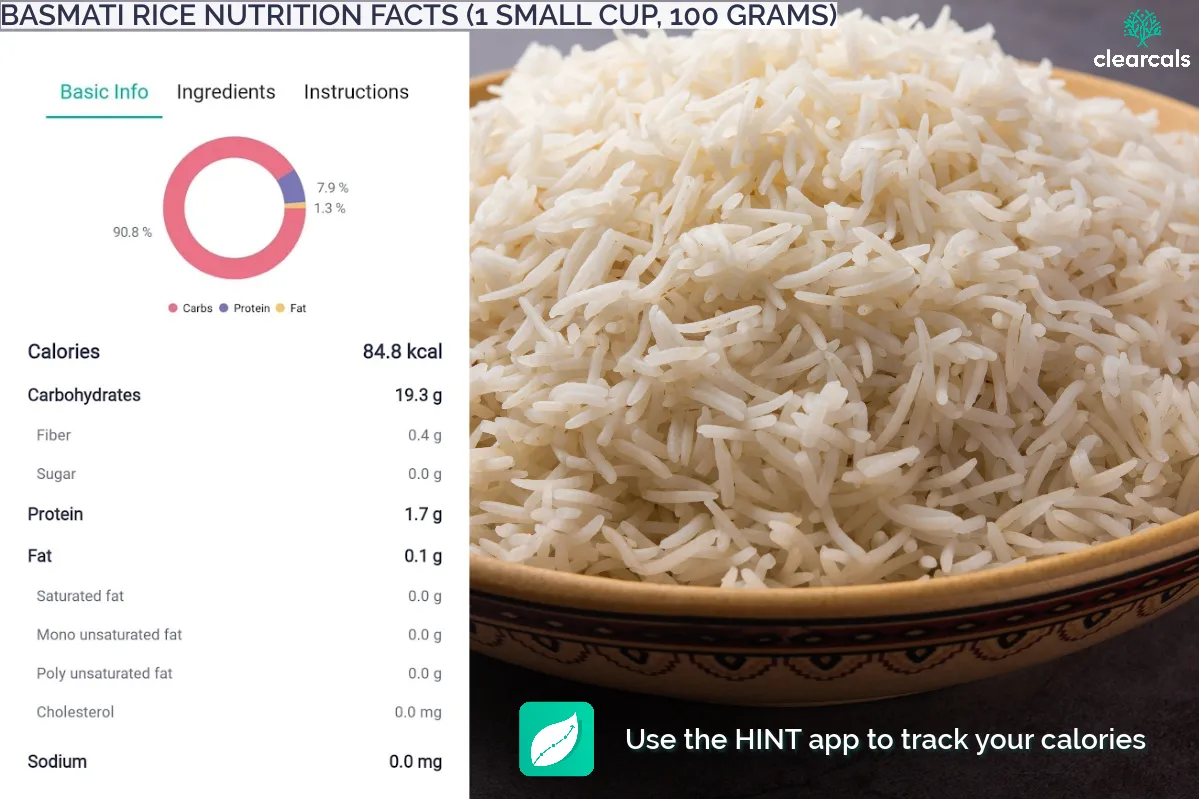
Basmati Rice Basmati rice (85 kcal/100g) has a lower glycaemic index than regular white rice. It is fragrant and long-grained, making it the preferred rice for biryanis, pulaos, and khichdi across Indian households. 👉 Read our diabetes diet guide →
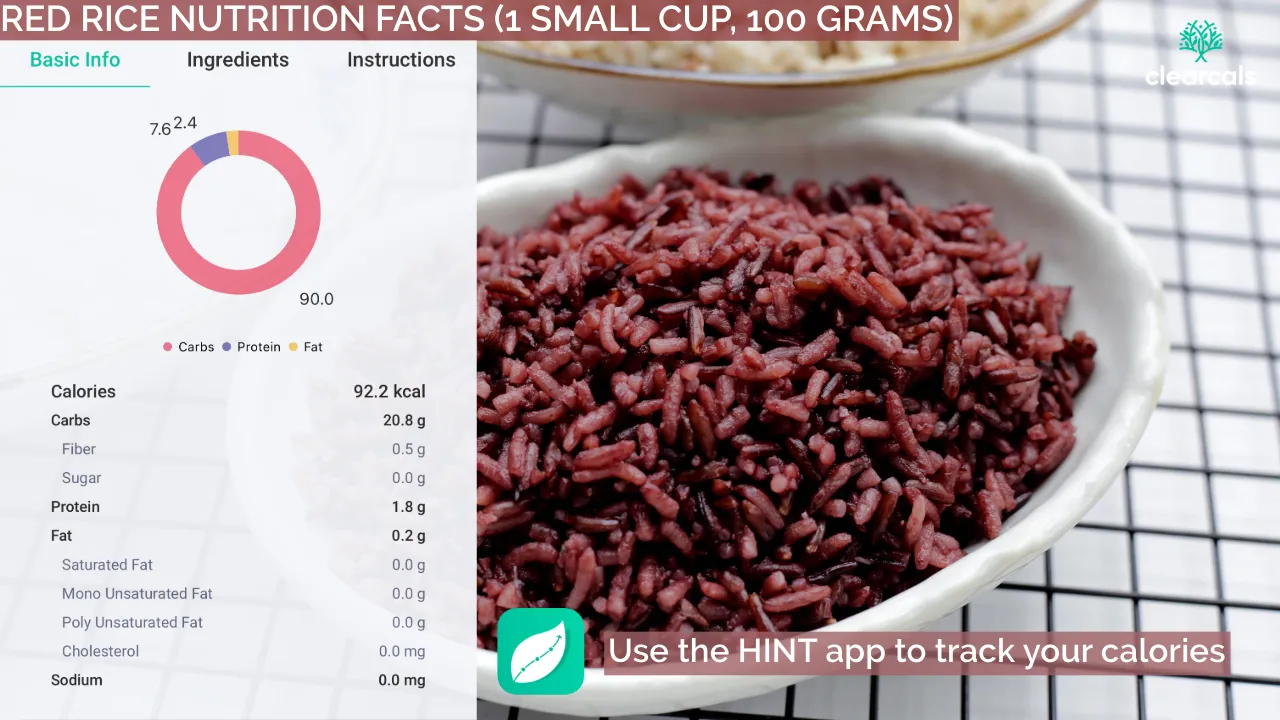
Red Rice Red rice (92 kcal/100g) is slightly higher in calories than white rice but has a significantly lower glycaemic index and higher antioxidant content due to its anthocyanin pigment. It is commonly eaten in South Indian states and is increasingly popular as a health-focused substitute for white rice.
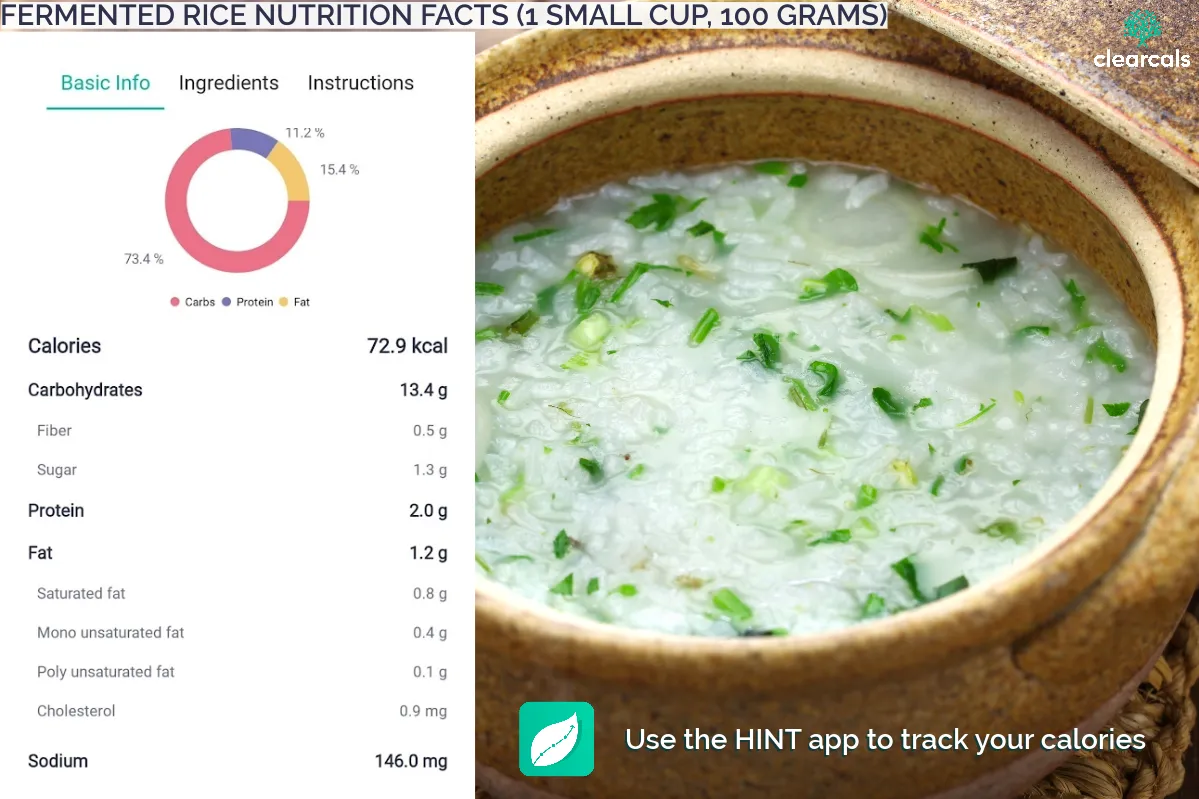
Fermented Rice Fermented rice (73 kcal/100g) is lower in calories and rich in probiotics from the fermentation process. Known as pazhaya sadam in Tamil Nadu, panta bhat in West Bengal, and torani in Odisha, it supports gut health and is traditionally eaten during summer months for its cooling properties.
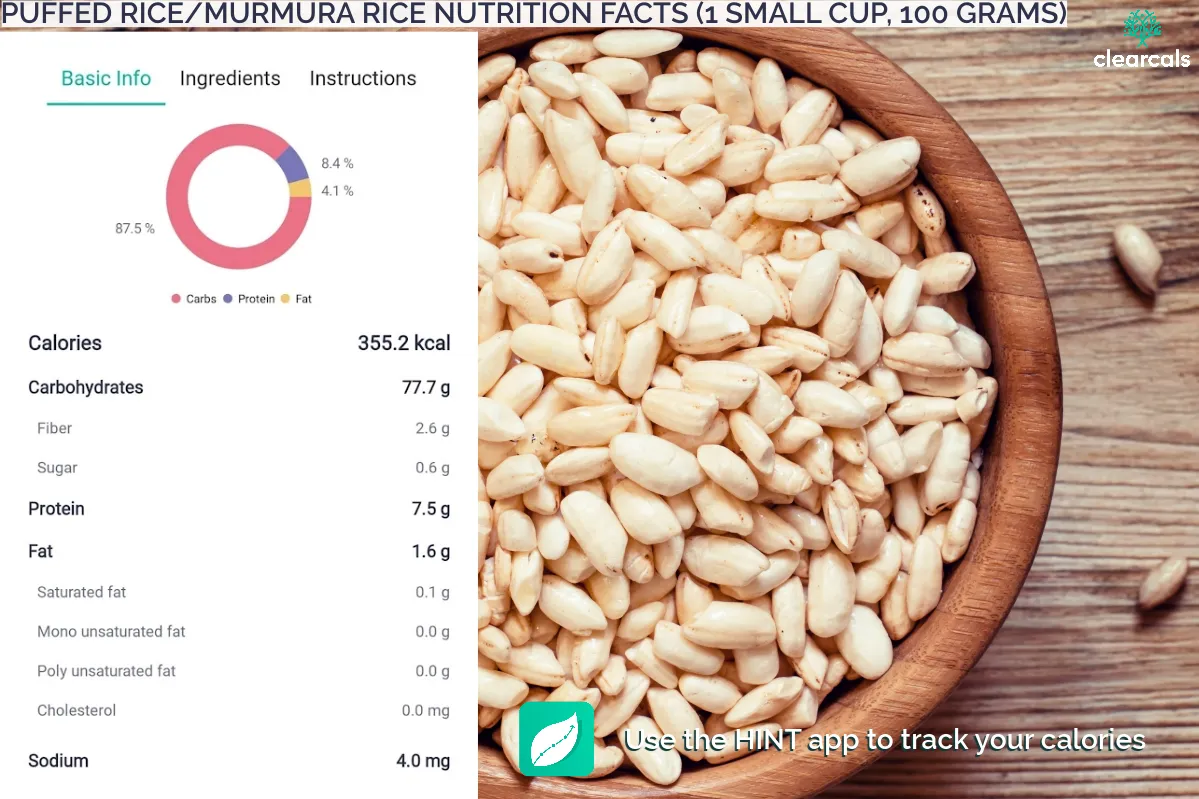
Puffed Rice (Murmura / Muri) 100g of dry puffed rice has 355 kcal, but 100g of puffed rice is a very large volume — several cups. A typical 20g serving (a standard bhel puri quantity) has only 71 kcal. Puffed rice is naturally low in fat and sodium, making it a light snack base when paired with vegetables and minimal chutney.
Rice Dish Calories (per 100g)
Popular Indian rice dishes vary significantly in calories depending on the preparation method and added ingredients.
Rice Dish Calorie Comparison (per 100g)
| Rice Dish | Calories (per 100g) | Notes |
|---|---|---|
| Plain cooked white rice | 87 kcal | No added oil |
| Curd rice | 86 kcal | Light; probiotics from curd |
| Brown rice | 87 kcal | Higher fibre |
| Basmati rice | 85 kcal | Lower GI |
| Red rice | 92 kcal | High antioxidants |
| Fermented rice | 73 kcal | Probiotics, gut-friendly |
| Sambar rice | 119 kcal | Protein, fibre, potassium |
| Lemon rice | 119 kcal | Good source of copper, manganese |
| Egg fried rice | 99 kcal | Protein-rich |
| Corn fried rice | 96 kcal | — |
| Garlic fried rice | 96 kcal | — |
| Vegetable fried rice | 116 kcal | Fibre, beta-carotene |
| Paneer fried rice | 110 kcal | Higher protein |
| Mushroom corn fried rice | 101 kcal | — |
| Chicken fried rice | 122 kcal | Good protein source |
| Prawns fried rice | 113 kcal | — |
| Schezwan paneer fried rice | 136 kcal | Higher fat and calories |
| Schezwan chicken fried rice | 146 kcal | Highest calorie fried rice |
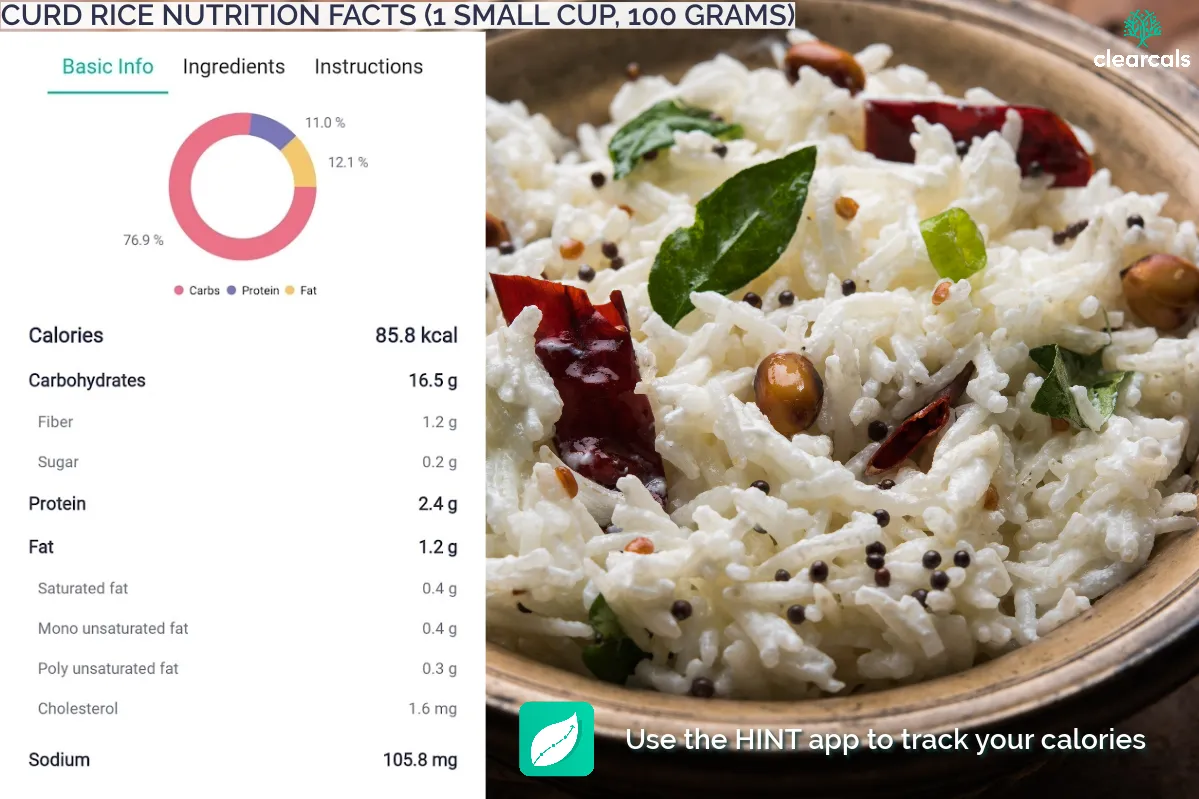
Curd Rice (86 kcal / 100g) Curd rice has 76.9% carbohydrates, 11% protein, and 12.1% fat. It is a light, refreshing dish rich in probiotics from the curd. The tempering (tadka) adds a small amount of fat, but the overall calorie count remains one of the lowest among Indian rice preparations.
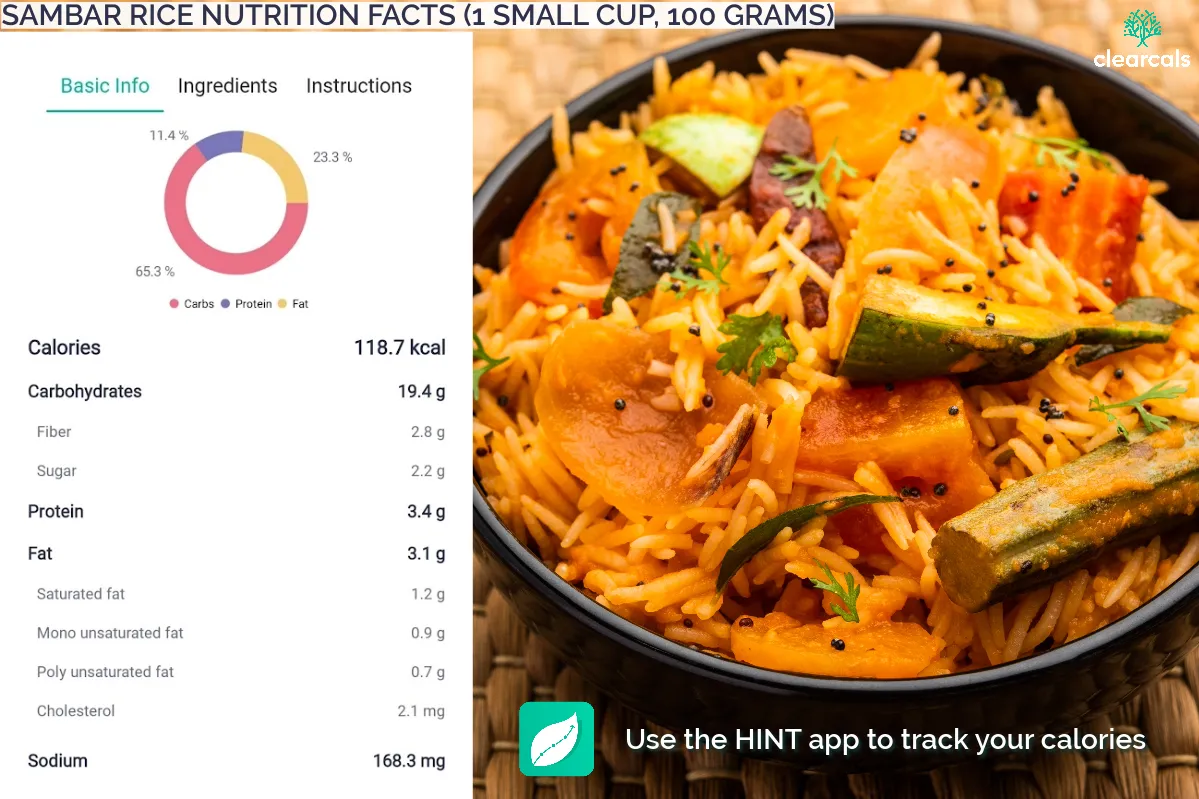
Sambar Rice (119 kcal / 100g) Sambar rice has 65.3% carbohydrates, 11.4% protein, and 23.3% fat. It is a good source of protein, dietary fibre, and potassium. The addition of toor dal in the sambar increases protein content meaningfully compared to plain rice — making it one of the most nutritionally complete rice dishes.
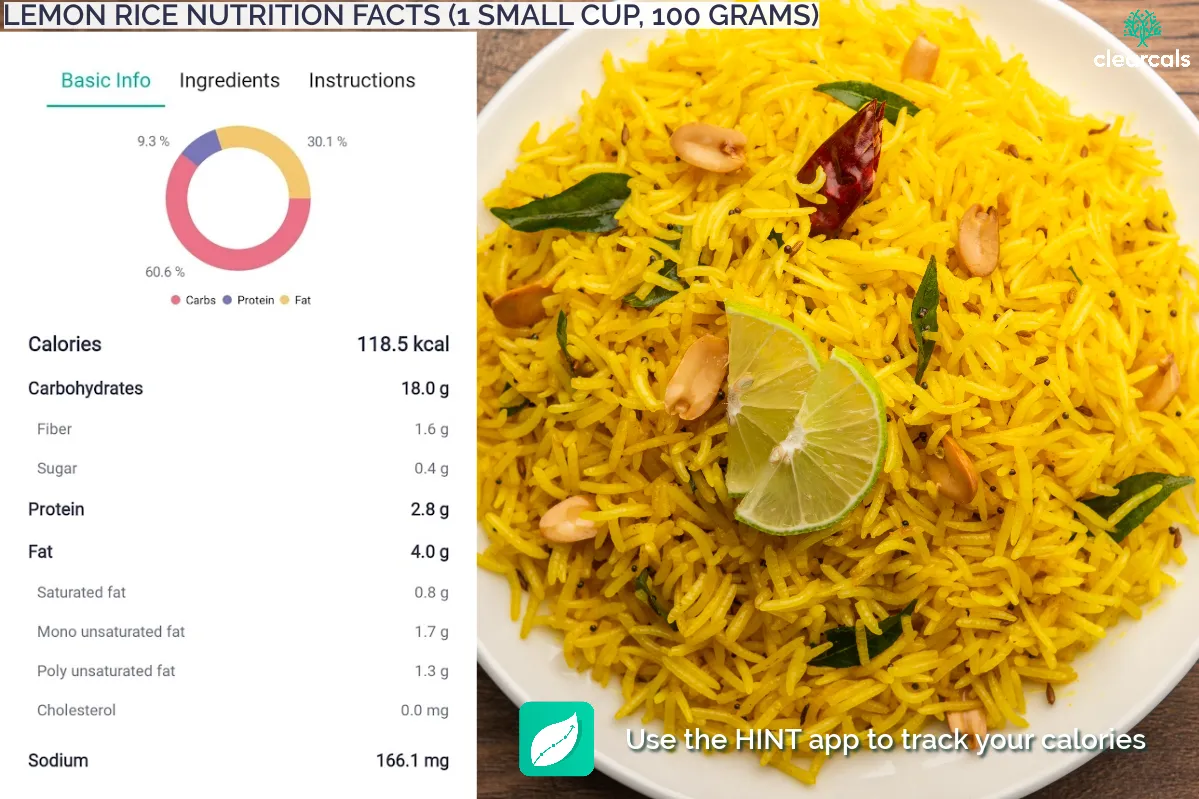
Lemon Rice (119 kcal / 100g) Lemon rice has 60.6% carbohydrates, 9.3% protein, and 30.1% fat. It is a good source of copper and manganese. The peanuts, oil, and mustard seeds in the tempering contribute significantly to the fat and calorie content.
Fried Rice Calories
Fried rice is a popular dish across Indian households and restaurants. It is made by stir-frying cooked rice with oil, vegetables, eggs, or meat — which increases calorie content substantially compared to plain boiled rice.
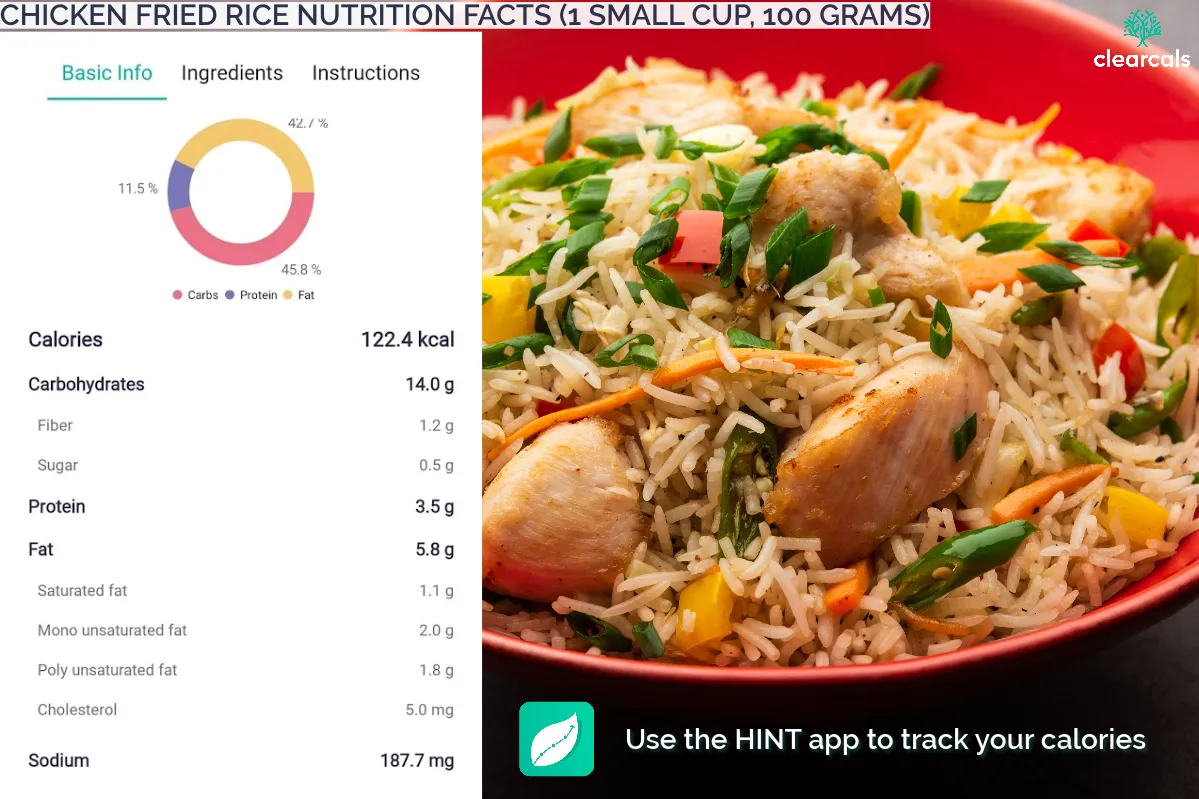
Chicken Fried Rice (122 kcal / 100g)
Chicken fried rice has 46% carbohydrates, 11% protein, and 43% fat per 100g. It is a good source of vitamin B12, phosphorus, and selenium.
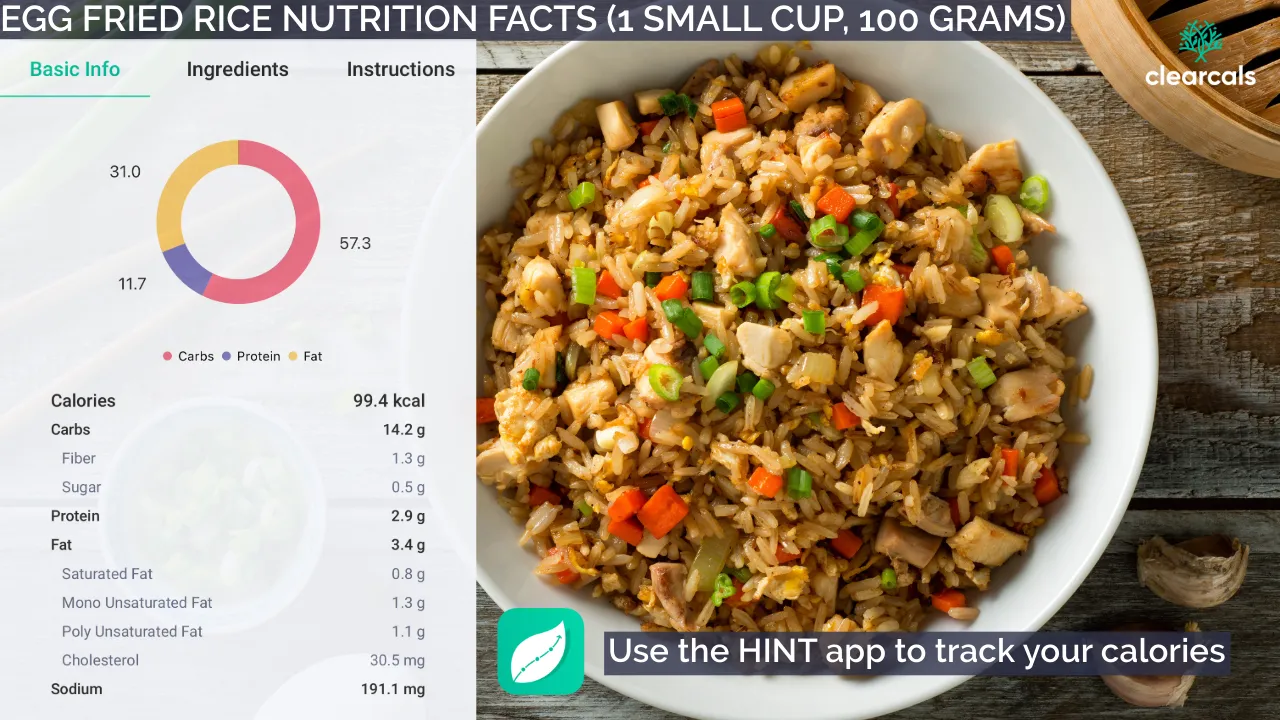
Egg Fried Rice (99 kcal / 100g)
Egg fried rice has 57% carbohydrates, 12% protein, and 31% fat per 100g. It is a good source of vitamin B12, folate, and choline from the eggs.
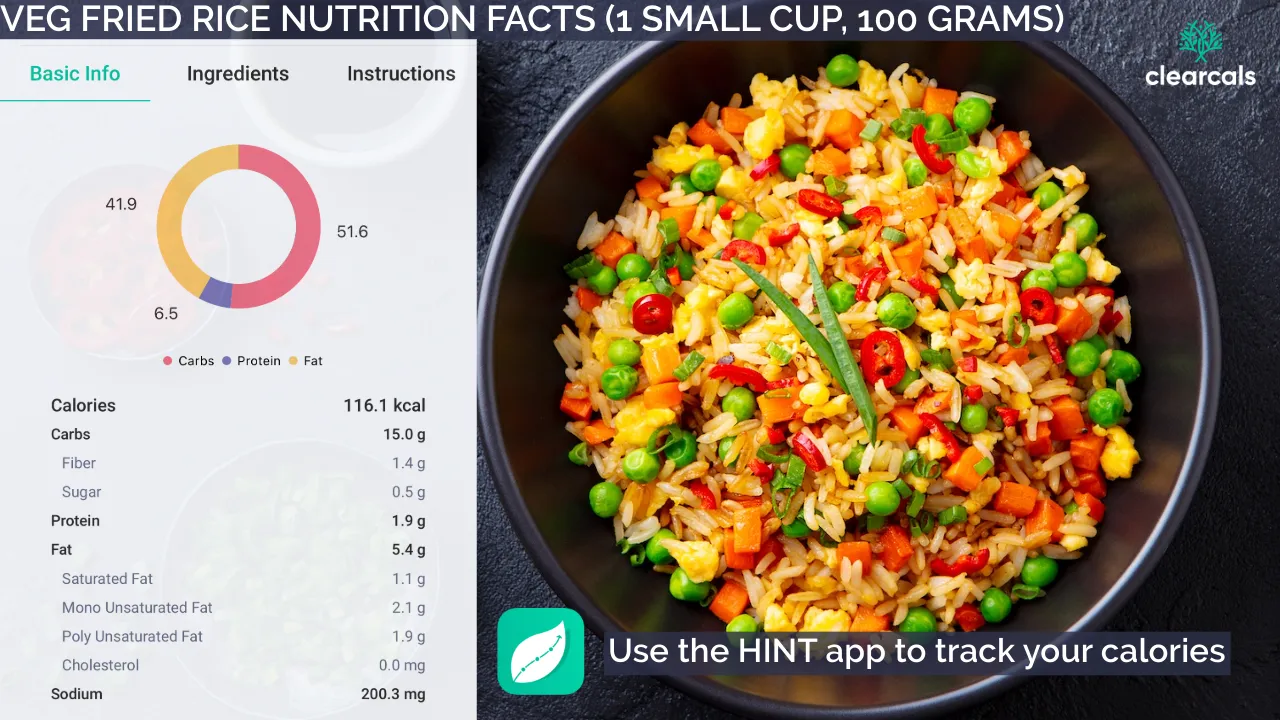
Vegetable Fried Rice (116 kcal / 100g)
Vegetable fried rice has 52% carbohydrates, 6% protein, and 42% fat per 100g. It is a good source of beta-carotene and vitamin C from the vegetables, but oil content is high relative to plain rice.
Fried Rice Calorie Comparison (13 Varieties, per 100g)
| Fried Rice Variety | Calories (per 100g) |
|---|---|
| Egg fried rice | 99 kcal |
| Corn fried rice | 96 kcal |
| Garlic fried rice | 96 kcal |
| Mushroom corn fried rice | 101 kcal |
| Paneer fried rice | 110 kcal |
| Vegetable fried rice | 116 kcal |
| Soya chunks fried rice | 116 kcal |
| Prawns fried rice | 113 kcal |
| Chicken fried rice | 122 kcal |
| Schezwan mushroom fried rice | 119 kcal |
| Schezwan paneer fried rice | 136 kcal |
| Schezwan egg fried rice | 140 kcal |
| Schezwan chicken fried rice | 146 kcal |
Schezwan variants are consistently higher in calories due to the chilli oil and sauce used in the preparation. Plain vegetable and egg fried rice are the lowest-calorie options among restaurant-style fried rice dishes.
Rice Benefits
Energy Source: Rice is rich in carbohydrates, the body's primary fuel. It provides steady energy and keeps you full through the day when eaten as part of a balanced meal with dal, sabzi, or curd.
Gluten-Free: All rice varieties — white, brown, red, basmati, and wild rice — are naturally gluten-free. This makes rice a safe and versatile staple for those with coeliac disease or gluten sensitivity.
Digestive Health: Brown rice, red rice, and fermented rice all provide meaningful dietary fibre and gut-supporting nutrients. Fermented rice adds probiotic benefits beyond what plain rice provides.
Heart Health: Whole grain rice varieties, such as brown and red rice, are associated with improved cholesterol levels and reduced cardiovascular risk. Their fibre, magnesium, and manganese content contribute to overall heart health.
Blood Sugar Management: Brown rice, basmati, and red rice all have lower glycaemic indices than regular white rice. They cause a slower and more gradual rise in blood glucose, making them better choices for those managing diabetes or prediabetes.
Frequently Asked Questions
How many calories are in one plate of rice? The answer depends on how much rice is on the plate. A small plate (150g of cooked white rice) has approximately 130 kcal. A medium plate (250g) has 218 kcal. A large plate (300g) has 262 kcal. The common assumption that "1 plate = 100g = 87 kcal" underestimates most realistic Indian servings significantly.
How many calories are in 1 bowl of rice? A medium bowl of cooked white rice (200g) has approximately 175 kcal and 4.0g protein. A small bowl (150g) has 130 kcal. Use the Hint app's serving size tools to adjust for the size of your bowl.
How many calories are in 1 katori of rice? One katori of cooked white rice (100g) has 87 kcal and 2.0g protein. This is the standard single-serving reference for nutritional data, but it is smaller than a typical plate or bowl serving.
How many calories are in half a plate of rice? Half a medium plate of rice (approximately 125g) has around 109 kcal and 2.5g of protein.
How many calories are in 500g of cooked rice? 500g of plain cooked white rice has approximately 437 kcal and 10g of protein.
How many calories are in 1 kg of rice? 1 kg of plain cooked white rice has approximately 874 kcal. 1 kg of raw (uncooked) white rice has 3,560 kcal.
Does rice make you fat? Rice itself does not cause weight gain — calorie surplus does. Plain cooked white rice is relatively low in calories (87 kcal per 100g) and fat.
Overeating or pairing large rice portions with calorie-dense sides is the more common cause of weight gain from rice-centred meals. Choosing brown or red rice provides more fibre, which promotes satiety and helps control overall intake.
👉 Read our weight loss diet guide →
Is rice good for weight loss? Yes, when eaten in appropriate portions. Rice provides filling carbohydrates at a moderate calorie density. Opting for brown or red rice, controlling portion size (1–2 katoris per meal), and pairing with protein-rich dal or sabzi makes rice a practical part of a weight loss diet.
👉 Read our weight loss diet guide →
Which rice is good for diabetes? Basmati rice, brown rice, and red rice are better choices for diabetes management due to their lower glycaemic indices compared to regular white rice.
Pairing any rice with protein (dal, curd, chicken) and fibre-rich vegetables further slows glucose absorption and reduces post-meal blood sugar spikes.
👉 Read our complete diabetes diet guide →
Is rice good for PCOS? Brown rice, red rice, and basmati rice are better choices for PCOS compared to white rice, as their lower GI supports insulin regulation, which is central to PCOS management.
Portion control and pairing rice with protein and fibre are more important than eliminating rice.
Is rice gluten-free? Yes. All varieties of rice — white, brown, basmati, red, wild, and parboiled — are naturally gluten-free, making them a safe staple for those with coeliac disease or gluten sensitivity.
What is the difference between white rice and brown rice? Brown rice is a whole grain — it retains the bran and germ layers that are removed in white rice.
This gives brown rice more fibre (1.8g vs 0.7g per 100g cooked), a lower glycaemic index, and higher levels of magnesium, B vitamins, and antioxidants. Calorie content is nearly identical (87 kcal per 100g for both).
Is rice good for muscle gain? Yes. Rice is a primary carbohydrate source that fuels workouts and replenishes glycogen after training.
For muscle gain, pair 2–3 katoris of rice with adequate protein (dal, paneer, chicken, or eggs) at each meal to meet both calorie and muscle-building nutrient needs. 👉 Read our muscle gain diet guide →
Final Thoughts
Rice is one of the most versatile and widely eaten foods in India — and it fits into virtually any health goal when portion size and rice type are chosen thoughtfully.
The Hint app makes it easy to log rice by Indian serving vessel (katori, plate, bowl) rather than grams, so you always get an accurate calorie and protein count for your actual meal — not a generic per-100g figure.
Download the free Hint app on the App Store or Google Play Store to start tracking.
Upgrade to Hint Pro for personalised Indian diet plans, weekly insights, and 300+ workout plans — or Hint Premium for unlimited dietitian consultations on top of everything in Hint Pro.
🎁 Free Hint with Every Watch Purchase
Garmin watches: Purchase any Garmin watch from the Clearcals Store and receive 1 month of Hint Premium (worth ₹1,999) free. With Hint version 2.0, if your Garmin watch syncs to Garmin Connect and Garmin Connect is connected to Apple Health, your workouts flow automatically into Hint — no manual logging needed.
Apple Watch: Purchase any Apple Watch from the Clearcals Store and receive a free Hint Pro subscription — including access to all Pro features for 1 month. With Hint version 2.0, any workout recorded on your Apple Watch syncs automatically into Hint — no manual logging needed.
Read Next
- Indian Food Calorie Calculator — Free Online Tool
- Calories in Roti — Nutrition Facts & Health Benefits
- Banana Calories — Nutrition Facts & Health Benefits
- Weight Loss Diet Plan for Indians
- Diabetes Diet Plan India
- PCOS Diet Plan India
- Muscle Gain Diet Plan India
- Calorie Tracking in India — Beginner's Guide
Scientific References
- Sun Q, Spiegelman D, van Dam RM, et al. White Rice, Brown Rice, and Risk of Type 2 Diabetes in US Men and Women. Archives of Internal Medicine. 2010;170(11):961–969. PubMed
- Hu EA, Pan A, Malik V, Sun Q. White rice consumption and risk of type 2 diabetes: meta-analysis and systematic review. BMJ. 2012;344:e1454. PubMed
- Aune D, Keum N, Giovannucci E, et al. Whole grain consumption and risk of cardiovascular disease, cancer, and all-cause and cause-specific mortality. BMJ. 2016;353:i2716. PubMed
- Barclay AW, Petocz P, McMillan-Price J, et al. Glycemic index, glycemic load, and chronic disease risk — a meta-analysis of observational studies. American Journal of Clinical Nutrition. 2008;87(3):627–637. PubMed
- Foster-Powell K, Holt SH, Brand-Miller JC. International table of glycemic index and glycemic load values: 2002. American Journal of Clinical Nutrition. 2002;76(1):5–56. PubMed
- Slavin JL. Dietary fiber and body weight. Nutrition. 2005;21(3):411–418. PubMed
- Thomas DE, Elliott EJ, Baur L. Low glycaemic index or low glycaemic load diets for overweight and obesity. Cochrane Database of Systematic Reviews. 2007;(3):CD005105. PubMed
- Goufo P, Trindade H. Rice antioxidants: phenolic acids, flavonoids, anthocyanins, proanthocyanidins, tocopherols, tocotrienols, γ-oryzanol, and phytic acid. Food Science & Nutrition. 2014;2(2):75–104. PubMed
About the Author
Asfia Fatima is the Chief Dietitian at Clearcals, with a Master's Degree in Dietetics and Clinical Nutrition and over a decade of clinical experience. She specialises in evidence-based diet planning for weight loss, diabetes, and metabolic health. At Clearcals, she leads the nutrition strategy behind the Hint app, helping users achieve their goals through personalised, data-driven dietary guidance.
Connect with Asfia on LinkedIn
Related Reading
- Calorie Tracking Guide for Indians
- Indian Food Calorie Calculator
- Samosa Calories, Nutrition, and Health Benefits
- Soya Chunks Calories, Nutrition, and Health Benefits
- Squats Calories Burned, Benefits, and Variations