Track your nutrition and health goals

Watermelon Calories, Nutrition & Health Benefits (Seeds, Rind & Keto Notes)
Watermelon Calories, Nutrition & Health Benefits (Seeds, Rind & Keto Notes)
Is Watermelon Good for You? The Short Answer
Yes — watermelon is about 92% water, very low in calories for its volume, and a genuine source of vitamin C, vitamin A, and lycopene (the same antioxidant compound tomatoes are known for, and watermelon actually contains more of it per serving than raw tomato). Its main nutritional character is exactly what its name suggests: hydration and a satisfying amount of naturally sweet food for relatively few calories, rather than a dense source of any single nutrient.
Watermelon Calories: Quick Reference
| Serving | Calories Per Serving |
|---|---|
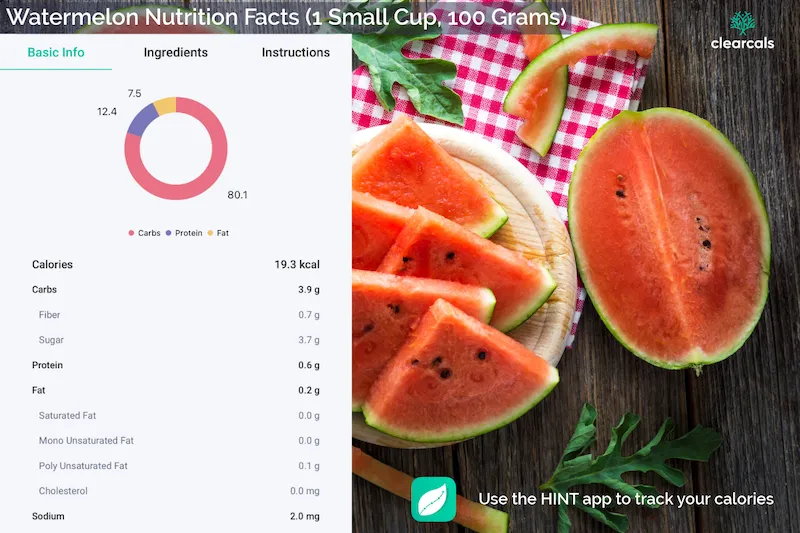
| 100g | 19 kcal |
| 1 cup, diced (~152g) | 29 kcal |
| 1 wedge (1/16 of a melon, ~286g) | 55 kcal |
| 1kg | 193 kcal |
| 1 whole medium watermelon (~9 kg, edible flesh only) | ~ 1500 kcal |
The "whole watermelon" figure is only the edible flesh — the rind, which isn't usually eaten, makes up a meaningful share of a watermelon's total weight, so it's not simply "9kg × 19 kcal."
Full Nutrition Facts (Per 100g)
| Nutrient | Per 100g |
|---|---|
| Calories | 19 kcal |
| Water | ~92% |
| Protein | 0.6g |
| Fat | 0.2g |
| Carbohydrates | 3.9g |
| Sugar | 3.7g |
| Fibre | 0.7g |
| Vitamin C | 8 mg (~9% of a typical daily target) |
| Vitamin A | 28mcg RAE (~11% of a typical daily target) |
| Potassium | 112 mg |
| Lycopene | 4,500mcg |
Watermelon Carbs, Sugar & Is It Keto-Friendly?
Watermelon has an unusual profile worth understanding rather than just quoting a number: it has a high glycemic index (roughly 72-80, since its sugar is quickly absorbed) but a low glycemic load in a typical serving, because a cup of watermelon is mostly water with only around 4 g of actual carbohydrate. In practice, this means a normal serving doesn't spike blood sugar as dramatically as the glycemic index alone would suggest — but a large amount eaten at once (several cups, or a big wedge) still adds up in total sugar.
For keto specifically, watermelon is more carb-heavy than most fruit people default to on a low-carb diet — a half-cup serving carries roughly 5-6g of net carbs (there's very little fibre to subtract), so it's usually flagged as an "eat in moderation" fruit on keto rather than a free food, in contrast to something like cucumber, which is genuinely low-carb in any amount.
Watermelon Seeds: Are They Safe to Eat?
Yes, completely safe — and the old idea that swallowed watermelon seeds will "grow a watermelon in your stomach" is a myth with no basis in how digestion works. Seeds pass through the digestive system like any other fibrous material.
There's a real nutritional distinction worth knowing, though:
- The few soft, immature seeds in a typical seeded watermelon contribute negligible calories or nutrition — you're eating too few of them, and they're mostly water at that stage, for it to matter.
- Dried, roasted watermelon seeds (sold separately as a snack, common in many cuisines) are a genuinely nutrient-dense food — around 557 kcal per 100g, with roughly 28g of protein, plus magnesium, iron, and healthy unsaturated fats, similar in profile to pumpkin or sunflower seeds. If you're eating a handful of roasted watermelon seeds as a snack, they're worth counting toward your day — they're closer to a nut/seed snack than to the fruit itself.
Watermelon Rind: Can You Eat It?
Yes — the white part of the rind (just beneath the green skin) is edible, though it's rarely eaten raw on its own because of its bland, crunchy texture; it's most commonly pickled, stir-fried, or blended into juice. Nutritionally, the rind is lower in sugar than the pink flesh and contains citrulline, an amino acid with some research interest around blood flow and exercise performance, though the evidence for a meaningful effect from eating rind casually (rather than a concentrated supplement) is limited. If you're going to eat it, wash the outer green skin thoroughly first, since that part isn't meant to be eaten and can carry surface residue.
Does Watermelon Have Fibre? Does It Help You Poop?
Watermelon is actually low in fibre (about 0.4g per 100g) despite how "healthy" and fruit-like it feels — so if you're looking for fibre specifically, watermelon isn't a strong source. What it does have is very high water content, which is likely why many people notice a mild laxative-like effect after eating a large amount — that's much more about hydration and volume than fibre. It's also completely normal to occasionally notice small bits of undigested watermelon (including seeds, if swallowed) — this isn't a sign of anything wrong, just how a high-water, low-fibre food sometimes passes through.
Watermelon Health Benefits
- Hydration — at ~92% water, watermelon is one of the most effective whole foods for adding fluid volume, especially useful in hot weather or after exercise.
- Lycopene — watermelon is a genuinely strong source of this antioxidant, associated in research with some cardiovascular and skin-health benefits, though most of the strongest evidence comes from broader dietary patterns rather than watermelon consumption in isolation.
- Vitamin C and vitamin A — meaningful contributors to daily intake, supporting immune function and skin health respectively.
- Very low calorie density — a large, satisfying portion for relatively few calories, useful within a calorie deficit.
- Potassium — a modest but real contributor to daily potassium intake, relevant for blood pressure and muscle function.
Tarbuj (watermelon) khane ke fayde: hydration, vitamin C, vitamin A aur lycopene milta hai — calories bhi kam hoti hain, isliye garmi mein ek accha, filling option hai.
Yellow Watermelon and Other Varieties: Are They Different Nutritionally?
Not meaningfully. Yellow-fleshed watermelon, seedless varieties, and the many novelty colours occasionally sold are close to nutritionally identical to standard red-fleshed watermelon per 100g — similar calorie count, similar water content. The one real difference is lycopene: it's the pigment responsible for watermelon's red-pink colour, so yellow watermelon (which lacks it) has less lycopene than red varieties meaningfully, even though its other nutrients (vitamin C, potassium, water content) stay comparable.
Is Watermelon Good for Diabetics?
Because of its high glycemic index, this is a legitimately common question — and the honest answer needs the glycemic-load nuance covered above (a normal serving raises blood sugar less than the raw glycemic index number suggests, but a large portion still adds meaningful sugar). We've covered this in detail, including safe portion guidance, in our dedicated Is Watermelon Good for diabetes guide — worth reading in full if this is a specific concern for you, rather than relying on a general nutrition page alone.
Watermelon for Weight Loss or Weight Gain?
Watermelon fits weight loss goals well as a high-volume, low-calorie food — a large bowl is genuinely filling from its water and fibre-free bulk for very few calories, making it a reasonable way to satisfy a sweet craving inside a calorie deficit. It's a poor fit for weight gain on its own, since it's mostly water rather than concentrated calories — if you're trying to gain weight, watermelon is fine to enjoy but won't do much heavy lifting; see our high-calorie foods for weight gain guide for foods that actually move the needle.
Watermelon During Pregnancy
Watermelon is a safe, hydrating, nutritious food during pregnancy for most people in normal amounts, and its water and electrolyte content can be genuinely helpful for pregnancy-related dehydration or swelling. As with any high-sugar fruit, portion is worth keeping in mind if you have gestational diabetes — check with your doctor or dietitian if that applies to you — but there's no general concern with watermelon in pregnancy beyond ordinary portion sense.
Ayurveda, Empty Stomach, and Eating Watermelon at Night
In Ayurvedic tradition, foods are sometimes categorised as "heating" or "cooling" for the body, and watermelon is generally considered a cooling food — this is a cultural/traditional framework rather than a claim with strong modern clinical evidence behind it, and it's fine to enjoy watermelon regardless of time of day if it agrees with you. The one genuine, evidence-adjacent consideration is eating a large amount of any very water-rich food on an empty stomach or right before bed — some people notice mild bloating or a diluting effect on stomach acid, though this varies a lot from person to person and isn't a reason to avoid watermelon generally.
How to Pick a Ripe Watermelon (and How to Cut It)
Picking a good one:
- Look for a yellow "field spot" — the area where the watermelon rested on the ground. A creamy yellow spot suggests it ripened fully on the vine; a white or pale spot suggests it was picked early.
- Check the weight — a ripe watermelon should feel heavy for its size, reflecting high water content.
- Tap it — a ripe watermelon typically produces a deep, hollow sound; an underripe one sounds higher-pitched or more solid.
- Look at the skin — a dull (not shiny) rind and slightly rough, webbed brown lines (from bee pollination) are both generally good signs of ripeness.
Cutting it: the simplest reliable method is to slice off both ends flat so the melon sits stably, stand it upright, then slice downward around the curve to remove the rind in strips, before cutting the flesh into slabs, cubes, or sticks. For a quick party-friendly option, halving or quartering the melon lengthwise and cutting a grid pattern into the flesh (without cutting through the rind) lets people scoop cubes straight out.
How Long Does Watermelon Last? Storage and Freezing
A whole, uncut watermelon keeps at room temperature for about 1 week, or up to 2 weeks refrigerated. Once cut, watermelon should be refrigerated and used within 3-5 days, covered to prevent it from drying out or picking up other fridge odours. Watermelon can be frozen — cubed and frozen, it's genuinely useful for smoothies or as a frozen snack, though the texture becomes noticeably softer and more watery once thawed, so it's better suited to blending than eating as fresh cubes afterward. Signs a watermelon has gone bad include a soft or mushy texture, a fermented or sour smell, visible mould, or juice that's become slimy rather than just wet.
Watermelon Season: When Is It Best?
Watermelon is a warm-season crop, so it's at its best (sweetest, most available, and cheapest) during summer months — roughly May through September in most Northern Hemisphere growing regions, including much of India, where peak season generally runs through the hot summer months. Watermelon bought well outside this window is more likely to be underripe or have travelled further, which can mean less flavour even if the nutrition content stays similar.
Track Your Watermelon With Hint
Because watermelon is mostly water, it's genuinely low-stakes to under-log a serving or two — but a large bowl eaten as an evening snack, or a few glasses of watermelon juice, can add up more than expected given how effortless it is to eat.
The Hint app makes it easy to log watermelon by cup, wedge, or weight so a "light" snack doesn't quietly become a bigger part of your day than you realised.
FAQs
How many calories are in watermelon? Roughly 19 kcal per 100g, or about 29 kcal for a 1-cup diced serving (~152g).
Is watermelon good for you? Yes — it's about 92% water, low in calories, and a genuine source of vitamin C, vitamin A, and lycopene.
Is it safe to eat watermelon seeds? Yes, completely safe — the myth that seeds "grow" inside you has no basis. The soft seeds in a typical melon add negligible nutrition; dried, roasted watermelon seeds sold separately are a genuinely nutrient-dense snack (~557 kcal and ~28 g protein per 100g).
Can you eat watermelon rind? Yes, the white inner rind is edible (usually pickled or blended, since it's bland raw) and contains citrulline, though the green outer skin should be washed thoroughly before use.
Does watermelon have fibre? Not much — only about 0.7g per 100g. Its very high water content, not fibre, is the likely reason it has a mild laxative-like effect for some people in large amounts.
Is watermelon keto-friendly? In small portions, reasonably — a half-cup carries roughly 2 g of net carbs. It's more carb-dense than most low-carb-friendly fruit, so it's usually treated as an occasional choice rather than a free food on keto.
Is watermelon good for diabetics? It has a high glycemic index but a low glycemic load in normal servings, so it can fit into a diabetic diet in moderation — see our dedicated guide for full portion guidance.
How do I pick a ripe watermelon? Look for a creamy yellow (not white) field spot, check that it feels heavy for its size, and tap it — a ripe watermelon sounds deep and hollow.
Is watermelon a fruit or a vegetable? Botanically, watermelon is a fruit — specifically a type of berry called a pepo, in the same plant family as cucumbers and squash — though it's occasionally classified as a vegetable in agricultural or culinary contexts because of how it's grown.
About the Author
Asfia Fatima is the Chief Dietitian at Clearcals, with a Master's Degree in Dietetics and Clinical Nutrition and over a decade of experience in clinical nutrition and lifestyle management. She specialises in evidence-based diet planning for weight loss, diabetes, and metabolic health, and leads the nutrition strategy behind the Hint app.
Connect with Asfia on LinkedIn