
Track your nutrition and health goals

Rinse and chop the vegetables
Rinse the peas and keep them aside. Rinse, peel and dice the potatoes.
Aloo te Matar da Kurma has 161.2 calories per serving (1 Small Cup) — that's 146.7 calories per 100g. It provides 3.7g protein, 10.8g carbs, and 11.5g fat. With a medium glycemic index (GI: 56), this recipe is suitable for weight loss, heart health. The 4.6g of dietary fiber per serving adds to its nutritional value. It contains anti-inflammatory ingredients like turmeric and ginger.
Track the exact calories and macros of Aloo te Matar da Kurma in the Hint app — India's comprehensive recipe and nutrition tracking platform.
Detected from the ingredient list. If you have an allergy, always check product labels.
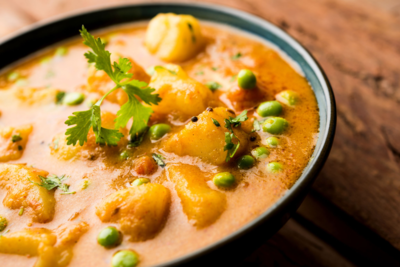
Calories and macros of Aloo te Matar da Kurma for common portion sizes.
| Portion | Weight (g) | Calories (kcal) | Protein (g) | Carbs (g) | Fat (g) |
|---|---|---|---|---|---|
| ½ small cup (katori) | 55 | 81 | 1.8 | 5.4 | 5.7 |
| 1 small cup (katori) | 110 | 161 | 3.7 | 10.8 | 11.5 |
| 1½ small cups (katori) | 165 | 242 | 5.5 | 16.2 | 17.2 |
| 2 small cups (katori) | 220 | 322 | 7.4 | 21.6 | 22.9 |
| 100 g | 100 | 147 | 3.4 | 9.8 | 10.4 |
1 serving = 109.9g
Time a 65 kg adult needs to burn one serving (161 kcal).
Likely to produce a moderate blood glucose rise; pair with protein/fiber for better stability.
| Nutrient | Aloo te Matar da Kurma | Aloo chana in mint coriander gravy | Aloo Chana in Mint Kottamalli Gravy | Pudina dhoniya rasune aloo cholar torkari |
|---|---|---|---|---|
| Calories | 161.2 kcal | 162.2 kcal | 162.2 kcal | 162.2 kcal |
| Carbs | 10.8 g | 15.3 g | 15.3 g | 15.3 g |
| Protein | 3.7 g | 5.3 g | 5.3 g | 5.3 g |
| Fat | 11.5 g | 8.9 g | 8.9 g | 8.9 g |
| Fiber | 4.6 g | 4.7 g | 4.7 g | 4.7 g |
| Sugar | 1.6 g | 2.7 g | 2.7 g | 2.7 g |
| Sodium | 43.5 mg | 245.9 mg | 245.9 mg | 245.9 mg |
| Cholesterol | 0.7 mg | 0 mg | 0 mg | 0 mg |
At just 161.2 kcal per serving, this is an excellent choice for weight management. The 4.6g of dietary fiber promotes satiety, helping you feel full longer.
Moderate glycemic index (GI: 56). The starchy ingredients raise the glycemic load — reduce portion or pair with protein-rich sides. Adding a fiber-rich side dish can help moderate the blood sugar response.
Low protein content (3.7g per serving) — not sufficient alone for muscle building. Combine with high-protein sides like paneer, eggs, chicken, dal, or a protein shake to reach 25-30g protein per meal.
Low cholesterol (0.7mg) and low saturated fat (3.2g) make this heart-friendly. Anti-inflammatory ingredients benefit overall heart health. Low sodium content is ideal for blood pressure management.
Moderate-to-high GI (56) can spike insulin — Women with PCOS should pair this with fiber-rich vegetables and a protein source to improve the insulin response. Consider replacing refined ingredients with whole grains or millets.
No goitrogenic ingredients — generally safe for thyroid conditions. The spices aid digestion, which can be sluggish in hypothyroidism.
1 Small Cup (~109.9g) or slightly less. Pair with a high-fiber side like cucumber raita or salad to feel full on fewer kcal.
1 Small Cup (~109.9g) plus a protein-rich addition (100g paneer, 2 eggs, or 1 cup dal) to hit 25-30g protein per meal.
1 Small Cup (~109.9g). Pair with whole wheat roti (not rice) to lower glycemic load. Eat protein and fiber portions first, carbs last.
1 Small Cup (~109.9g) provides a balanced portion. Adjust based on your daily kcal target — track accurately in the Hint app.
Use low-fat paneer or reduce ghee/butter by half. Switch to a non-stick pan to minimize oil.
Add 50g paneer, a boiled egg, or a side of sprouted moong dal. Stirring in 1 tbsp of peanut butter also adds 4g protein.
Replace refined flour (maida) with whole wheat atta, or swap white rice with brown rice or millets like jowar/bajra.
Replace potato with cauliflower or bottle gourd. Add a squeeze of lemon — the acidity lowers glycemic response.
Aloo te Matar da Kurma stores well for 2-3 days refrigerated. Reheat on stovetop for best texture. Prepare ingredients in advance for quick weeknight cooking.
Why it matters: Excess oil can double the calorie content without adding nutritional value.
Fix: Measure oil with a tablespoon instead of pouring freely. 1 tbsp = 120 kcal.
Why it matters: The nutrition values are for 1 standard serving. Eating 2-3x the serving means 2-3x the kcal (322.3-483.5 kcal).
Fix: Use the Hint app to scan and log the exact portion you eat for accurate tracking.
Why it matters: Eating rice with another starchy dish doubles the glycemic load, causing sharp blood sugar spikes.
Fix: Choose one carb source per meal. Pair with roti instead of rice, or add a protein-rich side.
One serving of Aloo te Matar da Kurma contains 161.2 kcal (3.7g protein, 10.8g carbs, 11.5g fat). That's 146.7 kcal per 100g. You can track exact portions in the Hint app.
At just 161.2 kcal per serving, this is an excellent choice for weight management. The 4.6g of dietary fiber promotes satiety, helping you feel full longer. Pair with a salad or raita for a filling, low-calorie meal.
Moderate glycemic index (GI: 56). The starchy ingredients raise the glycemic load — reduce portion or pair with protein-rich sides. Adding a fiber-rich side dish can help moderate the blood sugar response. The glycemic index is 56 (Medium). Always consult your dietitian for personalized guidance — Hint Premium connects you with expert dietitians.
Aloo te Matar da Kurma has 3.7g protein per serving. For a protein boost, combine with paneer, eggs, dal, or chicken.
Yes, Aloo te Matar da Kurma is light enough for dinner at 161.2 kcal. Having a lighter dinner 2-3 hours before sleep supports better digestion and weight management.
Since Aloo te Matar da Kurma is low in protein, pair it with dal, paneer, curd, or eggs. Add a fiber-rich salad for completeness. Track your full meal in the Hint app for accurate nutrition totals.
Moderate-to-high GI (56) can spike insulin — Women with PCOS should pair this with fiber-rich vegetables and a protein source to improve the insulin response. Consider replacing refined ingredients with whole grains or millets.
Increased dietary fiber intake is associated with lower body weight
Slavin JL (2005). Dietary fiber and body weight. Nutrition.
DOI: 10.1016/j.nut.2003.09.004Curcumin in turmeric has significant anti-inflammatory properties
Hewlings SJ & Kalman DS (2017). Curcumin: A Review of Its Effects on Human Health. Foods.
DOI: 10.3390/foods6100092Fenugreek seeds improve glucose tolerance and lower blood sugar levels
Neelakantan N et al. (2014). Effect of fenugreek intake on glycemia. Nutrition Journal.
DOI: 10.1186/1475-2891-13-7Portion control is one of the most effective strategies for managing calorie intake and body weight
Rolls BJ (2014). What is the role of portion control in weight management? International Journal of Obesity.
DOI: 10.1038/ijo.2014.82Nutrition is calculated from the ingredient quantities above using the Indian Food Composition Tables (IFCT 2017, ICMR-NIN) and USDA FNDDS. The glycemic index is estimated from the ingredients, not lab-tested. Activity times use the Compendium of Physical Activities for a 65 kg adult. This page is general information, not medical advice. Our data sources
Last updated:


