
Track your nutrition and health goals

Washing
Wash the rice flakes several times, drain and keep aside. Wash the vegetables thoroughly with water.
Mixed vegetable poha with peanuts has 326.6 calories per serving (1 Medium Cup) — that's 163.7 calories per 100g. It provides 7g protein, 51g carbs, and 10.5g fat. With a low glycemic index (GI: 54), this recipe is suitable for diabetes management, heart health, PCOS. The 4.7g of dietary fiber per serving adds to its nutritional value. It contains anti-inflammatory ingredients like turmeric and ginger.
Track the exact calories and macros of Mixed vegetable poha with peanuts in the Hint app — India's comprehensive recipe and nutrition tracking platform.
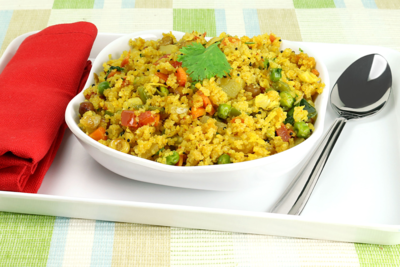
1 serving = 199.5g
Cooking time: 10 minutes
Serves: 2 persons
Likely to produce a slower, steadier rise in blood glucose for most people.
| Nutrient | Mixed vegetable poha with peanuts | Tamatar hari matar poha | Thakkali Aval Pattani | Thakkali Poha Padakkulli |
|---|---|---|---|---|
| Calories | 326.6 kcal | 272.8 kcal | 272.8 kcal | 272.8 kcal |
| Carbs | 51 g | 43.6 g | 43.6 g | 43.6 g |
| Protein | 7 g | 5.5 g | 5.5 g | 5.5 g |
| Fat | 10.5 g | 8.5 g | 8.5 g | 8.5 g |
| Fiber | 4.7 g | 4.3 g | 4.3 g | 4.3 g |
| Sugar | 1.8 g | 1.8 g | 1.8 g | 1.8 g |
| Sodium | 400.8 mg | 401.4 mg | 401.4 mg | 401.4 mg |
| Cholesterol | 0 mg | 0 mg | 0 mg | 0 mg |
At 326.6 kcal per serving, this is a higher-kcal dish. Enjoy as an occasional treat, or reduce the portion to half for better calorie control.
With a low glycemic index of 54, this recipe supports stable blood sugar levels. The 4.7g fiber further slows glucose absorption.
Low protein content (7g per serving) — not sufficient alone for muscle building. Combine with high-protein sides like paneer, eggs, chicken, dal, or a protein shake to reach 25-30g protein per meal.
Zero cholesterol and low saturated fat (2.1g) make this heart-friendly. Anti-inflammatory ingredients benefit overall heart health. Contains heart-healthy fats.
Low GI (54) with 4.7g fiber supports insulin sensitivity — key for PCOS management. Anti-inflammatory ingredients like turmeric and ginger are especially beneficial for PCOS.
No goitrogenic ingredients — generally safe for thyroid conditions. The spices aid digestion, which can be sluggish in hypothyroidism.
1 Medium Cup (~199.5g) or slightly less. Pair with a high-fiber side like cucumber raita or salad to feel full on fewer kcal.
1 Medium Cup (~199.5g) plus a protein-rich addition (100g paneer, 2 eggs, or 1 cup dal) to hit 25-30g protein per meal.
1 Medium Cup (~199.5g). Pair with whole wheat roti (not rice) to lower glycemic load. Eat protein and fiber portions first, carbs last.
1 Medium Cup (~199.5g) provides a balanced portion. Adjust based on your daily kcal target — track accurately in the Hint app.
Reduce oil to 1 teaspoon and use an air fryer or non-stick pan. Steaming vegetables before adding retains flavor with less fat.
Add 50g paneer, a boiled egg, or a side of sprouted moong dal. Stirring in 1 tbsp of peanut butter also adds 4g protein.
Replace refined flour (maida) with whole wheat atta, or swap white rice with brown rice or millets like jowar/bajra.
Reduce serving size by 25% to save ~81.6 kcal. Add extra vegetables (capsicum, spinach, mushrooms) to increase volume without adding many kcal.
Replace potato with cauliflower or bottle gourd. Add a squeeze of lemon — the acidity lowers glycemic response.
Cut salt by half and boost flavor with lemon juice, fresh herbs, or amchur (dry mango powder) instead.
Mixed vegetable poha with peanuts stores well for 2-3 days refrigerated. Reheat on stovetop for best texture. Prepare ingredients in advance for quick weeknight cooking.
Why it matters: Excess oil can double the calorie content without adding nutritional value.
Fix: Measure oil with a tablespoon instead of pouring freely. 1 tbsp = 120 kcal.
Why it matters: Excess sodium increases blood pressure risk. Indian cooking already uses salt-heavy ingredients like pickles and chutneys alongside.
Fix: Use ½ teaspoon salt and taste before adding more. Account for sodium from other meal components.
Why it matters: The nutrition values are for 1 standard serving. Eating 2-3x the serving means 2-3x the kcal (653.2-979.7 kcal).
Fix: Use the Hint app to scan and log the exact portion you eat for accurate tracking.
Why it matters: Eating rice with another starchy dish doubles the glycemic load, causing sharp blood sugar spikes.
Fix: Choose one carb source per meal. Pair with roti instead of rice, or add a protein-rich side.
Why it matters: Overcooking destroys heat-sensitive vitamins (C, B-complex) and reduces fiber quality.
Fix: Cook vegetables until just tender. Add delicate vegetables (like spinach or capsicum) in the last 2-3 minutes.
One serving of Mixed vegetable poha with peanuts contains 326.6 kcal (7g protein, 51g carbs, 10.5g fat). That's 163.7 kcal per 100g. You can track exact portions in the Hint app.
At 326.6 kcal per serving, this is a higher-kcal dish. Enjoy as an occasional treat, or reduce the portion to half for better calorie control. Stick to one measured serving and track it in the Hint app to stay within your calorie budget.
With a low glycemic index of 54, this recipe supports stable blood sugar levels. The 4.7g fiber further slows glucose absorption. The glycemic index is 54 (Low). Always consult your dietitian for personalized guidance — Hint Premium connects you with expert dietitians.
Mixed vegetable poha with peanuts has 7g protein per serving. It provides moderate protein — add a protein-rich side for a complete meal.
Mixed vegetable poha with peanuts at 326.6 kcal works for dinner if it's your main dish. Avoid eating within 2 hours of bedtime. If watching kcal intake, have a smaller portion at night.
Since Mixed vegetable poha with peanuts is moderate in protein, pair it with dal, paneer, curd, or eggs. Add a fiber-rich salad for completeness. Track your full meal in the Hint app for accurate nutrition totals.
Low GI (54) with 4.7g fiber supports insulin sensitivity — key for PCOS management. Anti-inflammatory ingredients like turmeric and ginger are especially beneficial for PCOS.
Low glycemic index foods help improve blood sugar control in people with diabetes
Brand-Miller J et al. (2003). Low-glycemic index diets in the management of diabetes. Diabetes Care.
DOI: 10.2337/diacare.26.8.2261Increased dietary fiber intake is associated with lower body weight
Slavin JL (2005). Dietary fiber and body weight. Nutrition.
DOI: 10.1016/j.nut.2003.09.004Dietary fiber slows glucose absorption and reduces post-meal blood sugar spikes
Weickert MO & Pfeiffer AFH (2008). Metabolic effects of dietary fiber consumption. Journal of Nutrition.
DOI: 10.1093/jn/138.3.439Curcumin in turmeric has significant anti-inflammatory properties
Hewlings SJ & Kalman DS (2017). Curcumin: A Review of Its Effects on Human Health. Foods.
DOI: 10.3390/foods6100092

