
Track your nutrition and health goals

Paneer Calories & Protein: Per 100g, 150g, 200g, 300g | Nutrition Facts
By Asfia Fatima, Chief Dietitian at Clearcals
Paneer is one of the most protein-rich foods in an Indian vegetarian diet — but how many calories and grams of protein does it actually contain at each serving size?
The short answer: 100g paneer contains 258 kcal and 19g of protein. The calories in your serving depend almost entirely on how many grams you eat.
This guide covers exact calorie and protein values for every common serving size — 50g, 150g, 160g, 200g, 250g, and 300g — plus nutrition facts for the most popular paneer recipes.
Paneer Calories and Protein — At a Glance
Here is a combined reference table covering the most commonly searched paneer serving sizes:
| Serving Size | Calories (kcal) | Protein (g) | Fat (g) | Carbs (g) |
|---|---|---|---|---|
| 25 grams | ~65 kcal | ~4.7g | ~3.8g | ~0.6g |
| 30 grams | ~77 kcal | ~5.7g | ~4.5g | ~0.7g |
| 50 grams | ~129 kcal | ~9.5g | ~7.5g | ~1.2g |
| 75 g (1 katori) | ~194 kcal | ~14.2g | ~11.3g | ~1.8g |
| 100 grams | ~258 kcal | ~18.9g | ~15.0g | ~2.4g |
| 125 grams | ~323 kcal | ~23.6g | ~18.8g | ~3.0g |
| 150 grams | ~387 kcal | ~28.4g | ~22.5g | ~3.6g |
| 160 grams | ~413 kcal | ~30.2g | ~24.0g | ~3.8g |
| 200 grams | ~516 kcal | ~37.8g | ~30.0g | ~4.8g |
| 250 grams | ~645 kcal | ~47.3g | ~37.5g | ~6.0g |
| 300 grams | ~774 kcal | ~56.7g | ~45.0g | ~7.2g |
| 400 grams | ~1,032 kcal | ~75.6g | ~60.0g | ~9.6g |
| 500 grams | ~1,290 kcal | ~94.5g | ~75.0g | ~12.0g |
| 1 kg | ~2,580 kcal | ~189g | ~150g | ~24.0g |
Values based on full-fat paneer made from whole milk at moderate density. Low-fat or toned-milk paneer has 15–20% fewer calories.
Track your exact paneer intake using the Hint app, which lets you log any quantity and see your full macronutrient breakdown in real time.
Watch: How to Track Paneer Calories on the Hint App
How Many Calories Are in 100 Grams of Paneer?
100 grams of paneer provides 258 kcal. At this serving size, paneer delivers approximately 19g protein, 15g fat, and 2.4g carbohydrates — making it one of the most protein-dense vegetarian foods available.
The calories in paneer depend primarily on serving size. Here is a full gram-by-gram calorie table:
| Quantity | Paneer Calories (kcal) |
|---|---|
| 50 grams | 129 |
| 100 grams | 258 |
| 150 grams | 387 |
| 200 grams | 516 |
| 250 grams | 645 |
| 300 grams | 774 |
| 350 grams | 903 |
| 400 grams | 1,032 |
| 450 grams | 1,161 |
| 500 grams | 1,290 |
| 1 kg | 2,580 |
Download the Hint app to track your calories and nutrition from paneer dishes and other meals.
50 Grams Paneer Calories and Protein
50 grams of paneer contains approximately 129 kcal and 9.5g of protein. At this serving size, fat is ~7.5g, and carbs are minimal (~1.2g).
50g is a common portion for garnishing dal, rice, or salads. It contributes meaningfully to daily protein intake without adding excessive calories.
150 Grams Paneer Calories and Protein
150 grams of paneer contains approximately 387 kcal and 28.4g of protein. Fat at this serving size is ~22.5g.
150g is one of the most commonly consumed serving sizes for paneer sabji or curry at a single meal. It provides roughly 50–60% of the daily protein requirement for a moderately active adult.
| Nutrient | Per 150g Paneer |
|---|---|
| Calories | ~387 kcal |
| Protein | ~28.4g |
| Fat | ~22.5g |
| Carbs | ~3.6g |
160 Grams Paneer Calories and Protein
160 grams of paneer contains approximately 413 kcal and 30.2g of protein, with ~24g of fat. This serving size is common when paneer is the primary protein source for a meal.
200 Grams Paneer Calories and Protein
200 grams of paneer contains approximately 516 kcal and 37.8g of protein, with ~30g of fat and ~4.8g of carbs.
200g is a large single-meal serving typically seen in restaurant portions of paneer curry or bhurji. At this quantity, paneer alone provides a significant share of daily caloric intake — keep this in mind if you're tracking a calorie deficit.
| Nutrient | Per 200g Paneer |
|---|---|
| Calories | ~516 kcal |
| Protein | ~37.8g |
| Fat | ~30.0g |
| Carbs | ~4.8g |
250 Grams Paneer Calories and Protein
250 grams of paneer contains approximately 645 kcal and 47.3g of protein, with ~37.5g of fat.
250g is approaching a full-day protein requirement for many adults in one sitting. It's common as a post-workout meal for those targeting high protein intake, but the calorie load means it should be accounted for carefully in a weight-loss context.
300 Grams Paneer Calories and Protein
300 grams of paneer contains approximately 774 kcal and 56.7g of protein, with ~45g of fat.
| Nutrient | Per 300g Paneer |
|---|---|
| Calories | ~774 kcal |
| Protein | ~56.7g |
| Fat | ~45.0g |
| Carbs | ~7.2g |
300g represents the daily protein target for a ~65 kg individual (at 0.8g protein/kg body weight) from paneer alone. This is an aggressive serving size; most nutritionists recommend distributing protein across meals rather than consuming it all at once.
1 Katori Paneer Calories and Protein
1 katori of paneer weighs approximately 75 grams and contains:
- Calories: ~194 kcal
- Protein: ~14.2g
- Fat: ~11.3g
- Carbs: ~1.8g
A katori is the standard small serving bowl used in Indian households — slightly smaller than a full "cup." For recipes like paneer sabji or paneer bhurji, you're typically eating 1–2 katoris per meal.
Paneer Protein Per 100g
Paneer provides approximately 18.9 grams of protein per 100g, making it one of the best plant-based (lacto-vegetarian) protein sources in the Indian diet.
Here is a cross-variety comparison of protein per 100g for context:
| Food | Protein per 100g |
|---|---|
| Full-fat paneer | ~18.9g |
| Low-fat paneer | ~17–20g |
| Homemade paneer (whole milk) | ~18–19g |
| Tofu (firm) | ~8–10g |
| Egg (boiled) | ~13g |
| Chicken breast | ~31g |
| Cooked dal | ~7–9g |
For vegetarians, paneer is among the most efficient protein sources per calorie. The Hint app offers high-protein recipe suggestions that incorporate paneer to help you hit daily targets.
Paneer Protein for Every Serving Size
| Quantity | Paneer Protein (grams) |
|---|---|
| 50 grams | 9.5 |
| 100 grams | 18.9 |
| 150 grams | 28.4 |
| 200 grams | 37.8 |
| 250 grams | 47.3 |
| 300 grams | 56.7 |
| 350 grams | 66.1 |
| 400 grams | 75.6 |
| 450 grams | 85.0 |
| 500 grams | 94.5 |
| 1 kg | 189 |
Whether you're aiming to build muscle or simply increase your protein intake, paneer is a versatile food that can help meet your protein goals.

Carbs in Paneer
Paneer is very low in carbohydrates. Plain full-fat paneer made from whole milk contains approximately 1.2–2.4g of carbohydrates per 100g — roughly 2–4% of total weight. The exact amount varies slightly depending on how the paneer is made (the whey removal process affects residual lactose).
At typical serving sizes:
- 50g paneer: ~0.6–1.2g carbs
- 100g paneer: ~1.2–2.4g carbs
- 150g paneer: ~1.8–3.6g carbs
- 200g paneer: ~2.4–4.8g carbs
This makes paneer a suitable food for low-carb, keto, and diabetic-friendly diets. Most of the carbs in paneer are trace amounts of lactose (milk sugar) remaining after the curdling and pressing process.
Does paneer have carbs? Yes — but in negligible amounts. Plain paneer is not considered a "carb food." However, paneer dishes like paneer butter masala, matar paneer, or paneer korma contain significant carbs from the sauce, onion, tomato, and other ingredients.
Fiber in Paneer
Paneer contains negligible dietary fiber — approximately 0–0.1g per 100g. As a dairy product, paneer is not a meaningful source of fiber.
If you're tracking fiber intake alongside paneer consumption, pair it with fiber-rich vegetables like spinach (palak paneer), peas (matar paneer), or a side of whole grains. The Hint app tracks fiber alongside protein, fat, and calories in your full meal.
Paneer Nutrition Facts (Per 100g)
Paneer is not only a rich source of protein but also contains essential micronutrients like calcium, phosphorus, selenium, and zinc.
It provides approximately 2% carbohydrates, 29% protein, and 52% fat by calorie distribution. These nutrients make paneer beneficial for bone health, muscle function, and immunity.
| Nutrient | Per 100g Paneer |
|---|---|
| Calories | 258 kcal |
| Protein | 18.9g |
| Fat | 15.0g |
| Carbohydrates | ~1.2–2.4g |
| Fiber | ~0g |
| Calcium | ~480–490mg (≈50% RDA) |
| Phosphorus | ~380mg |
| Selenium | ~14.7 mcg |
| Zinc | ~2.1mg |
With Hint Pro, you can personalize your diet and track your intake of key nutrients like protein, fat, and calcium to meet your specific health goals.
Fat in Paneer
Paneer contains approximately 15 grams of fat per 100 grams, which contributes to its rich, creamy texture. While it's high in fats, most of them are good fats, including conjugated linoleic acid (CLA), which helps in fat loss.
However, paneer is also high in saturated fats, so it's important to consume it in moderation.
You can use the Hint app to track your fat intake and maintain a balanced diet, especially if you're watching your cholesterol or weight.
Homemade Paneer vs Store-Bought — Calories and Protein
The calorie and protein content of homemade paneer is similar to store-bought when both are made from whole milk — approximately 250–270 kcal and 18–20g protein per 100g. However, there are a few differences worth noting:
Homemade paneer made from full-fat whole milk tends to be denser and slightly higher in fat. If you use toned milk or low-fat milk, the calorie and fat content drops proportionally:
- Full-fat whole milk paneer: ~258 kcal, ~18.9g protein per 100g
- Low-fat (toned milk) paneer: ~180–200 kcal, ~17–19g protein per 100g
- Skimmed milk paneer: ~140–160 kcal, ~16–18g protein per 100g
Store-bought paneer often has additives or is compressed differently, but the macronutrient profile per 100g is generally comparable to that of homemade.
To know the exact fat and protein in your homemade paneer, use the Hint app and log your recipe using the "Create Your Recipe" feature.
Is Paneer Good for Health?
Yes, paneer is a nutrient-dense food that provides essential vitamins and minerals. It supports bone health due to its high calcium content and helps maintain muscle mass due to its protein.
Paneer is also beneficial for heart health when consumed in moderation, as its healthy fats and micronutrients like selenium help reduce inflammation.
The Hint Pro subscription offers personalized health insights, helping you incorporate paneer into your diet in a balanced way.
Paneer Benefits
Weight Loss: Although high in fats, paneer's rich protein content promotes satiety, making it a great option for weight loss when eaten in moderation.
Muscle Gain: Paneer is an excellent source of protein, which is essential for muscle repair and growth.
Diabetes Management: Paneer has a low glycemic index, meaning it doesn't cause rapid spikes in blood sugar levels.
Bone Health: Packed with calcium, phosphorus, and magnesium, paneer supports strong bones and teeth.
Immunity Boost: Paneer contains zinc, selenium, and protein, which are essential for boosting the immune system.
Track your health benefits from paneer and other foods with the Hint app, and consult with dietitians through Hint Premium for expert advice.
Is Paneer Fat or Protein?
Paneer is rich in both protein and fat, but its exact ratio depends on the type of milk used and how it's prepared.
Full-fat paneer (made from whole milk) contains more fat, making it calorie-dense and suitable for muscle gain or keto diets.
Low-fat paneer (made from toned or skim milk) has a higher protein-to-fat ratio and is better for weight loss.
To know the exact fat and protein in your homemade paneer, use the Hint app and log your recipe using the "Create Your Recipe" feature.
Is Paneer Good for Cholesterol?
Paneer contains both healthy fats and saturated fats. While it can raise cholesterol levels if consumed in excess, moderate consumption, especially when paired with fiber-rich vegetables, can help balance cholesterol levels.
For people managing cholesterol, the Hint app can help track your saturated fat intake and ensure you're making heart-healthy food choices.
Is Paneer Good for Weight Loss?
Paneer is rich in protein, which helps you feel full longer, preventing overeating and aiding in weight loss. Although it is high in fat, the type of fats in paneer can support metabolism and fat burning when consumed in moderation.
Pairing paneer with fiber-rich foods like salads can create a balanced meal that promotes weight loss.
The Hint app provides tailored meal plans to help you achieve your weight loss goals.
Is Paneer Good for Diabetes?
Paneer has a low glycemic index, meaning it doesn't cause significant spikes in blood sugar.
Its high protein content and healthy fats also help stabilize blood sugar levels, making it a good option for people with diabetes.
Use the Hint app to find diabetic-friendly recipes and track your carb intake to manage your blood sugar effectively.
Is Paneer Good for Blood Pressure?
The sodium content in paneer is very low and hence helps in controlling blood pressure. The calcium, phosphorus, and potassium levels in the paneer help in restoring electrolyte balance and maintaining blood pressure.
However, one shouldn't go overboard as it is high in saturated fat.
Is Paneer Good for PCOS?
Paneer is high in fat and calories, which may interfere with ovarian function; hence not a good choice for PCOS. To learn more about the PCOS diet and treatment, read our blog.
Is Paneer Good for the Thyroid?
Paneer is an excellent source of selenium, a mineral that plays a critical role in thyroid health. Selenium supports the production of thyroid hormones and helps reduce oxidative stress.
Consuming selenium-rich foods like paneer can help maintain proper thyroid function.
With Hint Premium, you can consult with expert dietitians to optimize your diet for thyroid health.
Is Paneer Good for Immunity?
Paneer contains reasonable amounts of essential nutrients, is a good source of zinc and pantothenic acid, and is an excellent source of protein, biotin, calcium, phosphorus, and selenium, which helps in boosting immunity.
To know how these nutrients effectively boost immunity, read our blog on supporting your immunity through nutrition.

Is Paneer Good for Muscle Gain?
Paneer's high protein content makes it an ideal choice for muscle gain. It provides essential amino acids that help in muscle repair and growth, especially when combined with resistance training.
The Hint app allows you to track your protein intake and provides high-protein meal ideas to optimize muscle growth.
Is Paneer Good for Weight Gain?
Paneer contains high amounts of protein, which makes you feel satiated quickly as it is slowly digested. Hence, it is not considered a good choice for weight gain.
Is Paneer Good for Fat Loss?
Paneer contains conjugated linoleic acid (CLA), a fatty acid known to aid in fat loss. Its high protein content promotes fat burning and muscle retention during weight loss.
For those focusing on fat loss, the Hint app can help you monitor your calorie intake and track your macronutrients to meet your fitness goals.
Is Paneer Good for Fatty Liver?
Paneer, being high in protein and low in carbohydrates, can help manage fatty liver conditions when eaten in moderation.
Healthy fats support liver function, but individuals with fatty liver disease should monitor their saturated fat intake.
The Hint app helps you track your fat consumption to ensure you're eating in a way that supports liver health.
Calorie and Nutrition Facts of Paneer Recipes
Calories in a paneer dish depend on the recipe, serving size, or quantity in grams. The table below shows calorie values per 100g and a standard single-serving size for each recipe. Always eat paneer in moderation as it is high in fat.
| Paneer Recipe | Calories per 100g | Calories (1 std. serving) |
|---|---|---|
| Paneer capsicum curry | 93 kcal | ~186 kcal (200g) |
| Paneer do pyaza | 108 kcal | ~216 kcal (200g) |
| Paneer biryani | 126 kcal | ~252 kcal (200g) |
| Kadai paneer | 130 kcal | ~260 kcal (200g) |
| Shahi paneer | 143 kcal | ~286 kcal (200g) |
| Paneer tikka | 146 kcal | ~292 kcal (200g) |
| Palak paneer | 147 kcal | ~294 kcal (200g) |
| Matar paneer | 153 kcal | ~306 kcal (200g) |
| Paneer bhurji | 174 kcal | ~348 kcal (200g) |
| Paneer makhani | 176 kcal | ~352 kcal (200g) |
| Paneer butter masala | 220 kcal | ~440 kcal (200g) |
| Grilled paneer | 280 kcal | ~280 kcal (100g) |
Download the Hint app for more information on healthy paneer recipes, calories, and nutrition facts.

1. Butter Paneer Masala Calories
One small cup of butter paneer masala has 219 kcal per 100g. It contains 18% carbohydrates, 20% protein, and 62% of fat. Paneer butter masala is a good source of vitamin K, vitamin D, and manganese. It is an excellent source of protein, biotin, calcium, phosphorus, and selenium.
| Quantity | Butter Paneer Masala Calories (kcal) |
|---|---|
| 1 Small cup (100g) | 219 |
| 1 Medium cup (200g) | 438 |
| 1 Large cup (300g) | 656 |
2. Paneer Paratha Calories
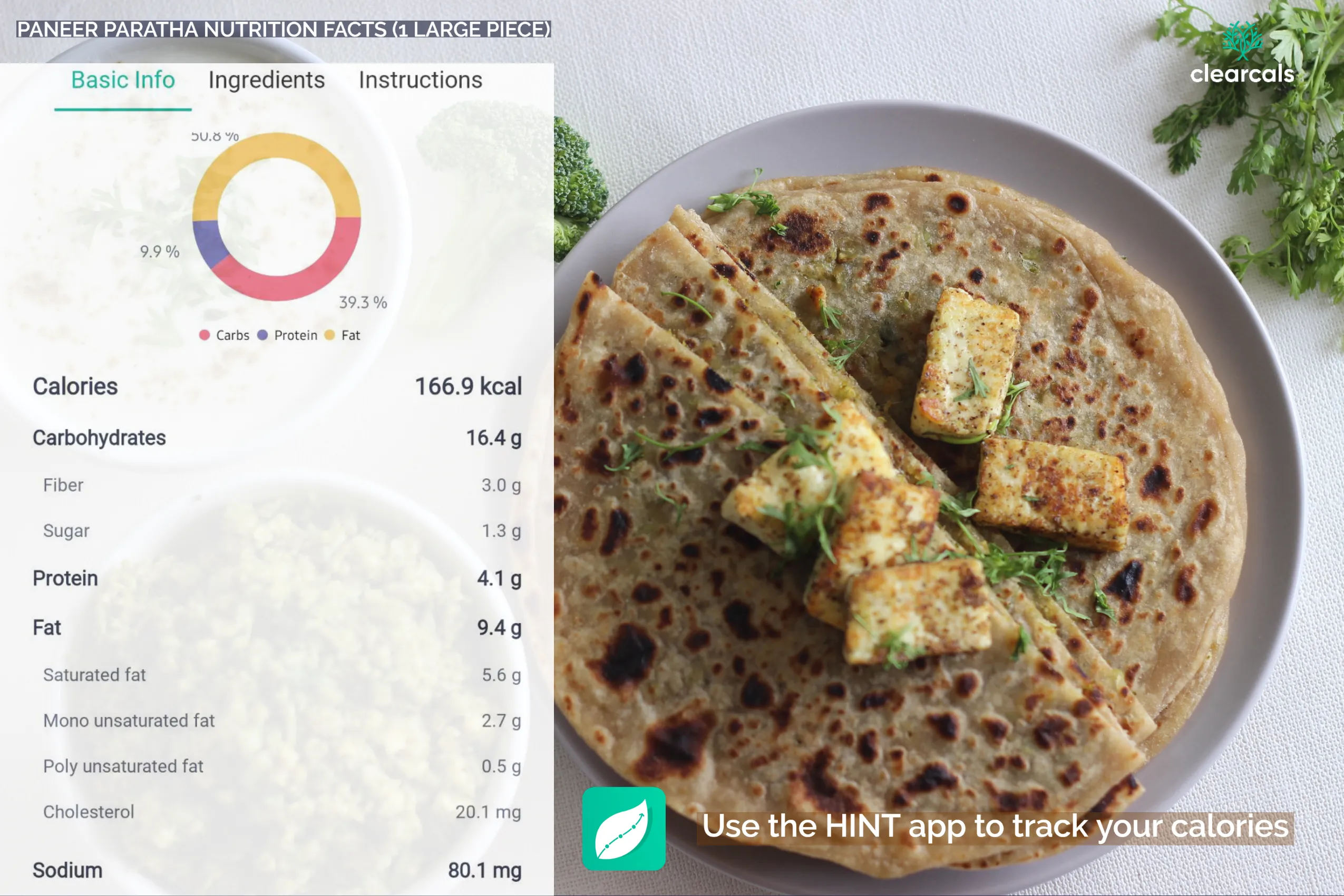
One large piece (50 grams) of paneer paratha contains 167 kcal. It contains 39% carbohydrates, 10% protein, and 51% fat. Paneer paratha is a good source of dietary fiber, manganese, lutein, and phosphorus, and is an excellent source of selenium and vitamin D. Eat this in moderation as it is high in saturated fat.
| Paratha Size (in grams) | 1 Paratha (kcal) | 2 Parathas (kcal) | 3 Parathas (kcal) | 4 Parathas (kcal) |
|---|---|---|---|---|
| Small piece (30g) | 100 | 200 | 301 | 401 |
| Medium piece (40g) | 134 | 267 | 401 | 534 |
| Large piece (50g) | 167 | 334 | 500 | 668 |
3. Paneer Tikka Calories
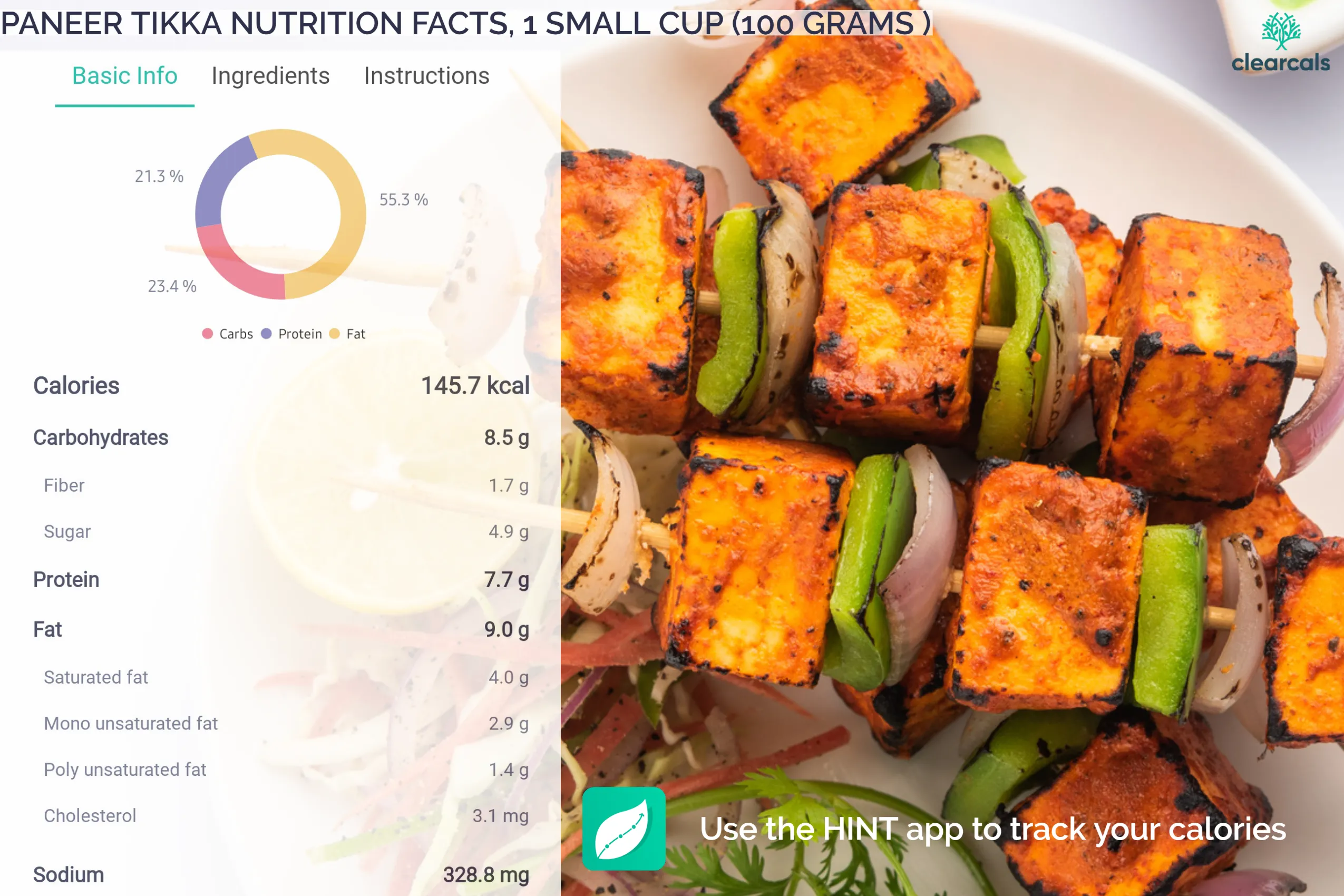
One small cup of paneer tikka has 146 kcal per 100g. It contains 23% carbohydrates, 21% protein, and 55% fat. Paneer tikka is a good source of protein, folate, vitamin E, calcium, and phosphorus. It is an excellent source of selenium and vitamin C.
| Quantity | Paneer Tikka Calories (kcal) |
|---|---|
| 1 Small cup (100g) | 146 |
| 1 Medium cup (200g) | 291 |
| 1 Large cup (300g) | 437 |

4. Palak Paneer Calories
One small cup of palak paneer has 145 kcal per 100g. It contains 21% carbohydrates, 20% protein, and 59% fat. Palak paneer is a good source of protein, potassium, dietary fiber, folate, vitamin C, vitamin D, phosphorus, magnesium, copper, vitamin E, and manganese, and an excellent source of calcium, selenium, biotin, beta carotene, and lutein.
| Quantity | Palak Paneer Calories (kcal) |
|---|---|
| 1 Small cup (100g) | 145 |
| 1 Medium cup (200g) | 291 |
| 1 Large cup (300g) | 436 |

5. Paneer Bhurji Calories
One small cup of paneer bhurji has 173 kcal per 100g. It contains 24% carbohydrates, 23% protein, and 53% fat. Paneer bhurji is a good source of protein, folate, vitamin C, vitamin E, and phosphorus, and an excellent source of biotin, calcium, selenium, and vitamin D.
| Quantity | Paneer Bhurji Calories (kcal) |
|---|---|
| 1 Small cup (100g) | 173 |
| 1 Medium cup (200g) | 347 |
| 1 Large cup (300g) | 520 |
6. Paneer Sandwich Calories
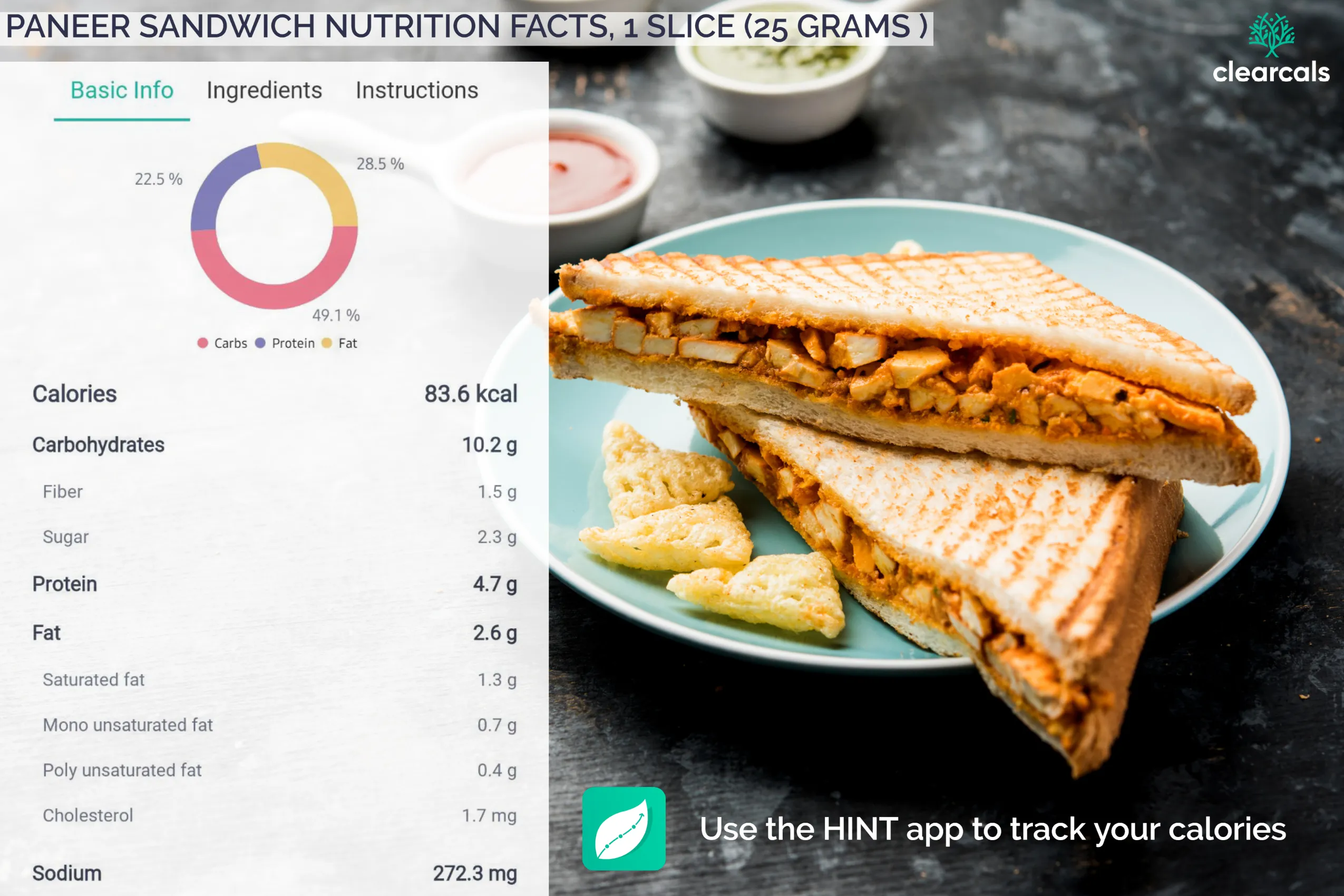
One slice of paneer sandwich has 84 kcal. It contains 49% carbohydrates, 23% protein, and 28% fat. A grilled paneer sandwich is a good source of protein, biotin, selenium, and calcium.
| Quantity | Paneer Sandwich Calories (kcal) |
|---|---|
| 1 Slice (25g) | 84 |
| 2 Slices (50g) | 167 |
| 3 Slices (75g) | 251 |

7. Matar Paneer Calories
One small cup of matar paneer has 153 kcal per 100g. It contains 24% carbohydrates, 20% protein, and 56% fat. Mutter paneer curry is a good source of protein, dietary fiber, folate, vitamin C, phosphorus, magnesium, copper, vitamin E, beta carotene, lycopene, lutein, and an excellent source of calcium, selenium, biotin, and vitamin D.
| Quantity | Matar Paneer Calories (kcal) |
|---|---|
| 1 Small cup (100g) | 153 |
| 1 Katori (~150g) | 230 |
| 1 Medium cup (200g) | 306 |
| 1 Large cup (300g) | 458 |
Final Thoughts
Paneer is a versatile, protein-rich food that can be part of a healthy diet when consumed in moderation. Its benefits for muscle gain, weight loss, and diabetes management make it a popular choice for those focusing on health and fitness.
However, paneer's fat content means it should be eaten mindfully, particularly if you're managing cholesterol or trying to lose weight. At the most common serving sizes — 100g (258 kcal, 19g protein) to 300g (774 kcal, 57g protein) — paneer makes a substantial nutritional contribution to any meal.
With the Hint app, you can easily track your calories, fat, and protein intake from paneer and other foods.
Hint Pro offers tailored meal plans, and Hint Premium provides access to expert dietitians for personalized guidance, ensuring you make the best choices for your health and wellness.
🎁 Free Hint with Every Watch Purchase
Garmin watches: Purchase any Garmin watch from the Clearcals Store and receive 1 month of Hint Premium (worth ₹1,999) free — including unlimited dietitian consultations, personalised diet and workout plans, and advanced nutrition tracking.
Apple Watch: Purchase any Apple Watch from the Clearcals Store and receive a free Hint Pro subscription — including personalised Indian diet plans, 300+ workouts, weekly insights, and more.
About the Author
Asfia Fatima is the Chief Dietitian at Clearcals, with a Master's Degree in Dietetics and Clinical Nutrition and over a decade of experience in clinical nutrition and lifestyle management.
She specializes in evidence-based diet planning for weight loss, diabetes, and metabolic health.
At Clearcals, she leads the nutrition strategy behind the Hint app, helping users achieve their goals with science-backed guidance.
🔗 Connect with Asfia on LinkedIn


