
Track your nutrition and health goals

Moong Dal Calories & Protein Per 100g | Chilla, Khichdi, Sprouts, Halwa

By Asfia Fatima, Chief Dietitian at Clearcals
Moong dal is one of India's most nutritious and versatile dals — a rich source of plant-based protein, dietary fiber, potassium, magnesium, and antioxidants. One small cup (100g) of cooked moong dal tadka has 97 kcal and 4.8g protein. Raw dry moong dal has 347 kcal and 24g protein per 100g.
This guide covers moong dal calories and protein by serving size, cooking method, and recipe — from plain dal to chilla, khichdi, sprouts, and halwa.
Track your moong dal intake with the Hint app.
Moong Dal Calories and Protein Per 100g
The calorie content of moong dal depends on how it is prepared. Raw (dry) moong dal is far more calorie-dense than cooked:
| Preparation | Calories (per 100g) | Protein (per 100g) |
|---|---|---|
| Raw / dry moong dal | 347 kcal | 24g |
| Cooked moong dal tadka | 97 kcal | 4.8g |
| Boiled moong dal | ~105 kcal | ~7g |
| Moong dal chilla | 260 kcal | ~15g |
| Moong sprouts | 28 kcal | ~2g |
| Moong dal halwa | 332 kcal | ~12g |
Cooked moong dal tadka (the most commonly consumed form) contains 97 kcal per 100g with a macronutrient split of 47% carbohydrates, 20% protein, and 33% fat.
| Serving Size | Calories | Protein |
|---|---|---|
| 50g | 49 kcal | 2.4g |
| 100g (1 small cup) | 97 kcal | 4.8g |
| 200g (1 medium cup) | 193 kcal | 9.6g |
| 300g (1 large cup) | 290 kcal | 14.4g |
50g Moong Dal Calories
50g of cooked moong dal tadka contains approximately 49 kcal and 2.4g protein. For raw/dry moong dal, 50g has approximately 174 kcal and 12g protein. Many recipes use 50g of raw dal per serving before cooking, which yields approximately 100–120g of cooked dal.
1 Bowl (1 Katori) Moong Dal Calories
1 medium bowl (katori) of cooked moong dal (approximately 150–200g) contains 145–193 kcal and 7–10g protein. Dal servings vary by bowl size:
| Serving | Weight | Calories | Protein |
|---|---|---|---|
| 1 small bowl (katori) | ~100g | 97 kcal | 4.8g |
| 1 medium bowl | ~150g | 145 kcal | 7.2g |
| 1 large bowl | ~200g | 193 kcal | 9.6g |
Moong Dal Nutritional Value Per 100g (Cooked)
100g of cooked moong dal tadka provides:
| Nutrient | Per 100g (Cooked) |
|---|---|
| Calories | 97 kcal |
| Protein | 4.8g |
| Carbohydrates | 11.4g |
| Dietary Fiber | 4.0g |
| Fat | 3.6g |
| Potassium | 372mg |
| Magnesium | 49mg |
| Copper | 0.2mg |
| Selenium | 8 mcg |
| Manganese | 0.6mg |
| Beta-Carotene | 1600 mcg |
| Lutein | 2322 mcg |
Moong dal is an excellent source of beta-carotene and lutein, and a good source of protein, fiber, potassium, magnesium, copper, selenium, and manganese.
Cooked / Boiled Moong Dal Calories Per 100g
Boiled moong dal (plain, without tadka) contains approximately 105 kcal and 7g protein per 100g. The difference from dal tadka is the cooking oil and spices — plain boiled moong is lighter. Boiling moong dal does not significantly reduce its protein content; the apparent change in per-100g values compared to raw dal is due to water absorption increasing the weight.
| Form | Calories per 100g | Protein per 100g |
|---|---|---|
| Raw/dry | 347 kcal | 24g |
| Boiled (plain) | ~105 kcal | ~7g |
| Dal tadka (with oil/spices) | 97 kcal | 4.8g |
| Soaked (not cooked) | ~180 kcal | ~12g |
Moong Dal Chilla Calories
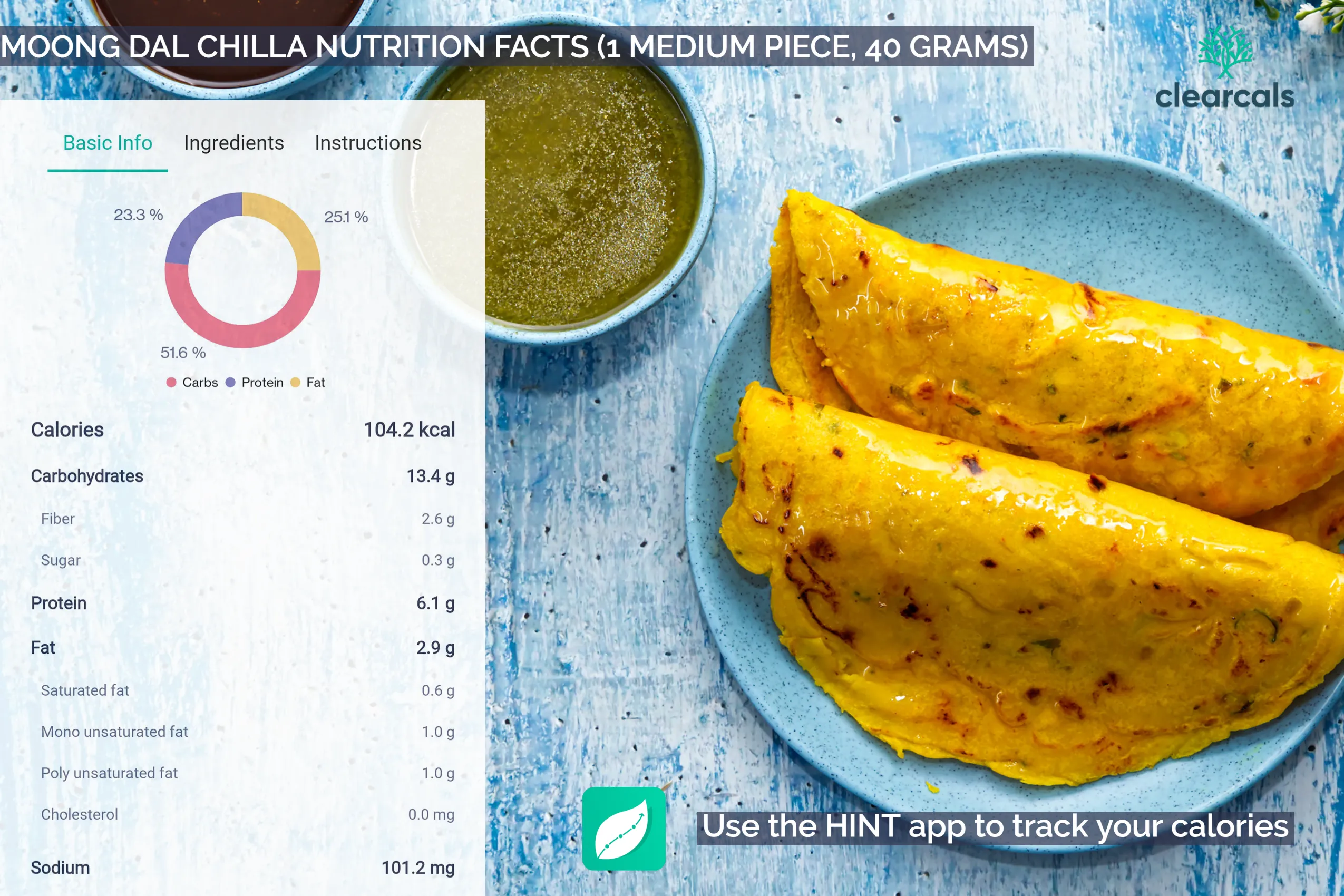
1 small moong dal chilla (30g) has 78 kcal — 52% from carbohydrates, 23% from protein, and 25% from fat. A medium chilla (40g) has 104 kcal; a large chilla (50g) has 130 kcal.
| Size | 1 Chilla | 2 Chillas | 3 Chillas | 4 Chillas |
|---|---|---|---|---|
| Small (30g) | 78 kcal | 156 kcal | 234 kcal | 312 kcal |
| Medium (40g) | 104 kcal | 208 kcal | 313 kcal | 417 kcal |
| Large (50g) | 130 kcal | 260 kcal | 391 kcal | 521 kcal |
2 Moong Dal Chilla Calories
2 small moong dal chillas (60g) contain 156 kcal and approximately 9g of protein. Two medium chillas (80g) contain 208 kcal and ~12g protein. Two moong dal chillas is a typical breakfast or snack portion.
Moong Dal Chilla Protein Per 100g
100g of moong dal chilla contains approximately 260 kcal and 15g of protein. The macronutrient breakdown per 100g is approximately: 34g carbohydrates, 15g protein, 7g fat.
| Moong Dal Chilla | Per 30g (1 small) | Per 100g |
|---|---|---|
| Calories | 78 kcal | 260 kcal |
| Protein | ~4.5g | ~15g |
| Carbohydrates | ~10g | ~34g |
| Fat | ~2g | ~6.5g |
Top 5 Popular Moong Dal Recipes
1. Moong Dal Chilla Calories
One small piece (30g) of moong dal chilla has 78 kcal — 52% from carbohydrates, 23% from protein, and 25% from fat. Moong dal chilla is a good source of protein, magnesium, phosphorus, and selenium. It helps lower blood pressure and reduce muscle cramps.
| Serving Size | 1 Chilla | 2 Chillas | 3 Chillas | 4 Chillas |
|---|---|---|---|---|
| Small (30g) | 78 kcal | 156 kcal | 234 kcal | 312 kcal |
| Medium (40g) | 104 kcal | 208 kcal | 313 kcal | 417 kcal |
| Large (50g) | 130 kcal | 260 kcal | 391 kcal | 521 kcal |

2. Moong Dal Khichdi Calories
One medium cup (200g) of moong dal khichdi has 259 kcal — 66% from carbohydrates, 12% from protein, and 22% from fat. It is a good source of dietary fiber, protein, thiamin, vitamin B5, phosphorus, copper, manganese, and selenium.
| Serving Size | Calories |
|---|---|
| Small cup (100g) | 129 kcal |
| Medium cup (200g) | 259 kcal |
| Large cup (300g) | 388 kcal |

3. Moong Dal Dosa Calories
Moong dal dosa (pesarattu) — one small piece (30g) has 75 kcal — 64% from carbohydrates, 21% from protein, and 14% from fat. It is an excellent source of protein, dietary fiber, magnesium, copper, and selenium.
| Serving Size | 1 Dosa | 2 Dosas | 3 Dosas | 4 Dosas |
|---|---|---|---|---|
| Small (30g) | 75 kcal | 150 kcal | 226 kcal | 301 kcal |
| Medium (40g) | 100 kcal | 201 kcal | 301 kcal | 401 kcal |
| Large (50g) | 125 kcal | 251 kcal | 376 kcal | 502 kcal |

4. Moong Dal Sprouts Calories
One small cup (100g) of moong sprouts salad has 28 kcal — 69% from carbohydrates, 21% from protein, and 10% from fat. Moong sprouts are an excellent source of alpha-carotene and beta-carotene and a good source of vitamin C.
| Serving Size | Calories |
|---|---|
| Small cup (100g) | 27 kcal |
| Medium cup (200g) | 55 kcal |
| Large cup (300g) | 83 kcal |
5. Moong Dal Halwa Calories
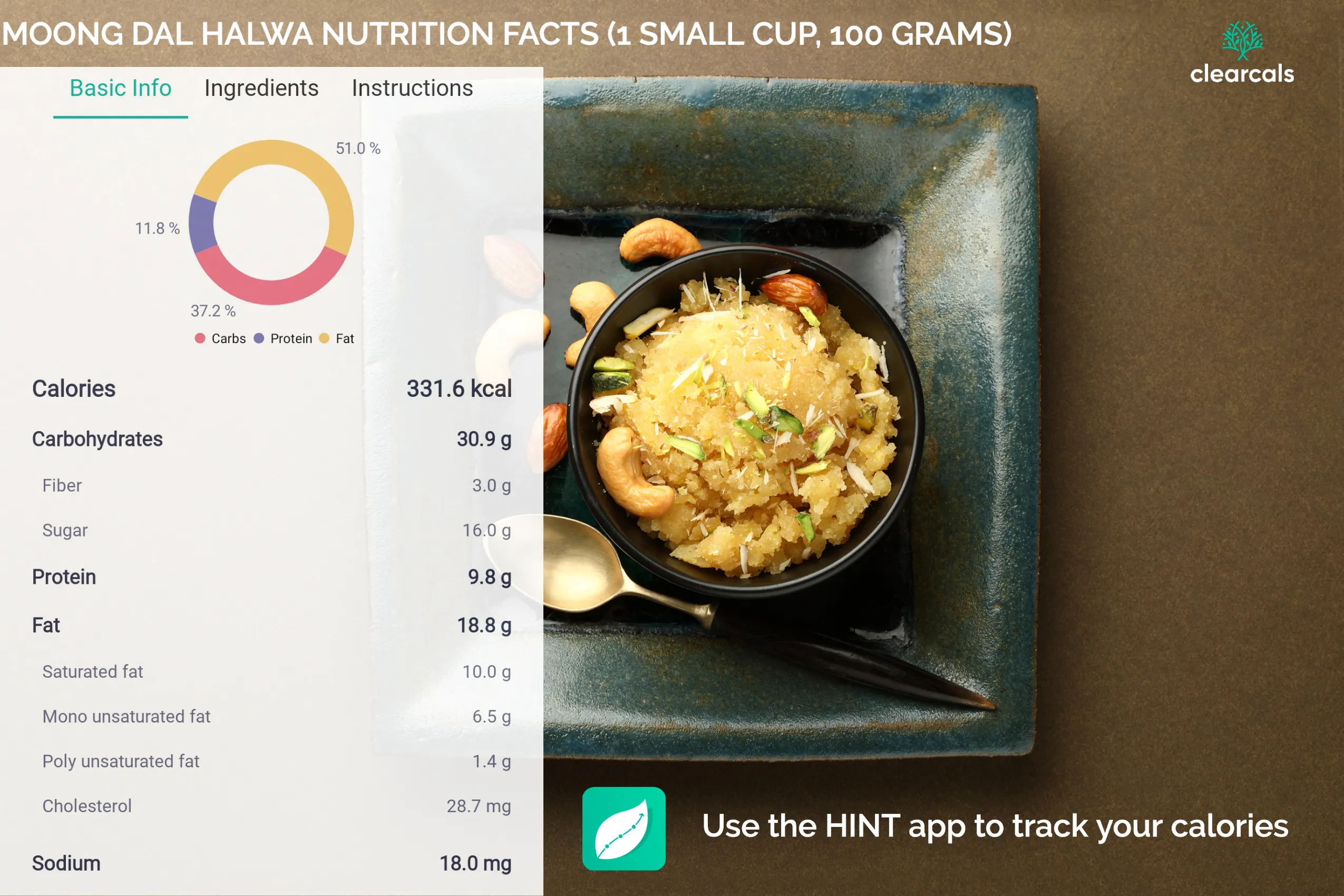
One small cup (100g) of moong dal halwa has 332 kcal — 37% from carbohydrates, 12% from protein, and 51% from fat. Eat in moderation as it is high in sugar and saturated fat.
| Serving Size | Calories |
|---|---|
| Small cup (100g) | 332 kcal |
| Medium cup (200g) | 663 kcal |
| Large cup (300g) | 995 kcal |
Moong Dal Recipes: Full Calorie Reference
Snacks (per 1 small piece, 30g):
| Recipe | Calories |
|---|---|
| Sprouted moong methi cheela | 35 kcal |
| Green moong dal and vegetable idli | 44 kcal |
| Lauki moong dal cheela | 47 kcal |
| Rice and moong dal idli | 53 kcal |
| Moong dal palak cheela | 56 kcal |
| Moong sprout kebab | 65 kcal |
| Moong dal dhokla | 72 kcal |
| Yellow moong pesarattu | 75 kcal |
| Moong dal cheela | 78 kcal |
| Oats and moong dal vada | 86 kcal |
| Yellow moong dal paratha | 108 kcal |
| Moong dal ladoo | 132 kcal |
Snacks and sides (per 1 small cup, 100g):
| Recipe | Calories |
|---|---|
| Moong sprouts salad | 28 kcal |
| Moong sprouts stir fry | 110 kcal |
| Carrot moong dal stir fry | 115 kcal |
| Moong dal halwa | 332 kcal |
| Haldiram's moong dal | 465 kcal |
Curries (per 1 small cup, 100g):
| Recipe | Calories |
|---|---|
| Pumpkin moong dal curry | 95 kcal |
| Ridge gourd moong dal curry | 106 kcal |
| Bottle gourd moong dal curry | 108 kcal |
| Spring onion moong dal curry | 109 kcal |
| Cabbage moong dal curry | 113 kcal |
| Moong dal usili | 129 kcal |
| Moong dal curry | 167 kcal |
Khichdi and soups (per 1 medium cup, 200g):
| Recipe | Calories |
|---|---|
| Moong dal vegetable soup | 167 kcal |
| Sabudana moong khichdi | 184 kcal |
| Yellow moong dal soup | 193 kcal |
| Spinach moong dal khichdi | 213 kcal |
| Moong dal khichdi | 259 kcal |
| Bajra moong dal khichdi | 257 kcal |
| Rice moong dal pongal | 285 kcal |
| Brown rice moong dal pongal | 304 kcal |
Moong Dal Benefits
- Supports weight loss: High fiber and protein promote satiety and reduce overall calorie intake.
- Helps control blood sugar: The low glycemic index makes it ideal for diabetes management. Studies show daily moong dal consumption significantly lowers fasting glucose and HbA1c levels.
- Boosts immunity: Antioxidants, including selenium and zinc, support immune health. Sprouting increases vitamin C content further.
- Improves heart health: Potassium and magnesium aid in maintaining healthy blood pressure. Research shows daily pulse consumption causes a significant reduction in systolic blood pressure.
- Supports thyroid function: Selenium-rich foods like moong dal help prevent selenium deficiency and improve thyroid function.
- Good for PCOS: A diet including dals and pulses improves insulin response, triglycerides, LDL-cholesterol, and HDL-cholesterol in women with PCOS.
Is Moong Dal Good for Weight Loss?
Yes — moong dal is high in dietary fiber and protein, both of which promote satiety. Eating moong dal daily as part of lunch or dinner while maintaining a calorie deficit significantly aids weight loss.
Is Moong Dal Good for Diabetes?
Yes — numerous studies show that daily moong dal consumption lowers fasting glucose, HbA1c, and insulin resistance (HOMA-IR). Its low glycemic index provides steady energy without causing rapid blood sugar spikes.
Is Moong Dal Good for Blood Pressure?
Yes — research demonstrates daily pulse consumption causes significant reductions in systolic blood pressure, likely due to potassium, magnesium, dietary fiber, and phytochemicals.
Moong Dal Glycemic Index
The glycemic index of moong dal is relatively low, making it an excellent food choice for people with diabetes or those monitoring blood sugar levels.
Moong Dal Side Effects
Some individuals may experience bloating or gas, especially when eating large amounts. Soaking or sprouting moong dal before cooking reduces these effects and improves digestibility.
Enhance Your Diet with the Hint App
For those following a high-protein diet plan, moong dal is a fantastic addition. The Hint app makes it easy to track your calorie and protein intake from all moong dal recipes.
- Free protein intake tracking to monitor daily protein and stay on target
- Hint Pro: Pro Workouts (300+ routines), advanced calorie tracking, and exercise guides
- Hint Premium: Unlimited dietitian consultations and personalised diet plans for diabetes, PCOS, and more
Conclusion
Moong dal is a nutritious and versatile ingredient — from plain dal at 97 kcal/100g to energy-dense halwa at 332 kcal/100g. Whether enjoyed as khichdi, chilla, sprouts, or dal tadka, it is one of the best plant-based protein sources available in Indian diets.
With the Hint app, tracking your moong dal intake across all recipes has never been easier.
References
- Kim SJ et al. Effects of dietary pulse consumption on body weight. Am J Clin Nutr. 2016;103(5):1213-23.
- Hafiz MS et al. Pulse consumption improves indices of glycemic control. Eur J Nutr. 2022;61(2):809-824.
- Lukus PK et al. The Role of Pulses in Cardiovascular Disease Risk. Am J Lifestyle Med. 2020;14(6):571-584.
🎁 Free Hint with Every Watch Purchase
Garmin watches: Purchase any Garmin watch from the Clearcals Store and receive 1 month of Hint Premium (worth ₹1,999) free — including unlimited dietitian consultations, personalised diet and workout plans, and advanced nutrition tracking. 👉 Browse Garmin watches →
Apple Watch: Purchase any Apple Watch from the Clearcals Store and receive a free Hint Pro subscription — including personalised Indian diet plans, 300+ workouts, weekly insights, and more. 👉 Browse Apple Watches →
About the Author
Asfia Fatima is the Chief Dietitian at Clearcals, with a Master's Degree in Dietetics and Clinical Nutrition and over a decade of experience in clinical nutrition and lifestyle management.
She specializes in evidence-based diet planning for weight loss, diabetes, and metabolic health.
At Clearcals, she leads the nutrition strategy behind the Hint app, helping users achieve their goals with science-backed guidance.
🔗 Connect with Asfia on LinkedIn


