Track your nutrition and health goals

Pani Puri Calories: 51 kcal per Piece | Golgappa Nutrition & Health Guide
By Asfia Fatima, Chief Dietitian at Clearcals
Pani puri — called golgappa in Delhi and UP, puchka in Kolkata and Bengal, phuchka in Assam, and pani poori across Maharashtra and South India — is India's most universally loved street food. It's tangy, spicy, and gone in one bite.
It's also one of the most-searched street foods when people are counting calories.
This guide has every number you need: calories per piece, per plate, per 100g, and broken down by filling type — so you can enjoy pani puri and still know exactly where you stand.
TL;DR
- 1 pani puri = 51 kcal (30g piece with standard potato-chickpea filling)
- 6 pani puri (1 plate) = 306 kcal
- 10 pani puri = 510 kcal
- Golgappa calories are identical — same food, different regional name
- AI Overviews often answer "how many calories" directly — the calorie data above is what they pull from
- Baked puri = ~35 kcal per piece (31% less)
- Track pani puri with the Hint app — it's in the Indian food database
Calories in Pani Puri — Per Piece, Per Plate, Per 100g
Based on nutritional data from Clearcals' pani puri recipe, with standard potato and chickpea filling, fried puri:
| Serving Size | Calories (kcal) | Carbs (g) | Protein (g) | Fat (g) |
|---|---|---|---|---|
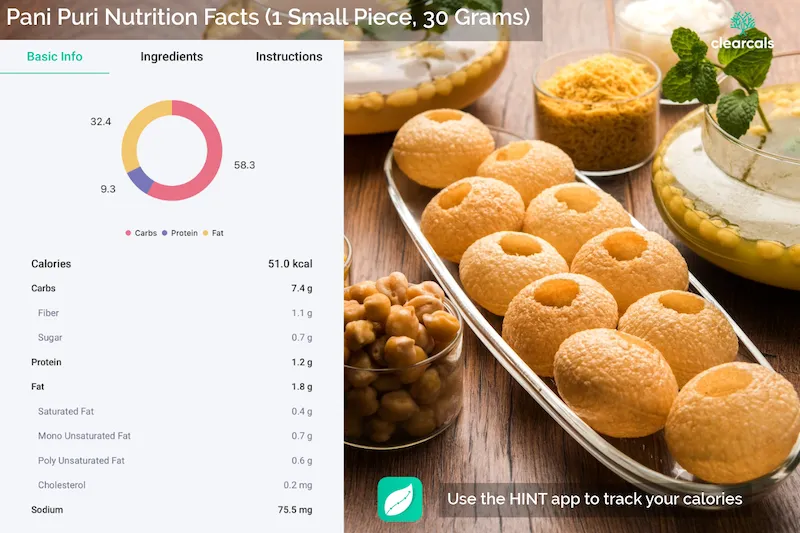
| 1 piece (30g) | 51 | 7.4 | 1.2 | 1.8 |
| 2 pieces (60g) | 102 | 14.8 | 2.4 | 3.6 |
| 3 pieces (90g) | 153 | 22.2 | 3.6 | 5.4 |
| 4 pieces (120g) | 204 | 29.6 | 4.8 | 7.2 |
| 5 pieces (150g) | 255 | 37.0 | 6.0 | 9.0 |
| 6 pieces — 1 plate (180g) | 306 | 44.4 | 7.2 | 10.8 |
| 8 pieces (240g) | 408 | 59.2 | 9.6 | 14.4 |
| 10 pieces (300g) | 510 | 74.0 | 12.0 | 18.0 |
| Per 100g | 170 | 24.7 | 4.0 | 6.0 |
1 Plate Pani Puri Calories
A standard pani puri plate at most street stalls and restaurants in India contains 6 pieces. That is 306 kcal.
However, plates vary:
| Plate Type | Pieces | Calories |
|---|---|---|
| Small plate (street vendor) | 4 pieces | 204 kcal |
| Standard plate (6 pieces) | 6 pieces | 306 kcal |
| Large plate (8 pieces) | 8 pieces | 408 kcal |
| Double plate / binge serving | 12 pieces | 612 kcal |
Most searches for "1 plate pani puri calories" are looking for the 6-piece answer: 306 kcal.
If you're at a street stall where the vendor keeps refilling automatically, it helps to tell them to stop at 6 — or count and use the Hint app to log as you eat.
Golgappa Calories — Same Food, Same Numbers
Golgappa = pani puri. The calorie content is identical.
The name varies by region:
| Region | Name Used |
|---|---|
| Delhi, UP, Haryana, Rajasthan | Golgappa |
| West Bengal, Assam, Bihar | Puchka / Phuchka |
| Maharashtra, Gujarat | Pani puri |
| South India | Pani poori |
| Madhya Pradesh | Fulki |
The core components — fried semolina puri, spiced water (pani), potato and chickpea filling — are the same. Calorie differences across regions come from filling variations and puri size, not the name.
| Serving | Golgappa Calories | Notes |
|---|---|---|
| 1 golgappa | 51 kcal | Standard small piece |
| 5 golgappa | 255 kcal | |
| 6 golgappa | 306 kcal | Typical plate |
| 10 golgappa | 510 kcal | |
| 1 plate golgappa | 306 kcal | 6-piece standard |
Puchka (Kolkata-style): Kolkata puchka is typically smaller and uses a spicier tamarind water with mashed potato filling. Slightly fewer calories per piece (~40–45 kcal) due to smaller puri size.
Pani Puri Calories by Filling Type
The filling makes a meaningful difference to total calories:
| Filling Type | Calories per Piece | Calories for 6 Pieces |
|---|---|---|
| Standard (potato + chickpea) | 51 kcal | 306 kcal |
| Ragda (white peas curry) | 58–65 kcal | 350–390 kcal |
| Only spiced water, no filling | 30–35 kcal | 180–210 kcal |
| With extra sweet tamarind chutney | 55–60 kcal | 330–360 kcal |
| With potato only (no chickpeas) | 48–52 kcal | 290–310 kcal |
| Baked puri (instead of fried) | 35 kcal | 210 kcal |
| Air-fried puri | 38–40 kcal | 230–240 kcal |
Pani Puri Calories With Potato
The standard pani puri filling is mashed potato with chickpeas and spices. At 51 kcal per piece, the potato contributes roughly 20–22 kcal of the total (the puri accounts for ~25 kcal and the pani + filling makes up the rest).
Pani puri with extra potato (heavier filling): approximately 55–58 kcal per piece, or 330–350 kcal for 6 pieces.
Pani puri with ragda (white peas curry instead of mashed potato): 58–65 kcal per piece because white peas add more protein and carbohydrate density than mashed potato.
Suji Golgappa Calories
Suji (semolina) golgappa is the standard variety found at most north Indian street stalls — the classic fried crispy puri is made from suji/rava. This is what most calorie data refers to.
Suji golgappa: ~51 kcal per piece — same as the standard pani puri calorie number.
Some vendors also make whole wheat (atta) golgappa, which has a slightly different texture. The calorie difference is minimal (~48–50 kcal per piece), but fibre content is marginally higher with atta.
Detailed Nutrition Facts — Per Piece and Per 100g
Macronutrients (Per 100g)
| Nutrient | Amount | % Daily Value* |
|---|---|---|
| Calories | 170 kcal | 8.5% |
| Carbohydrates | 24.7g | 8% |
| Dietary Fibre | 3.7g | 13% |
| Sugars | 2.3g | 5% |
| Protein | 4.0g | 8% |
| Total Fat | 6.0g | 8% |
| Sodium | 252mg | 11% |
*Based on a 2000 kcal diet
Per Piece Breakdown (30g)
- Carbohydrates: 7.4g (58% of calories)
- Protein: 1.2g (9% of calories)
- Fat: 1.8g (32% of calories)
- Sodium: ~75mg per piece (453mg for 6 pieces)
Pani puri is a predominantly carbohydrate food with moderate fat from frying. Protein content is low.
Vitamins and Minerals
The potato and chickpea filling contribute meaningfully to micronutrients:
- Vitamin C (from potato and tamarind): 6–10% DV
- Vitamin B6 (metabolism support): 5–8% DV
- Iron (from chickpeas): 6–10% DV
- Potassium (heart health): 8–12% DV
- Magnesium: 5–8% DV
- Phosphorus: 6–10% DV
The spiced water (pani) — made with mint, coriander, cumin, tamarind, and black salt — adds antioxidants and digestive benefits beyond what the macronutrient count shows.
Health Benefits of Pani Puri
Pani puri is street food, not a health food — but it does have some genuine benefits when consumed in reasonable portions:
1. Digestive properties from the pani: Mint, cumin, coriander, and black salt in the spiced water all have traditional and evidence-based digestive benefits. Mint soothes the stomach, cumin stimulates digestive enzymes, and the combination supports gut motility.
2. Hydration: The pani provides fluid intake, particularly useful in summer. The flavour encourages drinking more of the spiced water than plain water.
3. Antioxidants: Tamarind, mint, and coriander are all antioxidant-rich. Tamarind specifically provides vitamin C, tartaric acid, and polyphenols.
4. Fibre: 1.1g of fibre per piece (3.7g per 100g) contributes to daily fibre intake and supports satiety.
5. Complex carbohydrates: Semolina and chickpeas provide longer-digesting carbohydrates compared to simple sugars.
6. Cooling effect: The mint and black salt combination has a thermally cooling effect on the body — one reason pani puri is particularly popular in summer.
These benefits apply to hygienically prepared pani puri. Street food carries a hygiene risk that is separate from its nutritional profile.
Is Pani Puri Good for Weight Loss?
It can fit into a weight loss diet — it just requires planning.
Why pani puri makes weight loss harder:
- High in refined carbohydrates (semolina puri, fried)
- Moderate fat from deep frying
- Low protein (only 7.2g for a 6-piece plate) — doesn't keep you full long
- Easy to overconsume at a street stall where portions aren't fixed
- Sweet tamarind chutney adds sugar calories quickly
How to make pani puri work on a diet:
- 4–6 pieces as an occasional snack: 204–306 kcal, manageable in a deficit
- Use baked or air-fried puris: drops to 210–240 kcal for 6 pieces
- Add chickpeas/sprouted moong to filling: increases protein and fibre, improves satiety
- Log it with Hint before eating, not after — pre-logging makes portion decisions easier
- Treat it as a meal, not a snack — if you're having 6 pieces (306 kcal), make that your lunch, not an addition to it
- Reduce sweet chutney: each extra teaspoon of tamarind chutney adds 15–20 kcal
At 51 kcal per piece, pani puri is not particularly high-calorie for street food. The issue is usually eating 10–15 pieces without noticing, which becomes 510–765 kcal from a single street snack.
For a full calorie deficit guide, see: Calorie Deficit Diet — Indian Guide
Pani Puri Khane Ke Fayde — Health Benefits in Hindi
पानी पुरी खाने के फायदे (Pani Puri Ke Fayde):
पाचन में मदद (Digestion): पानी पुरी की पानी में पुदीना, जीरा, धनिया और काला नमक होता है जो पाचन क्रिया में मदद करते हैं। जीरा digestive enzymes को activate करता है।
हाइड्रेशन (Hydration): गर्मी के मौसम में पानी पुरी की spiced water body को hydrate करती है।
एंटीऑक्सीडेंट (Antioxidants): इमली (tamarind), पुदीना, और धनिया में antioxidants होते हैं जो free radicals से बचाते हैं।
Pani Puri mein kitni calorie hoti hai?
| Serving | Calories |
|---|---|
| 1 pani puri / golgappa | 51 kcal |
| 5 pani puri | 255 kcal |
| 6 pani puri (1 plate) | 306 kcal |
| 10 pani puri | 510 kcal |
क्या पानी पुरी रोज़ खानी चाहिए? नहीं। Fried puri और refined carbs की वजह से रोज़ खाना weight और digestion दोनों के लिए सही नहीं है। हफ्ते में 1–2 बार, 4–6 pieces तक — यह reasonable है।
Weight loss में पानी पुरी: अगर calorie deficit में हो, तो 4–6 pieces (204–306 kcal) occasional treat के रूप में fit हो सकते हैं। Hint app में Indian food database में pani puri available है — log करके track करें।
Healthier Ways to Make Pani Puri at Home
Making pani puri at home gives you control over the biggest calorie factors:
Bake instead of fry: Roll the dough thin, prick with a fork, brush lightly with oil, bake at 200°C for 8–10 minutes until puffed and golden. Calories drop from ~51 to ~35 per piece. For 6 pieces: 210 kcal vs 306 kcal — a 96 kcal saving per plate.
Use whole wheat flour: Replacing suji with atta or a suji-atta mix increases fibre and slightly reduces glycaemic index. The calorie difference is small (~2–3 kcal per piece) but the nutritional quality improves.
Protein-boost the filling: Add sprouted moong, extra chickpeas, or boiled white peas to the mashed potato filling. This increases protein from 1.2g to 1.8–2.2g per piece without meaningfully increasing calories.
Control the sweet chutney: Sweet tamarind chutney adds 15–20 kcal per teaspoon. Use it sparingly or replace with a date-sweetened version for lower sugar impact.
Make your own pani: Homemade spiced water lets you control sodium. Reduce salt and increase mint, green chilli, and lemon juice for flavour. Sodium per piece can drop from ~75 mg to ~40–50mg.
For detailed recipes: Pani Puri Recipe — Clearcals
How the Hint App Helps You Track Pani Puri
The Hint app has pani puri in its Indian food database — 51 kcal per piece, with macros. You can log by piece count and see exactly how it fits into your day's calorie and macro budget.
Key features relevant to street food tracking:
- Indian food database including street foods, restaurant dishes, and packaged items
- Barcode scanning for packaged foods
- Portion flexibility — log 4, 6, 8, or 10 pieces and see the calorie impact
- Hint Pro builds your personalised Indian diet plan around your calorie goal, including room for treats like pani puri
Frequently Asked Questions
How many calories are in one pani puri?
One small pani puri (30g) contains 51 calories — 7.4g carbs, 1.2g protein, 1.8g fat. This is based on a standard piece with mashed potato and chickpea filling, fried puri.
How many calories are in 6 pani puri?
6 pieces (a standard plate) = 306 kcal, 44.4g carbs, 7.2g protein, 10.8g fat.
How many calories are in 10 pani puri?
10 pieces = 510 kcal, 74g carbs, 12g protein, 18g fat.
What is the difference between pani puri, golgappa, and puchka?
These are regional names for the same dish. Golgappa is the term used in Delhi, UP, and north India. Puchka is used in West Bengal and eastern India (typically smaller and spicier). Pani puri is the term used in Maharashtra, Gujarat, and across India broadly. The calorie content is the same.
Is pani puri healthy?
Pani puri is not a nutritious food — it's fried, refined carbohydrate-heavy, and low in protein. But the spiced water contains genuine digestive and antioxidant benefits. Consumed in moderation (4–6 pieces, occasionally), it fits into a healthy diet without issues.
Can I eat pani puri every day?
Not recommended. The combination of refined fried carbs, moderate fat, and sodium (453mg for 6 pieces) makes it better as an occasional treat. 1–2 times per week in controlled portions (4–6 pieces) is reasonable.
How many pani puris can I eat while dieting?
4–6 pieces (204–306 kcal) as an occasional snack or light meal fits into most calorie deficit plans. Log it first in Hint and see how it fits your daily budget before eating.
How many calories in baked pani puri?
Baked puri = approximately 35 kcal per piece, or 210 kcal for 6 pieces — about 30% fewer calories than the fried version.
What are golgappa calories per piece?
Same as pani puri: 51 kcal per piece for a standard-sized golgappa with potato filling.
🎁 Exclusive Offer for Clearcals Store Customers
- Buy select Garmin watches → Get 1 Month FREE Hint Premium (worth ₹1,999)
- Buy Apple Watch models → Get FREE Hint Pro access
Explore More
- Samosa Calories — Nutrition & Health Benefits
- Dosa Calories — Nutrition & Health Benefits
- Calorie Deficit Diet — Indian Guide
- Roti Calories — Nutrition & Health Benefits
- How to Lose Weight — Indian Guide
References
- Slavin JL, Lloyd B. Health benefits of fruits and vegetables. Adv Nutr. 2012;3(4):506-516. doi:10.3945/an.112.002154
- Dhingra D, Michael M, Rajput H, Patil RT. Dietary fibre in foods: a review. J Food Sci Technol. 2012;49(3):255-266. doi:10.1007/s13197-011-0365-5
- Gadiraju TV, Patel Y, Gaziano JM, Djoussé L. Fried Food Consumption and Cardiovascular Health: A Review of Current Evidence. Nutrients. 2015;7(10):8424-8430. doi:10.3390/nu7105404
- McKay DL, Blumberg JB. A review of the bioactivity and potential health benefits of peppermint tea (Mentha piperita L.). Phytother Res. 2006;20(8):619-633.
- Rebello CJ, Greenway FL, Finley JW. A review of the nutritional value of legumes and their effects on obesity and its related co-morbidities. Obes Rev. 2014;15(5):392-407.
About the Author
Asfia Fatima is the Chief Dietitian at Clearcals, with a Master's Degree in Dietetics and Clinical Nutrition and over a decade of experience in clinical nutrition and lifestyle management.
She specialises in evidence-based diet planning for weight loss, diabetes, and metabolic health. At Clearcals, she leads the nutrition strategy behind the Hint app, helping users achieve their goals with science-backed guidance.
🔗 Connect with Asfia on LinkedIn