Track your nutrition and health goals

Statins and Diet: What to Eat, When to Take & What to Avoid
Atorvastatin and Rosuvastatin (Statins) and Diet: What to Eat, When to Take Them, and What to Avoid
By Dr. Sumedha Verma, Consultant Physician at Clearcals
The short answer
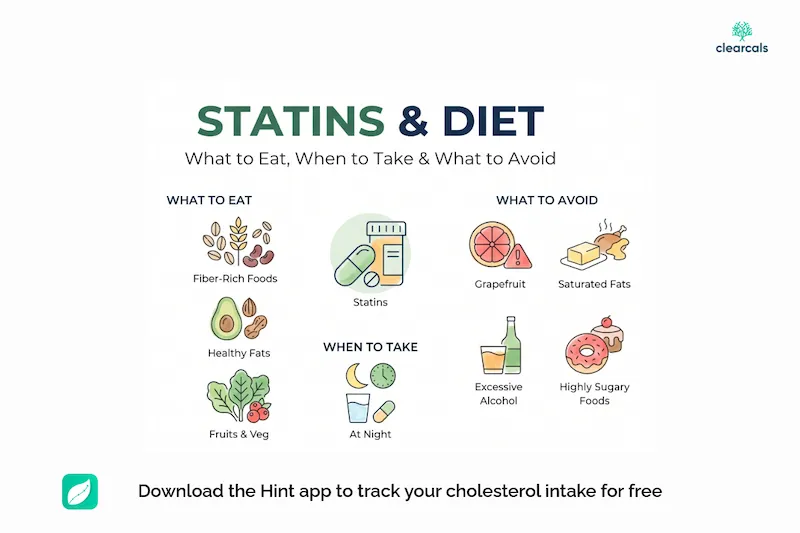
Atorvastatin and rosuvastatin are statins, medicines that lower "bad" LDL cholesterol and reduce the risk of heart attack and stroke. They work best together with a heart-healthy diet and regular activity, and food cannot replace them if your doctor has prescribed one. Always follow your own doctor's advice.
- When to take it: At the same time every day. For atorvastatin and rosuvastatin, the time of day matters less than taking it regularly, and many doctors still suggest the evening or bedtime.
- With or without food: Both can usually be taken with or without food. Follow your prescriber's instructions.
- Foods to limit: Fried food, ghee and butter in large amounts, bakery items and packaged snacks made with hydrogenated fat, and sugary drinks and sweets.
- Foods to add: Oats, dal, vegetables, fruit, nuts, fish and whole grains, which supply fibre and healthier fats.
- Alcohol: Heavy drinking is not advised on a statin. Ask your doctor what is safe for you.
- Grapefruit: Large amounts of grapefruit juice can raise atorvastatin levels. Everyday Indian fruits are fine.
- Never stop on your own. Cholesterol rises again within weeks of stopping.
What do statins do, and who takes them?
Statins block an enzyme your liver uses to make cholesterol. This lowers LDL cholesterol in the blood, which over time reduces plaque build-up in the arteries. Doctors prescribe them for high cholesterol, for people who have had a heart attack or stroke, and for people at higher risk because of diabetes, high blood pressure, age, or family history.
Atorvastatin and rosuvastatin are two of the most common statins in India. Most people take them long term, and the dose depends on your cholesterol levels, your overall heart risk, and other medicines you take, so never change it without your doctor.
When to take atorvastatin or rosuvastatin: morning or night?
Many people are told to take statins at night. This comes from older statins, such as simvastatin, which work better in the evening because the liver makes most cholesterol overnight. Atorvastatin and rosuvastatin stay in the body longer, so they work at any time of day.
What matters most:
- Take it at the same time every day, so you do not forget doses.
- Pick a time you can keep. If your doctor suggested the evening, keep to that. If you forget evening doses, a morning routine is better than missed tablets.
- With or without food: both are usually fine. Atorvastatin and rosuvastatin do not require an empty stomach.
- If you miss a dose, take it when you remember that day, but skip it if it is almost time for the next one. Never double up.
- Do not stop or change your dose without asking your doctor, even if your cholesterol report looks normal. Normal numbers usually mean the tablet is working.
Diet that lowers cholesterol
Food choices can improve your cholesterol numbers and heart health, and can reduce how much work your medicine has to do. The aim is not a perfect diet, but steady habits.
Eat more of:
- Soluble fibre: oats, barley (jau), dal, rajma, chole, beans, fruits such as apples, guava and oranges, and vegetables. Fibre helps lower LDL.
- Nuts and seeds: a small handful of almonds, walnuts, peanuts, flaxseed or chia seeds each day.
- Fish, especially oily fish like mackerel and sardines, a couple of times a week if you eat fish.
- Whole grains and millets such as whole wheat, jowar, bajra and ragi instead of refined flour.
- Vegetables and salads at every meal, filling half your plate.
- Healthy fats in small amounts: a measured amount of oil for cooking, using a mix of oils rather than one.
Eat less of:
- Saturated fat: large amounts of ghee, butter, cream, fatty red meat and full-fat sweets. Small amounts are fine, but do not use them freely.
- Trans fat: vanaspati, hydrogenated fats, and many bakery products, biscuits, namkeen and packaged snacks.
- Deep-fried food such as samosa, pakora, puri and chips, especially from reused oil.
- Sugar, sweets and sugary drinks, which can raise triglycerides and weight.
- Refined carbohydrates in large portions, such as white bread, maida and a lot of white rice.
For more detail on specific foods, see our guides on paneer and cholesterol, which oil to choose for cholesterol, ghee and cholesterol, and eggs and cholesterol.
Alcohol, grapefruit and other interactions
- Alcohol: Statins can sometimes raise liver enzymes, and heavy alcohol also stresses the liver. Heavy or binge drinking is not advised on a statin. If you drink, speak to your doctor about what is appropriate for you.
- Grapefruit: Very large amounts of grapefruit juice can raise atorvastatin levels and the risk of side effects. Rosuvastatin is much less affected. Ordinary fruit like bananas, oranges, apples and guava is fine.
- Milk and curd: There is no problem taking a statin with milk or curd.
- Supplements: Red yeast rice and other "natural statin" supplements contain statin-like compounds with uncertain dose and quality. Do not use them as a substitute for your prescribed tablet, and do not combine them with a statin.
- Other medicines: Some medicines, such as certain antibiotics and antifungals, interact with statins. Always tell any doctor or pharmacist that you take one.
A sample heart-healthy Indian day
This is an example, not a prescribed plan. Adjust it to your appetite, calorie needs and your doctor or dietitian's advice.
| Meal | Example |
|---|---|
| Early morning | Warm water, a handful of soaked almonds or walnuts |
| Breakfast | Vegetable oats upma or besan chilla with mint chutney, and a fruit |
| Mid-morning | A fruit such as guava or apple, or buttermilk |
| Lunch | One or two whole wheat or millet rotis, a bowl of dal, a large serving of sabzi, salad and curd |
| Evening snack | Roasted chana or sprouts chaat, and tea without too much sugar |
| Dinner | Smaller portion of rice or roti with a vegetable curry, and grilled fish, paneer or tofu |
Cook with a measured amount of oil, and prefer steaming, grilling, roasting or pressure cooking over deep frying.
Habits beyond the plate
- Move most days. Aim for around 150 minutes of brisk walking or similar activity each week, unless your doctor advises otherwise.
- Manage your weight. Even a modest loss in body weight can improve cholesterol, especially triglycerides.
- Do not smoke, as it adds to your heart risk and lowers HDL ("good") cholesterol.
- Get a lipid profile test as advised, usually a few weeks to months after starting or changing a dose, and then once a year when stable. Our LDL calculator and VLDL calculator can help you make sense of the numbers on your report.
- Look after blood sugar and blood pressure as well, since heart risk depends on all three.
Side effects and when to call your doctor
Most people tolerate statins well. Common effects are mild muscle aches, headache, or an upset stomach. Statins can also slightly raise blood sugar in some people, which your doctor will keep an eye on if you are at risk of diabetes.
Contact your doctor promptly if you have:
- Muscle pain, tenderness or weakness that is unexplained or severe, especially with dark urine, which can be a sign of a rare but serious muscle problem
- Yellowing of the skin or eyes, dark urine, or pale stools
- Severe stomach pain, or persistent nausea or vomiting
- Chest pain, breathlessness, or fainting. Seek urgent care
- A planned or confirmed pregnancy. Statins are usually avoided in pregnancy, so tell your doctor early
Track your meals with Hint
Heart-healthy eating is easier when you can see what is on your plate. Hint is built for Indian food, so you can log your meals and see the calories and protein in each. A week or two of logging shows where fried snacks, sweets, and large portions add up, and gives you something concrete to discuss with your doctor or dietitian. You can also try our free Indian food calorie calculator.
Frequently asked questions
Should I take atorvastatin in the morning or at night? Either works for atorvastatin and rosuvastatin. Take it at the same time every day, and follow your doctor's advice.
Can I take a statin with food? Yes, atorvastatin and rosuvastatin can usually be taken with or without food.
Can I drink alcohol on a statin? Heavy drinking is not advised. Ask your doctor what is appropriate for you.
Do I have to avoid grapefruit? Large amounts of grapefruit juice can raise atorvastatin levels, so avoid them with atorvastatin. Other common fruits are fine.
Can I stop my statin if my cholesterol is normal? No. Normal numbers usually mean the medicine is working, and your cholesterol can rise again within weeks of stopping. Only your doctor should decide to change or stop it.
Can diet alone replace a statin? Not if your doctor has prescribed one for your heart risk. Diet and exercise are an essential partner, and sometimes enough for people at lower risk, but that decision should be made with your doctor.
Can I eat eggs, paneer or ghee? In sensible portions, yes, for most people, as part of a balanced diet. Your doctor or dietitian can advise you based on your cholesterol levels and heart risk.
Medical disclaimer. This article is for general education and is not medical advice. Atorvastatin and rosuvastatin are prescription medicines. Do not start, stop, or change your dose based on this article. Speak to your doctor or a registered dietitian about your own situation.
Related reading and tools
Start here: our dyslipidemia diet guide and calorie tracking for Indian food if you are new to logging meals.
Related reading:
- Paneer and cholesterol
- Ghee and cholesterol
- Does eating eggs increase cholesterol?
- Which oil is good for cholesterol in India?
- High triglycerides
- How to reduce triglycerides
- How to increase HDL cholesterol with Indian food
- Almonds: calories and benefits
- Calories burned in 10,000 steps
Other medicine and diet guides:
Free tools:
- LDL calculator
- VLDL calculator
- Indian food calorie calculator
- Calories burned calculator
- Hint, the Indian food and calorie tracking app
About the author
Dr. Sumedha Verma is a Consultant Physician at Clearcals with extensive experience in clinical medicine and healthcare services.
She has significant expertise in managing chronic conditions such as diabetes, thyroid disorders, PCOS, infertility, and other gynecological health concerns.
Known for her patient-centered approach, Dr. Verma focuses on improving patient compliance and helping individuals achieve better health outcomes through personalized medical guidance and long-term care.
Connect with Dr. Sumedha on LinkedIn