
Track your nutrition and health goals

Curd (Dahi) Calories & Protein: Per 100g, Katori & Bowl | Clearcals

Written by Asfia Fatima, Chief Dietitian at Clearcals
TL;DR
- Curd (dahi) has 62 kcal and 3.5g protein per 100g — a katori (150g) has 93 kcal and 5.2g protein; a bowl (200g) has 124 kcal and 6.9g protein
- Hung curd is more calorie- and protein-dense than regular curd: approximately 97 kcal and 5.5g protein per 100g
- Curd is an excellent source of calcium (121mg per 100g), vitamin B12, and probiotics
- A glass of lassi (240mL) has 170 kcal; a glass of buttermilk has just 30 kcal
- Daily curd consumption is associated with improved digestion, lower blood pressure, better blood sugar regulation, and reduced risk of type 2 diabetes
- Track your curd intake across all recipes with the free Hint app
How Many Calories Are in Curd (Dahi)?
Curd (dahi) has 62 kcal per 100g. How many calories you actually consume depends entirely on how much curd you eat.
A katori of curd is typically 150g and has 93 kcal. A bowl is closer to 200g and has 124 kcal. If you are eating 250g of curd with a meal — a common serving size — that is 155 kcal, not 62.
Understanding your actual portion size makes a significant difference, especially when tracking for weight management or diabetes.
The table below combines calories and protein in a single view across all common serving sizes, because both nutrients are frequently searched together for curd.
Curd Calories and Protein by Serving Size
Curd (Dahi) Calories and Protein — All Common Serving Sizes
| Serving Size | Weight | Calories | Protein |
|---|---|---|---|
| Half katori | 50g | 31 kcal | 1.7g |
| 1 small cup / 1 katori | 100g | 62 kcal | 3.5g |
| 1 katori (standard) | 150g | 93 kcal | 5.2g |
| 1 medium bowl | 200g | 124 kcal | 6.9g |
| 1 large bowl | 250g | 155 kcal | 8.7g |
| 300g | 300g | 185 kcal | 10.4g |
| 500g (full container) | 500g | 310 kcal | 17.5g |
Note: A "katori" in Indian kitchens varies from 100g to 150g depending on the vessel size. The most common curd katori used in Indian households is approximately 150g. Use the Hint app's serving size adjuster to enter the exact weight of your portion.
For a complete picture of your daily protein and calcium intake across all meals, the Hint app tracks 31 nutrients calibrated to Indian foods and NIN-ICMR-recommended daily allowances.
Watch: How to Track Curd Calories on the Hint App
Curd Nutrition Facts
One 100g serving of plain whole-milk curd contains 62 kcal — made up of 30% carbohydrates, 23% protein, and 47% fat. Curd is an excellent source of calcium and vitamin B12, and a good source of probiotics, vitamin D, riboflavin, and phosphorus.
Curd (Dahi) Nutrition — Per 100g and Per 200g Bowl
| Nutrient | Per 100g | Per 200g (1 bowl) |
|---|---|---|
| Calories | 62 kcal | 124 kcal |
| Carbohydrates | 4.7g | 9.4g |
| Protein | 3.5g | 6.9g |
| Fat | 3.3g | 6.6g |
| Calcium | 121mg | 242mg |
| Vitamin B12 | 0.4mcg | 0.8mcg |
| Phosphorus | 95mg | 190mg |
| Potassium | 155mg | 310mg |
| Sodium | 46mg | 92mg |
A 200g column has been added to reflect a more realistic bowl serving. Use the Hint app to log your exact portion.

Hung Curd (Chakka) — Calories and Protein
Hung curd is made by draining the whey from regular curd, leaving a thicker, more concentrated product. Because water is removed, hung curd is higher in calories, protein, and fat per 100g compared to regular curd.
Hung Curd vs Regular Curd (per 100g)
| Regular Curd | Hung Curd | |
|---|---|---|
| Calories | 62 kcal | ~97 kcal |
| Protein | 3.5g | ~5.5g |
| Fat | 3.3g | ~6.8g |
| Carbohydrates | 4.7g | ~4.4g |
Hung curd is widely used in dips, sandwiches, and marinades. Its higher protein density makes it particularly useful for weight management and muscle gain — you get more protein per calorie than regular curd.
Hung curd macros (protein, fat, carbs) are available in the Hint app database.
Is Curd the Same as Yogurt?
Curd (dahi) and yogurt are both fermented dairy products, but differ in how they are made. Curd is prepared by adding a small amount of previously made curd to warm milk, fermenting it using naturally occurring Lactobacillus bacteria.
Yogurt is made using specific commercial bacterial strains — Lactobacillus bulgaricus and Streptococcus thermophilus. Both are rich in probiotics, but the strains and concentrations differ.
For nutritional tracking purposes, the calorie and protein values are nearly identical; the difference is primarily in probiotic variety.
Curd Benefits
Digestion: The probiotics in curd support a healthy gut microbiome, improving digestion and reducing digestive discomfort. Regular consumption is associated with improved gut motility and reduced bloating.
Immunity: Studies show that curd and yogurt consumption enhances immune response — the beneficial bacteria in fermented dairy help prime the immune system, increasing resistance to infection.
Weight Management: Research consistently associates regular yogurt and curd consumption with lower body mass index, reduced body fat, and smaller waist circumference. The protein content promotes satiety, and probiotics may support healthy metabolism.
Bone Health: With 121mg of calcium per 100g, curd is one of the most practical everyday calcium sources in the Indian diet. Combined with its vitamin D content, curd supports bone density and reduces the risk of osteoporosis.
Blood Pressure: Curd is rich in calcium, potassium, and magnesium — all of which contribute to healthy blood pressure. Studies show curd consumption as part of a DASH-style diet is associated with reduced hypertension risk.
Blood Sugar and Diabetes: A meta-analysis found a 14% lower risk of type 2 diabetes in people who consumed curd or yogurt daily compared to non-consumers.
Curd's low glycaemic index, good protein content, and probiotic activity all contribute to better glucose regulation. 👉 Read our diabetes diet guide →
Thyroid Health: Probiotic-rich foods like curd support gut microbiome health, which plays a role in regulating thyroid hormones.
Research suggests curd may help reduce serum hormone fluctuations in thyroid conditions. 👉 Read our thyroid diet guide →
Muscle Gain: Curd provides all essential amino acids and is highly bioavailable, making it an effective post-workout protein source.
Consuming curd or hung curd after exercise supports muscle repair and growth. 👉 Read our muscle gain diet guide →
Side Effects of Curd
Curd is well tolerated by most people, but a few considerations apply. Those with lactose intolerance may experience digestive discomfort — the fermentation process reduces lactose content compared to fresh milk, but it is not eliminated entirely.
In some individuals, cold curd may increase mucus production. Full-fat curd contributes meaningful fat intake — those managing weight or cardiovascular conditions may prefer low-fat or toned-milk curd.
Curd Recipe Calories
Curd is one of the most versatile dairy ingredients in Indian cooking. Here is a full calorie guide across every major curd-based recipe category.
Curd Rice

One medium cup (200g) of curd rice has 172 kcal — 77% carbohydrates, 11% protein, and 12% fat. It is a good source of probiotics, manganese, and an excellent source of vitamin D, beta-carotene, and lutein.
Curd brown rice is a more nutritious alternative: one medium cup (200g) has 196 kcal and is a good source of fibre, protein, phosphorus, magnesium, and vitamin B6.
| Curd Rice Serving | Calories |
|---|---|
| 1 small cup (100g) | 86 kcal |
| 1 medium cup (200g) | 172 kcal |
| 1 large cup (300g) | 258 kcal |
Curd Upma

One medium cup (200g) of curd upma has 175 kcal — 57% carbohydrates, 14% protein, and 29% fat. It is an excellent source of dietary fibre, manganese, vitamin D, and beta-carotene.
Raita

Mixed vegetable raita (100g) has 46 kcal — a low-calorie accompaniment that adds probiotics, vitamin C, and beta-carotene to any meal.
Raita Calorie Guide (per 100g)
| Raita Variety | Calories |
|---|---|
| Bottle gourd tomato raita | 27 kcal |
| Bottle gourd mint raita | 31 kcal |
| Bottle gourd raita | 36 kcal |
| Pumpkin raita | 40 kcal |
| Cucumber raita | 40 kcal |
| Ash gourd raita | 42 kcal |
| Tomato raita | 44 kcal |
| Mixed vegetable raita | 46 kcal |
| Mango raita | 46 kcal |
| Carrot raita | 49 kcal |
| Pineapple raita | 53 kcal |
| Onion raita | 55 kcal |
| Fresh fruit raita | 58 kcal |
| Yam raita | 67 kcal |
| Dates and palak raita | 78 kcal |
| Banana raita | 85 kcal |
| Cucumber and sesame seeds raita | 87 kcal |
| Flax seeds raita | 96 kcal |
| Boondi raita | 167 kcal |
Hung Curd Sandwich

One slice (45g) of hung curd sandwich has 39 kcal — 59% carbohydrates, 19% protein, and 22% fat. An excellent source of beta-carotene.
Lassi

One glass (240mL) of plain lassi has 170 kcal — 54% carbohydrates, 15% protein, and 31% fat. An excellent source of calcium, manganese, vitamin B12, and vitamin D, and a good source of riboflavin, phosphorus, and selenium. Supports immunity and digestion.
Lassi Calorie Guide (per 240 mL glass)
| Lassi Variety | Calories |
|---|---|
| Salted lassi | 121 kcal |
| Sabudana lassi | 144 kcal |
| Saffron lassi | 148 kcal |
| Cucumber mint lassi | 150 kcal |
| Mint lassi | 153 kcal |
| Strawberry lassi | 154 kcal |
| Honey lassi | 158 kcal |
| Watermelon lassi | 166 kcal |
| Mango lassi | 169 kcal |
| Lassi (plain) | 170 kcal |
| Chia seeds and pear lassi | 172 kcal |
| Green apple lassi | 174 kcal |
| Blackcurrant lassi | 175 kcal |
| Beetroot lassi | 179 kcal |
| Jeera lassi | 183 kcal |
| Mango mawa lassi | 187 kcal |
| Kiwi lassi | 188 kcal |
| Orange lassi | 189 kcal |
| Pineapple lassi | 190 kcal |
| Elaichi lassi | 201 kcal |
| Muskmelon lassi | 202 kcal |
| Apple lassi | 202 kcal |
| Black grapes lassi | 237 kcal |
| Chia seeds lassi | 238 kcal |
| Kaju orange lassi | 244 kcal |
| Banana lassi | 245 kcal |
| Herb lassi | 259 kcal |
| Coconut lassi | 275 kcal |
| Pista lassi | 321 kcal |
Buttermilk (Chaas)

One glass (240mL) of buttermilk has just 30 kcal — making it one of the lowest-calorie drinks in the Indian diet. It is a good source of probiotics and supports digestion and weight management.
Buttermilk Calorie Guide (per 240mL glass)
| Buttermilk Variety | Calories |
|---|---|
| Minty buttermilk | 22 kcal |
| Plain buttermilk | 30 kcal |
| Jeera buttermilk | 34 kcal |
| Masala buttermilk | 37 kcal |
| Beetroot buttermilk | 44 kcal |
| Chilli buttermilk | 93 kcal |
| Buttermilk with flaxseeds | 102 kcal |
| Buttermilk with chia seeds | 102 kcal |
| Almond buttermilk | 109 kcal |
Smoothies with Curd

Curd adds protein and probiotics to smoothies. Calorie content varies widely by fruit and added ingredients.
Curd Smoothie Calorie Guide (per 240mL glass)
| Smoothie Variety | Calories |
|---|---|
| Spinach apple smoothie | 90 kcal |
| Watermelon smoothie | 104 kcal |
| Strawberry smoothie | 108 kcal |
| Muskmelon smoothie | 113 kcal |
| Pineapple papaya smoothie | 121 kcal |
| Beetroot smoothie | 124 kcal |
| Pineapple smoothie | 135 kcal |
| Mango smoothie | 147 kcal |
| Mango banana smoothie | 197 kcal |
| Banana smoothie | 220 kcal |
| Banana oats smoothie | 231 kcal |
| Avocado smoothie | 276 kcal |
Kadhi
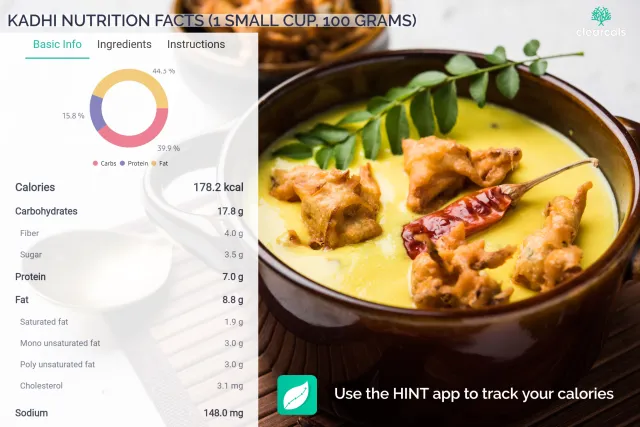
One small cup (100g) of besan kadhi has 178 kcal — 40% carbohydrates, 16% protein, and 44% fat. An excellent source of folate and vitamin E, and a good source of protein, phosphorus, magnesium, copper, and thiamine.
Dahi Vada

One small cup (100g) of dahi vada has 224 kcal — 23% carbohydrates, 11% protein, and 65% fat. An excellent source of selenium and vitamin E. Consume in moderation due to high saturated fat content.
Frequently Asked Questions
How many calories are in 1 bowl of curd? A medium bowl of curd (200g) has 124 kcal and 6.9g protein. A smaller bowl (150g, the size of a standard katori) has 93 kcal and 5.2g protein.
How many calories are in 1 katori of dahi? A standard katori of dahi is approximately 150g and has 93 kcal and 5.2g protein. A smaller katori (100g) has 62 kcal and 3.5g protein.
How much protein is in 100g of curd (dahi)? 100g of plain whole-milk curd has 3.5g of protein. Indian curd typically falls between 3.0–3.8g protein per 100g, depending on the milk fat content used.
How much protein is in 250g of curd? 250g of curd provides approximately 8.7g of protein and 155 kcal.
How much protein is in 300g of curd? 300g of curd provides approximately 10.4g of protein and 185 kcal.
What is hung curd, and how many calories does it have? Hung curd (chakka) is regular curd with the whey drained out, producing a thicker, more protein-dense product. Per 100g, hung curd has approximately 97 kcal and 5.5g protein — significantly more than regular curd (62 kcal, 3.5g protein per 100g).
It is widely used in dips, sandwiches, and as a marinade for grilled foods.
Is curd good for weight loss? Yes. Studies show that regular curd and yogurt consumption promotes body weight stability, reduces body fat, and is associated with lower BMI and smaller waist circumference.
Curd's protein content supports satiety, and its probiotics support healthy metabolism. For weight management, plain low-fat curd without added sugar is the best choice.
👉 Read our weight loss diet guide for Indians →
Is curd good for diabetes? Yes. A meta-analysis found a 14% lower risk of type 2 diabetes in people who consumed curd or yogurt daily. Curd has a low glycaemic index, is high in protein relative to carbohydrates, and its probiotics support insulin sensitivity.
Unsweetened, plain curd is preferable over flavoured or sweetened varieties.
👉 Read our diabetes diet guide →
Is curd good for PCOS? Curd can be part of a healthy PCOS diet in moderation. Its protein and probiotic content support hormone regulation and gut health.
However, excessive dairy consumption may influence insulin levels in some individuals with PCOS — monitoring your total dairy intake is advisable.
👉 Read our PCOS diet guide → | Read our insulin resistance diet guide →
Is curd good for the thyroid? Yes. Curd's probiotic content supports the gut-thyroid axis — research suggests that gut microbiome health plays a role in regulating thyroid hormone levels.
Selenium from curd also contributes to thyroid hormone synthesis. 👉 Read our thyroid diet guide →
Is curd good for blood pressure? Yes. Curd is rich in calcium, potassium, and magnesium — nutrients that contribute to healthy blood pressure. Studies show curd consumption as part of a DASH-pattern diet is associated with reduced risk of hypertension.
Is curd good for immunity? Yes. The beneficial bacteria in curd help prime the immune system and increase resistance to infection. Regular fermented dairy consumption is consistently associated with enhanced immune response in clinical studies.
Is curd good for muscle gain? Yes. Curd provides all essential amino acids in a highly bioavailable form.
Consumed post-workout, it supports muscle protein synthesis and recovery. Hung curd is particularly useful for muscle gain due to its higher protein density. 👉 Read our muscle gain diet guide →
Is curd good for acidity? Yes. Curd's cooling properties can help neutralise stomach acidity and soothe the digestive tract. Its probiotic content supports overall digestive health and may reduce the frequency of acid reflux.
Consume curd at room temperature rather than cold if you are prone to acidity.
Is curd good for fat loss? Yes. Curd is low in calories, high in protein, and its probiotics support healthy digestion and metabolism — all of which contribute to effective fat loss.
Phulka curd (plain curd with chapati) and curd raita are both calorie-controlled, high-protein meal additions that support fat loss without reducing meal satisfaction.
Final Thoughts
Curd is one of the most nutritionally complete everyday foods in the Indian diet — providing calcium, protein, B12, probiotics, and vitamin D in a single, affordable, and versatile package.
Whether you consume it as plain dahi, raita, lassi, or buttermilk, the Hint app tracks every recipe variation and gives you an accurate calorie and protein count for your actual serving size.
Download the free Hint app on the App Store or Google Play Store to start tracking.
Upgrade to Hint Pro for personalised Indian diet plans, weekly insights, and 300+ workout plans — or Hint Premium for unlimited dietitian consultations on top of everything in Hint Pro.
🎁 Free Hint with Every Watch Purchase
Garmin watches: Purchase any Garmin watch from the Clearcals Store and receive 1 month of Hint Premium (worth ₹1,999) free — including unlimited dietitian consultations, personalised diet and workout plans, and advanced nutrition tracking.
Apple Watch: Purchase any Apple Watch from the Clearcals Store and receive a free Hint Pro subscription — including personalised Indian diet plans, 300+ workouts, weekly insights, and more.
Read Next
- Indian Food Calorie Calculator — Free Online Tool
- Calories in Roti — Nutrition Facts & Health Benefits
- Calories in Rice — Nutrition Facts & Health Benefits
- Banana Calories — Nutrition Facts & Health Benefits
- Weight Loss Diet Plan for Indians
- Diabetes Diet Plan India
- PCOS Diet Plan India
- Thyroid Diet Plan India
- Calorie Tracking in India — Beginner's Guide
References
- Tremblay A, Doyon C, Sanchez M. Impact of yogurt on appetite control, energy balance, and body composition. Nutrition Reviews, 2015;73(S1):23–27.
- Eales J et al. Is consuming yogurt associated with weight management outcomes? Int J Obes, 2016;40(5):731–746.
- Salas-Salvadó J et al. Yogurt and Diabetes: Overview of Recent Observational Studies. J Nutr, 2017;147(7):1452S–1461S.
- Buendia JR et al. Long-term yogurt consumption and risk of incident hypertension in adults. J Hypertens, 2018;36(8):1671–1679.
- Knezevic J et al. Thyroid-Gut-Axis: How Does the Microbiota Influence Thyroid Function? Nutrients, 2020;12(6):1769.
- Meydani SN, Ha WK. Immunologic effects of yogurt. Am J Clin Nutr, 2000;71(4):861–872.
About the Author
Asfia Fatima is the Chief Dietitian at Clearcals, with a Master’s Degree in Dietetics and Clinical Nutrition and over a decade of experience in clinical nutrition and lifestyle management.
She specializes in evidence-based diet planning for weight loss, diabetes, and metabolic health.
At Clearcals, she leads the nutrition strategy behind the Hint app, helping users achieve their goals with science-backed guidance.
🔗 Connect with Asfia on LinkedIn


