Track your nutrition and health goals

Jowar Roti Calories, Protein & Nutrition: Per Roti, 100g | Bhakri, Jolada Rotti
By Asfia Fatima, Chief Dietitian at Clearcals
TL;DR
- 1 medium jowar roti (40g) has 111 kcal, 2.5g protein, 22g carbs, and 1.4g fiber
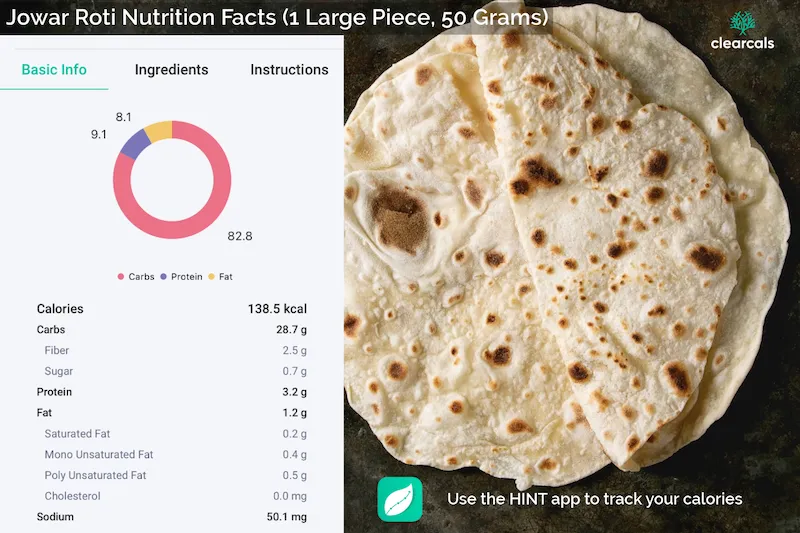
- 1 small jowar roti (30g): 83 kcal | 1 large jowar roti (50g): 138 kcal
- Per 100g: 277 kcal, 6.4g protein, 55g carbs, 3.5g fiber
- Jowar roti has a glycemic index of ~55 — significantly lower than wheat roti (~70)
- Jowar roti is naturally gluten-free, making it one of the few high-fiber Indian staple rotis safe for celiac disease
- Regional names: Bhakri (Maharashtra), Jolada Rotti (Karnataka), Jonna Rotte (Andhra/Telangana), Juvar ni Roti (Gujarat)
Jowar Roti Calories
1 jowar roti calories: 83 kcal (small, 30g) | 111 kcal (medium, 40g) | 138 kcal (large, 50g) 1 jowar roti protein: 1.9g (small) | 2.5g (medium) | 3.2g (large)
Jowar, also known as sorghum, is an ancient grain that has made a strong comeback as a modern superfood. In India, jowar roti is a staple in many regions, especially in the western and southern states.
The calorie content of one medium jowar roti (40g) is 111 kcal. One large jowar roti (50g) has 138 kcal. One small jowar roti (30g) has 83 kcal.
| Jowar Roti Size | 1 Roti | 2 Rotis | 3 Rotis | 4 Rotis | 5 Rotis |
|---|---|---|---|---|---|
| Small (30g) | 83 kcal | 166 kcal | 249 kcal | 332 kcal | 415 kcal |
| Medium (40g) | 111 kcal | 222 kcal | 332 kcal | 443 kcal | 554 kcal |
| Large (50g) | 138 kcal | 277 kcal | 415 kcal | 554 kcal | 692 kcal |
Use the Hint app to accurately log jowar roti calories and see how they fit into your daily calorie budget.
1 Jowar Roti Calories and Protein
1 jowar roti calories and protein: 111 kcal + 2.5g protein (medium, 40g) | 83 kcal + 1.9g protein (small, 30g) | 138 kcal + 3.2g protein (large, 50g)
One medium jowar roti provides 111 kcal and 2.5g protein. For those tracking both calories and protein together, pairing 2 jowar rotis with a dal or sabzi brings the protein contribution of the meal to 15–20g total.
50g Jowar Roti Calories
50g jowar roti calories: 138 kcal | Protein: 3.2g | Carbs: 27.5g | Fiber: 1.75g | Fat: 1.5g
A 50g (large) jowar roti has 138 kcal. This is the size most commonly made at home for adults — thicker and larger than a standard restaurant serving. At 138 kcal with 3.2g protein and 1.75g fiber, it is one of the most calorie-efficient, nutrient-dense Indian roti options available.
2 Jowar Roti Calories
2 jowar roti calories: 166 kcal (small) | 222 kcal (medium) | 277 kcal (large) | Protein: 3.8–6.4g
Two medium jowar rotis (40g each) provide 222 kcal and 5g of protein. This is a standard light meal or dinner serving for most adults — comfortable, filling due to the resistant starch content, and well within a calorie-controlled daily budget.
3 Jowar Roti Calories
3 jowar roti calories: 249 kcal (small) | 332 kcal (medium) | 415 kcal (large)
Three medium jowar rotis have 332 kcal and 7.5g protein. With a dal or sabzi, a 3-roti meal can reach 450–500 kcal while providing 15–20g of total protein — a nutritionally complete dinner for most adults.
4 Jowar Roti Calories and Protein
4 jowar roti calories: 332 kcal (small) | 443 kcal (medium) | 4 roti calories and protein: 443 kcal + 10g protein (medium)
Four medium jowar rotis provide 443 kcal and approximately 10g of protein. For active individuals, athletes, or those in a muscle-building phase, 4 jowar rotis with a protein-rich sabzi (paneer, chicken, or dal) can form a complete, high-satiety lunch or dinner.
Jowar Roti Protein
Protein in jowar roti: 1.9g (small, 30g) | 2.5g (medium, 40g) | 3.2g (large, 50g) | Per 100g: 6.4g
Each jowar roti provides approximately 2.5–3g of protein per medium piece (40g). While not a complete protein on its own, jowar contains all essential amino acids when paired with legumes like dal or sabzi made from lentils.
| Jowar Roti Size | 1 Roti | 2 Rotis | 3 Rotis | 4 Rotis | 5 Rotis |
|---|---|---|---|---|---|
| Small (30g) | 1.9g | 3.8g | 5.7g | 7.6g | 9.5g |
| Medium (40g) | 2.5g | 5.0g | 7.5g | 10.0g | 12.5g |
| Large (50g) | 3.2g | 6.4g | 9.5g | 12.6g | 15.8g |
Track your daily protein intake with Hint Pro and ensure you meet your fitness and muscle gain goals.
Jowar Roti Calories and Protein per 100g
Jowar roti per 100g: 277 kcal | Protein: 6.4g | Carbs: 55g | Fiber: 3.5g | Fat: ~3g
| Nutrient | Per 100g | % Indian RDA |
|---|---|---|
| Calories | 277 kcal | 14% |
| Protein | 6.4g | 12% |
| Carbohydrates | 55g | 18% |
| Fat | ~3g | 5% |
| Dietary Fiber | 3.5g | 14% |
Per 100g, jowar roti provides 277 kcal and 6.4g of protein — slightly fewer calories than wheat roti (~300 kcal/100g) and with a significantly lower glycemic index (~55 vs ~70).
Jowar Protein per 100g
Jowar protein per 100g (cooked roti): 6.4g | Jowar atta (raw flour) protein per 100g: ~10.4g
Per 100g of cooked jowar roti, protein content is 6.4g. This is slightly lower than wheat roti (~8.5g/100g) but jowar's protein is better tolerated by individuals with gluten sensitivity or celiac disease, as jowar is entirely gluten-free.
Jowar contains all essential amino acids, though it is lower in lysine compared to animal proteins. Pairing jowar roti with dal or a legume-based sabzi provides a complete amino acid profile at the meal level.
Jowar Carbs per 100g
Jowar carbs per 100g: 55g total carbs | Fiber: 3.5g | Net carbs: ~51.5g | GI: ~55 (medium)
Per 100g of jowar roti, carbohydrate content is 55g, of which 3.5g is dietary fiber. Net carbohydrates (total carbs minus fiber) are approximately 51.5g per 100g.
Despite the high carbohydrate content, jowar's glycemic index of ~55 means blood sugar rises more slowly after a jowar roti meal compared to wheat roti (~70 GI) or white rice (~72 GI). This makes jowar roti a better carbohydrate choice for those managing diabetes or insulin resistance.
Jowar Atta Calories
Jowar atta (raw flour) per 100g: ~339 kcal | Protein: 10.4g | Carbs: 72g | Fiber: 6.7g | Fat: 1.9g
Raw jowar flour (atta) has significantly more calories and protein per 100g than cooked jowar roti, because cooking adds water and increases weight. When jowar atta is made into roti, the cooked weight is approximately 10–15% higher than the raw flour weight used.
| Jowar Atta | Per 100g (raw) |
|---|---|
| Calories | ~339 kcal |
| Protein | ~10.4g |
| Carbohydrates | ~72g |
| Dietary Fiber | ~6.7g |
| Fat | ~1.9g |
A medium jowar roti (40g cooked) uses approximately 35–38g of raw jowar atta — contributing roughly 119–129 kcal from the flour before cooking.
Jowar Roti Carbs
One medium jowar roti (40g) contains approximately 22g of carbohydrates. These are primarily complex carbohydrates that digest more slowly than refined grain carbohydrates.
| Jowar Roti Size | Carbs (g) | Fiber (g) | Net Carbs (g) |
|---|---|---|---|
| Small (30g) | 16.5g | 1.1g | 15.4g |
| Medium (40g) | 22g | 1.4g | 20.6g |
| Large (50g) | 27.5g | 1.75g | 25.75g |
Jowar is a complex carbohydrate with a naturally lower glycemic response than refined wheat flour. Due to its resistant starch and polyphenol content, it promotes slower glucose absorption and better post-meal blood sugar control.
Jowar Roti Fiber
One medium jowar roti (40g) provides approximately 1.4g of dietary fiber, and the large 50g roti contains ~1.75g. Per 100g, jowar roti has 3.5g of fiber.
Jowar is particularly high in insoluble fiber, which:
- Supports gut motility and prevents constipation
- Feeds beneficial gut bacteria
- Reduces cholesterol absorption in the gut
- Promotes satiety and reduces total calorie intake Compared to wheat roti (~4g fiber per 50g), jowar roti has slightly less fiber per piece, but its fiber type — predominantly insoluble — offers distinct gut health benefits.
Jowar Roti Glycemic Index
The glycemic index (GI) of jowar roti is approximately ~55, placing it at the lower end of the medium-GI range.
| Food | Glycemic Index |
|---|---|
| Jowar Roti / Bhakri | ~55 |
| Wheat Roti (chapati) | ~70 |
| White rice | ~72 |
| Brown rice | ~55 |
| Bajra roti | ~55 |
| Maida (white flour) roti | ~75–80 |
Why does jowar have a lower GI? Jowar contains resistant starch and polyphenols that slow carbohydrate digestion. The bran layer in jowar flour also creates a physical barrier that slows amylase action on starch molecules.
GI vs. Glycemic Load: For a medium jowar roti (40g, ~22g carbs), the glycemic load is approximately 12 — in the low-to-medium range. This makes jowar roti a practical daily carbohydrate choice for people managing blood sugar.
Get a personalized meal plan that uses jowar roti's GI advantage through Hint Premium.
Jowar Roti Nutrition Facts (Full Breakdown per Piece)
| Nutrient | Small (30g) | Medium (40g) | Large (50g) |
|---|---|---|---|
| Calories (kcal) | 83 | 111 | 138 |
| Protein (g) | 1.9 | 2.5 | 3.2 |
| Carbohydrates (g) | 16.5 | 22 | 27.5 |
| Dietary Fiber (g) | 1.1 | 1.4 | 1.75 |
| Fat (g) | 0.9 | 1.2 | 1.5 |
Jowar Roti with Ghee Calories
Adding ghee to jowar roti increases the calorie count. One teaspoon of ghee (5g) adds approximately 45 kcal.
| Serving | Calories without Ghee | + 1 tsp Ghee | + 2 tsp Ghee |
|---|---|---|---|
| 1 medium roti (40g) | 111 kcal | 156 kcal | 201 kcal |
| 2 medium rotis | 222 kcal | 312 kcal | 402 kcal |
| 1 large roti (50g) | 138 kcal | 183 kcal | 228 kcal |
While ghee adds calories, small amounts (1 tsp per roti) improve fat-soluble vitamin absorption and add beneficial short-chain fatty acids. For weight loss, limit ghee to 1 tsp per roti or omit it altogether.
Jowar Roti vs Wheat Roti — Calories Compared
Jowar roti vs wheat roti (50g each): Jowar = 138 kcal, GI ~55, gluten-free | Wheat roti = 140 kcal, GI ~70, contains gluten | Near-identical calories, significant GI advantage for jowar
| Feature / Nutrient | Jowar Roti (50g) | Wheat Roti (50g) |
|---|---|---|
| Gluten-free | Yes | No |
| Calories | 138 kcal | ~140 kcal |
| Protein | 3.2g | 3.7g |
| Carbohydrates | 27.5g | 29g |
| Dietary Fiber | 1.75g | ~2.5g |
| Glycemic Index | ~55 | ~70 |
| Satiety | Higher (resistant starch) | Moderate |
| Best for | Diabetes, gluten intolerance | General use |
The key takeaway: jowar roti and wheat roti have virtually identical calories per piece, but jowar roti has a significantly lower glycemic index and is the only naturally gluten-free option among common Indian rotis. If blood sugar control is a priority, jowar roti is the better choice.
Jowar Roti Benefits
1. Naturally gluten-free: Ideal for those with gluten intolerance or celiac disease. Jowar is one of the few Indian staple grains that is completely free of gluten.
2. Supports blood sugar control: With a GI of ~55 and resistant starch content, jowar roti raises blood sugar more slowly than wheat roti or white rice. Studies suggest sorghum consumption is associated with improved insulin sensitivity.
3. Promotes satiety and weight management: The combination of fiber (3.5g/100g) and resistant starch in jowar keeps you fuller for longer, reducing total calorie intake across the day.
4. Supports heart health: Jowar contains polyphenols and soluble fiber that help lower LDL (bad cholesterol). Regular consumption is linked to improved cardiovascular risk markers.
5. Good for digestion: High in insoluble fiber, jowar supports regular bowel movements and gut microbiome health.
6. Rich in micronutrients: Jowar roti is a good source of iron, magnesium, phosphorus, and B vitamins, supporting energy metabolism and red blood cell production.
Frequently Asked Questions
Is Jowar Roti Good for Weight Loss? Yes. Jowar roti is rich in dietary fiber and resistant starch, which promotes satiety and reduces hunger between meals. Its low GI (~55) prevents blood sugar spikes, thereby reducing fat-storage signals. Studies suggest that regular sorghum consumption supports healthy weight management. Use the Hint app to track calories, fiber, and weight trends in real time.
Is Jowar Roti Good for Diabetes? Absolutely. Jowar has a glycemic index of ~55 — significantly lower than wheat (~70) — meaning it digests more slowly and causes a gentler blood sugar rise. For a diabetic meal, pair 1–2 jowar rotis with a protein-rich sabzi or dal. The combination of protein, fiber, and resistant starch from jowar further slows glucose absorption.
Is Jowar Roti Good for Weight Gain? Yes, if consumed in larger portions and paired with calorie-dense sides like ghee, paneer, or dal makhani. 4–5 large jowar rotis with ghee and protein-rich sides can contribute 700–900 kcal per meal, supporting a calorie surplus.
Does Jowar Roti Increase Weight? Not by itself. Weight gain depends on overall calorie intake. Jowar roti supports balanced weight when eaten in reasonable portions (2–3 rotis per meal). Excess consumption of any roti — including jowar — combined with calorie-dense sides will contribute to a calorie surplus.
Is Jowar Roti Good for Fatty Liver? Yes. Its fiber and antioxidant content help regulate blood sugar and reduce liver fat, making it suitable for individuals managing non-alcoholic fatty liver disease (NAFLD). Replacing refined carbohydrates (maida, white rice) with jowar roti is a positive dietary shift for liver health.
Is Jowar Roti Good for Kidney Patients? Jowar is relatively low in potassium and phosphorus compared to many other grains, making it safe for most kidney patients in moderate portions. However, kidney patients should always confirm any dietary changes with their nephrologist or dietitian. Hint Premium gives you access to dietitian consultations tailored to kidney health.
Is Jowar Roti Good for Cholesterol? Yes. The high fiber in jowar helps lower LDL (bad cholesterol) by binding bile acids in the gut and reducing cholesterol reabsorption. Polyphenols in jowar also have antioxidant effects that support cardiovascular health.
जोवार की रोटी में कितनी कैलोरी होती है? (How many calories in jowar roti?) एक मध्यम जोवार की रोटी (40g) में 111 kcal और 2.5g protein होती है। एक छोटी रोटी (30g) में 83 kcal, और एक बड़ी रोटी (50g) में 138 kcal होती है।
जोवार की रोटी में कितना प्रोटीन होता है? (How much protein in jowar roti?) एक मध्यम जोवार की रोटी (40g) में 2.5g protein होती है। प्रति 100g, जोवार रोटी में 6.4g protein होती है। प्रोटीन intake बढ़ाने के लिए, जोवार रोटी के साथ dal या paneer sabzi खाएं।
Regional Names for Jowar Roti
Jowar roti is known by different names across India and refers to the same or very similar preparations from sorghum flour.
Jolada Rotti (Karnataka)
Jolada rotti calories: 88 kcal (small, 30g) | 117 kcal (medium, 40g) | 146 kcal (large, 50g) — same as jowar bhakri nutrition
The Kannada name for jowar roti. Jolada rotti is a staple in North Karnataka cuisine and is slightly thicker than a standard jowar roti, closer to bhakri in texture. Nutritional values per 100g are identical to jowar roti: 277–293 kcal, 6.4g protein, 55g carbs, 3.5g fiber.
Jonna Rotte (Andhra Pradesh & Telangana)
Jonna rotte calories: 83 kcal (small, 30g) | 111 kcal (medium, 40g) | 138 kcal (large, 50g) | Protein: 1.9–3.2g per roti — identical to jowar roti
The Telugu name for jowar roti. Jonna rotte nutrition is identical to jowar roti — one medium jonna rotte (40g) has 111 kcal and 2.5g protein. It is typically served with spicy chutneys, dal, or chicken curries in Andhra and Telangana.
Jonna rotte protein: One medium jonna rotte has 2.5g protein. Per 100g: 6.4g protein, same as jowar roti.
Jwari chi Bhakri / Jowar Bhakri (Maharashtra)
Bhakri is the Marathi name for a thick, rustic jowar roti. Jowar bhakri is slightly denser than a standard jowar roti and has marginally more calories per 100g (~292 kcal vs ~277 kcal). See the dedicated Jowar Bhakri Calories section below for the full table.
Jau ki Roti — Is It Jowar or Barley?
Jau roti (barley roti) per 100g: ~310 kcal | Protein: ~12g | Fiber: ~10g — nutritionally different from jowar roti
"Jau" in standard Hindi refers to barley, not jowar. However, in some regional dialects — particularly in Maharashtra and parts of Rajasthan — "jau roti" or "jau ki roti" is used loosely to mean jowar roti.
If jau roti means jowar roti (regional usage): 83–138 kcal per roti (same as jowar roti table above).
If jau roti means barley roti (standard Hindi): one medium barley roti (40g) has approximately 120–130 kcal, with significantly more fiber (~6–7g per roti) and protein (~5g per roti). Barley roti has a notably lower glycemic index (~25–30) than jowar roti (~55), making it one of the most blood-sugar-friendly roti options available.
| Feature | Jowar Roti (40g) | Barley (Jau) Roti (40g) |
|---|---|---|
| Calories | 111 kcal | ~125 kcal |
| Protein | 2.5g | ~5g |
| Fiber | 1.4g | ~6.9g |
| GI | ~55 | ~25–30 |
Juvar ni Roti (Gujarat)
The Gujarati name for jowar roti. Nutritional values are the same as standard jowar roti: 83 kcal (small), 111 kcal (medium), 138 kcal (large).
Jowar Bhakri Calories
1 jowar bhakri calories: 88 kcal (small, 30g) | 117 kcal (medium, 40g) | 146 kcal (large, 50g) 1 jowar bhakri calories and protein: 117 kcal + 2.5g protein (medium) | per 100g: 292 kcal, 6.4g protein
Jowar bhakri is a thick, rustic roti made from coarse jowar flour, popular in Maharashtra. One large bhakri (50g) has 146 kcal.
| Bhakri Size | 1 Bhakri | 2 Bhakris | 3 Bhakris |
|---|---|---|---|
| Small (30g) | 88 kcal | 175 kcal | 263 kcal |
| Medium (40g) | 117 kcal | 234 kcal | 351 kcal |
| Large (50g) | 146 kcal | 292 kcal | 438 kcal |
Jowar Bhakri Protein:
| Bhakri Size | Protein |
|---|---|
| Small (30g) | ~1.9g |
| Medium (40g) | ~2.5g |
| Large (50g) | ~3.2g |
Jowar Bhakri per 100g: approximately 292 kcal, 6.4g protein.
1 Bhakri Calories and Protein: One medium bhakri (40g) = 117 kcal + 2.5g protein. One large bhakri (50g) = 146 kcal + 3.2g protein.
Top Jowar Recipes
1. Jowar Bhakri
Rustic and thick rotis popular in Maharashtra. One large piece (50g) of jowar bhakri contains 146 kcal.
| Jowar Bhakri Size | 1 Bhakri | 2 Bhakris | 3 Bhakris |
|---|---|---|---|
| Small (30g) | 88 kcal | 175 kcal | 263 kcal |
| Medium (40g) | 117 kcal | 234 kcal | 351 kcal |
| Large (50g) | 146 kcal | 292 kcal | 438 kcal |
2. Jowar Chilla
Savory pancakes made with jowar flour and veggies. One large piece (50g) of jowar chilla contains 110 kcal.
| Jowar Chilla Size | 1 Chilla | 2 Chillas | 3 Chillas |
|---|---|---|---|
| Small (30g) | 66 kcal | 132 kcal | 198 kcal |
| Medium (40g) | 88 kcal | 176 kcal | 264 kcal |
| Large (50g) | 110 kcal | 220 kcal | 330 kcal |
3. Jowar Upma
A wholesome breakfast alternative to semolina upma. One medium cup (200g) of jowar upma contains 268 kcal.
| Jowar Upma Quantity | Calories |
|---|---|
| Small Cup (100g) | 134 kcal |
| Medium Cup (200g) | 268 kcal |
| Large Cup (300g) | 402 kcal |
4. Jowar Popcorn
Light and crunchy roasted jowar puffs. 50g of jowar popcorn contains 198 kcal — 59% of these calories come from carbohydrates.
| Jowar Popcorn Quantity | Calories |
|---|---|
| 25g | 99 kcal |
| 50g | 198 kcal |
| Small Cup (100g) | 395 kcal |
5. Jowar Bajra Roti
A multi-millet roti combining sorghum and pearl millet. One large piece (50g) of jowar bajra roti contains 132 kcal.
| Jowar Bajra Roti Size | 1 Roti | 2 Rotis | 3 Rotis |
|---|---|---|---|
| Small (30g) | 79 kcal | 159 kcal | 238 kcal |
| Medium (40g) | 106 kcal | 212 kcal | 317 kcal |
| Large (50g) | 132 kcal | 264 kcal | 397 kcal |
6. Jowar Idli
Steamed and fluffy, made by fermenting jowar batter. One large piece (50g) of jowar idli contains 106 kcal.
| Jowar Idli Size | 1 Idli | 2 Idlis | 3 Idlis |
|---|---|---|---|
| Small (30g) | 63 kcal | 127 kcal | 190 kcal |
| Medium (40g) | 85 kcal | 169 kcal | 254 kcal |
| Large (50g) | 106 kcal | 211 kcal | 317 kcal |
Log these recipes in the Hint app and get instant calorie and nutrient breakdowns.

Conclusion
Whether you're eating jowar roti for weight loss, diabetes management, or general health, it's a fantastic choice — gluten-free, low GI, rich in resistant starch, and virtually identical in calories to wheat roti. One medium jowar roti has 111 kcal and 2.5g protein; a full meal of 3 rotis with dal lands at 450–500 kcal with 15–20g of protein.
Download the Hint app today to track your meals, explore healthy jowar recipes, and get personalised dietitian support on your health journey.
🎁 Free Hint with Every Watch Purchase
Garmin watches: Purchase any Garmin watch from the Clearcals Store and receive 1 month of Hint Premium (worth ₹1,999) free. With Hint version 2.0, if your Garmin watch syncs to Garmin Connect and Garmin Connect is connected to Apple Health, your workouts flow automatically into Hint — no manual logging needed.
Apple Watch: Purchase any Apple Watch from the Clearcals Store and receive a free Hint Pro subscription — including access to all Pro features for 1 month. With Hint version 2.0, any workout recorded on your Apple Watch syncs automatically into Hint — no manual logging needed.
Scientific References
- Awika JM, Rooney LW. Sorghum phytochemicals and their potential impact on human health. Phytochemistry. 2004;65(9):1199–1221. PMID: 15184005
- Dykes L, Rooney LW. Sorghum and millet phenols and antioxidants. J Cereal Sci. 2006;44(3):236–251. PMID: 16626475
- Anitha S, Kane-Potaka J, Tsusaka TW, et al. A Systematic Review and Meta-Analysis of the Potential of Millets for Managing and Reducing the Risk of Developing Diabetes Mellitus. Front Nutr. 2021;8:687428. PMID: 34490318
- Slavin J. Fiber and prebiotics: mechanisms and health benefits. Nutrients. 2013;5(4):1417–1435. PMID: 23609775
- Brown L, Rosner B, Willett WW, Sacks FM. Cholesterol-lowering effects of dietary fiber: a meta-analysis. Am J Clin Nutr. 1999;69(1):30–42. PMID: 9925120
- Saturni L, Ferretti G, Bacchetti T. The gluten-free diet: safety and nutritional quality. Nutrients. 2010;2(1):16–34. PMID: 22253989
- Wolever TM, Jenkins DJ, Jenkins AL, Josse RG. The glycemic index: methodology and clinical implications. Am J Clin Nutr. 1991;54(5):846–854. PMID: 1951155
- Würsch P, Pi-Sunyer FX. The role of viscous soluble fiber in the metabolic control of diabetes. Diabetes Care. 1997;20(11):1774–1780. PMID: 9353622
About the Author
Asfia Fatima is the Chief Dietitian at Clearcals, with a Master's Degree in Dietetics and Clinical Nutrition and over a decade of experience in clinical nutrition and lifestyle management. She specialises in evidence-based diet planning for weight loss, diabetes, and metabolic health. At Clearcals, she leads the nutrition strategy behind the Hint app, helping users achieve their goals through personalised, science-backed dietary guidance.
Connect with Asfia on LinkedIn
Related Reading
- Weight Loss Guide for Indians
- Dalia Calories, Nutrition Facts and Health Benefits
- Roti Calories, Nutrition Facts & Health Benefits
- Rice Calories, Nutrition, and Health Benefits
- Bajra Roti Calories, Nutrition, and Health Benefits