Track your nutrition and health goals

Rice Calories: Per Bowl, Plate & 100g | White, Brown & Basmati | Clearcals`
Written by Asfia Fatima, Chief Dietitian at Clearcals
TL;DR
- One katori (100g) of plain cooked white rice has 87 kcal and 2.0g protein; a medium plate (250g) has 218 kcal and 5.0g protein
- A bowl of rice (200g) has approximately 175 kcal, not 87 kcal, which is only one small katori
- Rice calorie content varies significantly by serving size, rice type, and whether oil or ghee was added during cooking
- Brown rice (87 kcal/100g) and basmati rice (85 kcal/100g) are comparable in calories to white rice — the difference is fibre content and glycaemic index
- Red rice (92 kcal/100g) has a lower GI and higher antioxidant content, making it a better choice for diabetes management
- Track your exact portion size with the free Hint app — Indian serving sizes are built into the database
How Many Calories Are in Rice?
Rice calorie content depends primarily on how much you eat and what type of rice you use.
A single katori (100g of cooked plain white rice) has 87 kcal. A medium plate — a typical lunch or dinner serving — weighs around 250g and has approximately 218 kcal.
If you are eating 2 large plates of rice per day with ghee or oil added during cooking, your total rice calories can easily exceed 600–700 kcal.
The single most common source of confusion is equating "one plate" or "one bowl" with 100g. In practice, Indian serving vessels hold significantly more than 100g of cooked rice.
The table below uses realistic gram equivalents for each vessel so the calorie numbers match what you are actually eating.
Rice Calories by Indian Serving Size
Indian households measure rice by the vessel — katori, bowl, or plate — rather than by grams. The table below maps realistic gram equivalents to each serving to give you an accurate calorie count.
Rice Calories and Protein by Indian Serving Size (Plain Cooked White Rice)
| Serving | Approx. Weight | Calories | Protein |
|---|---|---|---|
| 1 katori (small cup) | 100g | 87 kcal | 2.0g |
| Half plate | 125g | 109 kcal | 2.5g |
| 1 small bowl | 150g | 130 kcal | 3.0g |
| 1 medium bowl / small plate | 200g | 175 kcal | 4.0g |
| 1 medium plate | 250g | 218 kcal | 5.0g |
| 1 large plate | 300g | 262 kcal | 6.0g |
| 2 bowls / 2 medium plates | 400g | 349 kcal | 8.0g |
Note: These weights are estimates for cooked rice without added oil or ghee. Actual weights depend on how tightly rice is packed into the vessel. Use the Hint app's serving size selector to adjust for your actual portion.
Rice Calories by Weight (Cooked Plain White Rice)
| Weight | Calories | Protein |
|---|---|---|
| 50g | 44 kcal | 1.0g |
| 100g | 87 kcal | 2.0g |
| 150g | 130 kcal | 3.0g |
| 200g | 175 kcal | 4.0g |
| 250g | 218 kcal | 5.0g |
| 300g | 262 kcal | 6.0g |
| 500g | 437 kcal | 10.0g |
| 1 kg | 874 kcal | 20.0g |
Rice Nutrition Facts
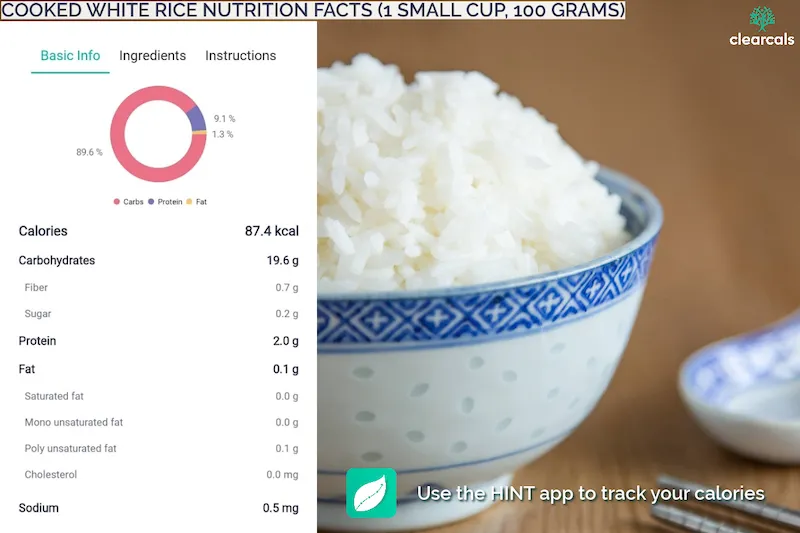
Cooked White Rice Nutrition (per 100g, plain, no added fat)
| Nutrient | Per 100g Cooked | Per 200g (1 medium bowl) |
|---|---|---|
| Calories | 87 kcal | 175 kcal |
| Carbohydrates | 19.6g | 39.2g |
| Protein | 2.0g | 4.0g |
| Fat | 0.1g | 0.2g |
| Dietary Fibre | 0.7g | 1.4g |
| Sugar | 0.2g | 0.4g |
| Sodium | 0.5mg | 1.0mg |
| Potassium | 27mg | 54mg |
| Manganese | 0.2mg | 0.4mg |
| Vitamin B5 | 0.1mg | 0.2mg |
A 200g column has been added to reflect a realistic bowl serving — this is the actual intake for most people, not 100g.
Raw vs Cooked Rice: Why the Numbers Look So Different
People are often confused by the large difference between raw and cooked rice calories. 100g of raw white rice has 356 kcal. 100g of cooked white rice has only 87 kcal.
They are not different products — the difference is entirely due to water absorption during cooking. Raw rice roughly triples in weight when cooked, so 100g of raw rice becomes approximately 300g of cooked rice.
Raw vs Cooked White Rice (per 100g)
| Nutrient | Raw White Rice (100g) | Cooked White Rice (100g) |
|---|---|---|
| Calories | 356 kcal | 87 kcal |
| Carbohydrates | 78.2g | 19.6g |
| Protein | 7.9g | 2.0g |
| Fat | 0.5g | 0.1g |
| Dietary Fibre | 2.8g | 0.7g |
| Potassium | 108mg | 27mg |
| Manganese | 0.7mg | 0.2mg |
Practical rule: If you measure rice before cooking, 100g of raw rice produces approximately 300g of cooked rice, which is 1 large plate (262 kcal). Use the Hint app's "Create Your Recipe" feature to enter your raw ingredient weights and get the precise cooked calorie value for your portion.
Rice Calories Depend on Cooking Method
The calorie values in this blog are for plain cooked rice with no added oil, ghee, or fat. In practice, rice calorie content increases depending on:
Added ghee or oil — 1 teaspoon of ghee added while cooking adds approximately 45 kcal
Tempering (tadka) — oil-based tadka used in curd rice, lemon rice, and sambar rice adds 30–60 kcal per serving
Cooking method — pressure-cooked versus open-pot rice has similar calorie values; the difference lies in water quantity, which affects final weight and density
These values can vary based on rice type (e.g., parboiled, brown, basmati) and cooking technique (pressure cooking, open pot, rice cooker, etc.).
Want to know the exact calories in your rice recipe?
Download the Hint app and use the “Create Your Recipe” feature to log your ingredients, adjust quantities (including water and fat), and get a personalized calorie and nutrition profile instantly.
For more insights into calories in Indian dishes, check out our Indian Food Calorie Calculator blog.
Incorporate Rice into Your Diet with the Hint App
The Hint app provides a comprehensive solution to track rice intake and other nutrients.
Whether you’re managing weight or diabetes, or simply aiming for a balanced diet, you can rely on the Hint Pro and Hint Premium subscriptions for advanced calorie tracking, personalized diet plans, and expert dietitian consultations.
- Hint Pro: Gain access to a personalized diet plan tailored to your health goals, be it weight loss, muscle gain, or balanced nutrition.
- Hint Premium: Enjoy unlimited consultations with expert dietitians, allowing you to adjust your diet based on ongoing feedback and track nutrient intake more effectively.
Watch: How to Track Rice Calories on the Hint App
Rice Types and Their Calories (per 100g cooked)
Different rice varieties have similar calorie counts but very different nutritional profiles — particularly in terms of fibre, glycaemic index, and micronutrients.
Rice Variety Calories at a Glance
| Rice Type | Calories (per 100g cooked) | Protein | Key Advantage |
|---|---|---|---|
| White rice (plain) | 87 kcal | 2.0g | Versatile, easy to digest |
| Brown rice | 87 kcal | 2.3g | Higher fibre, lower GI |
| Basmati rice | 85 kcal | 1.8g | Lower GI, fragrant |
| Red rice | 92 kcal | 1.8g | High antioxidants, low GI |
| Fermented rice | 73 kcal | 2.0g | Rich in probiotics |
| Puffed rice (muri/murmura) | 355 kcal per 100g dry weight | — | Very light; a typical 20g serving = 71 kcal |
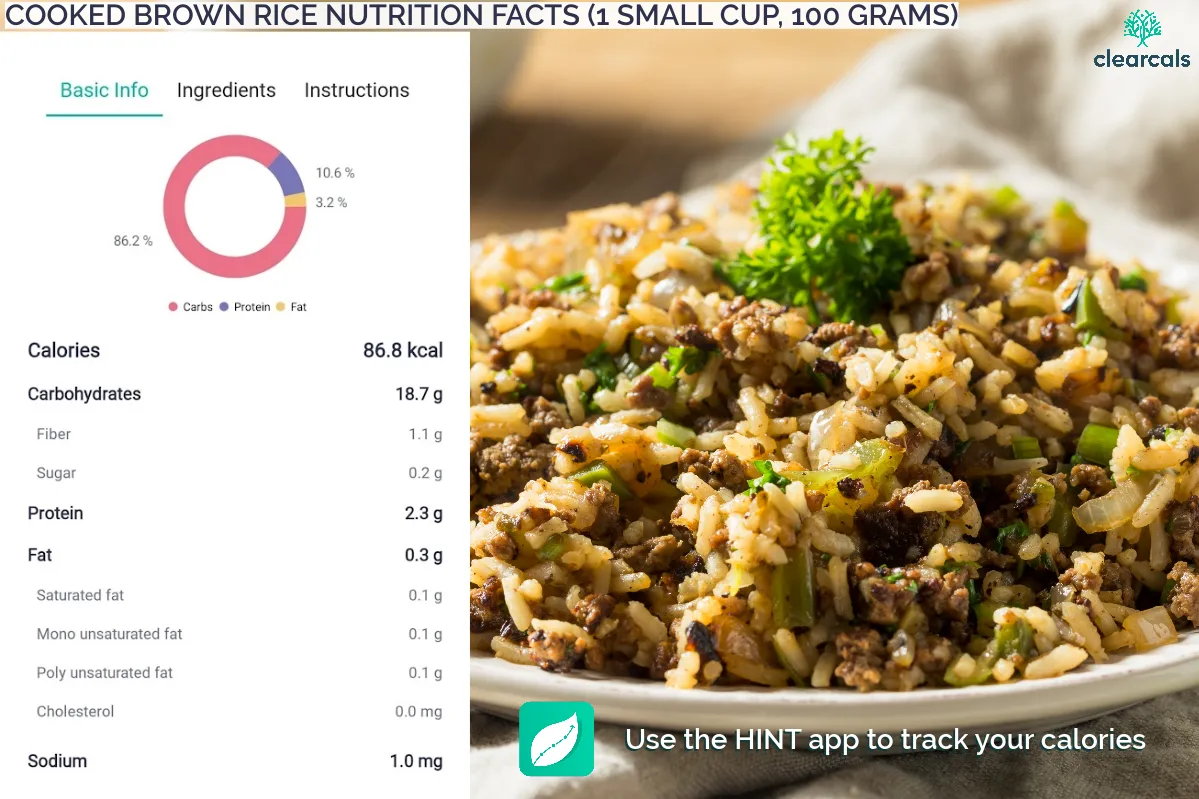
Brown Rice Brown rice (87 kcal/100g) has the same calorie count as white rice but contains more dietary fibre (1.8g vs 0.7g per 100g) and a lower glycaemic index. It provides around 2.3g protein per 100g and is a better option for sustained energy and blood sugar control.
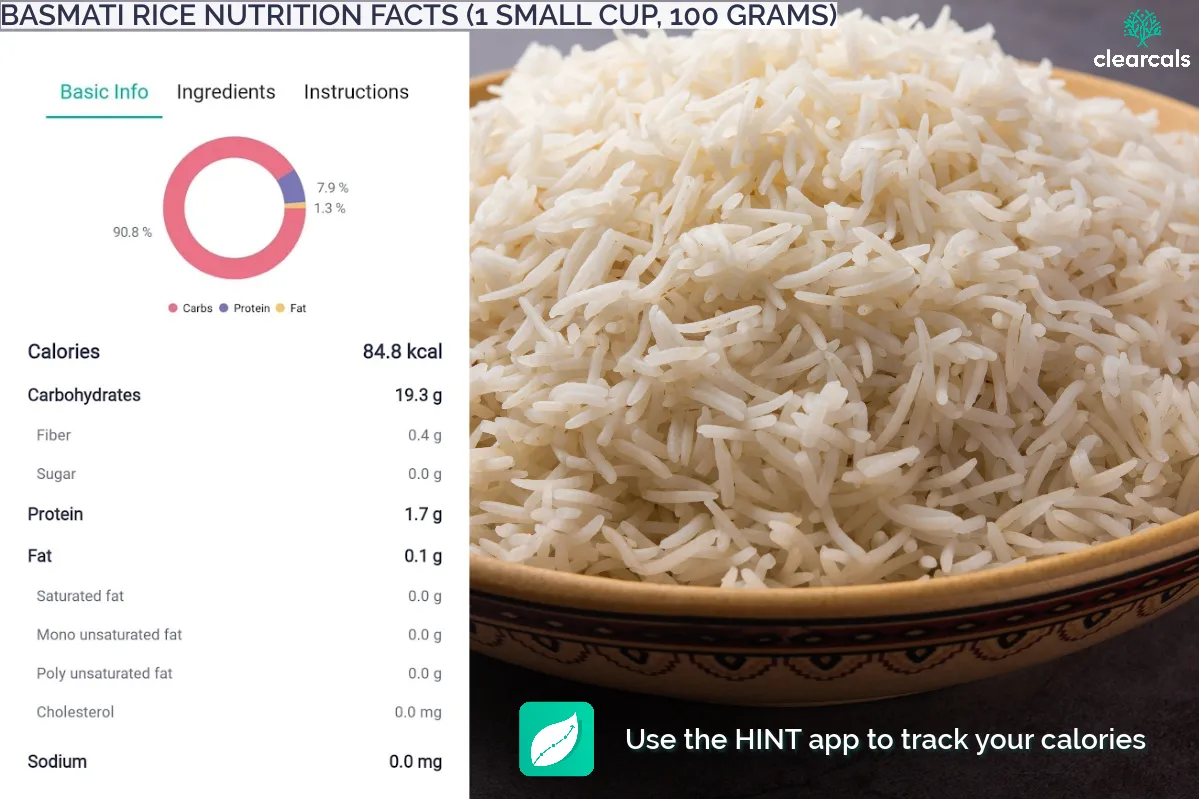
Basmati Rice Basmati rice (85 kcal/100g) has a lower glycaemic index than regular white rice. It is fragrant and contains magnesium, thiamine, and complex carbohydrates that provide steady energy release. A better choice for those managing blood sugar. 👉 Read our diabetes diet guide →
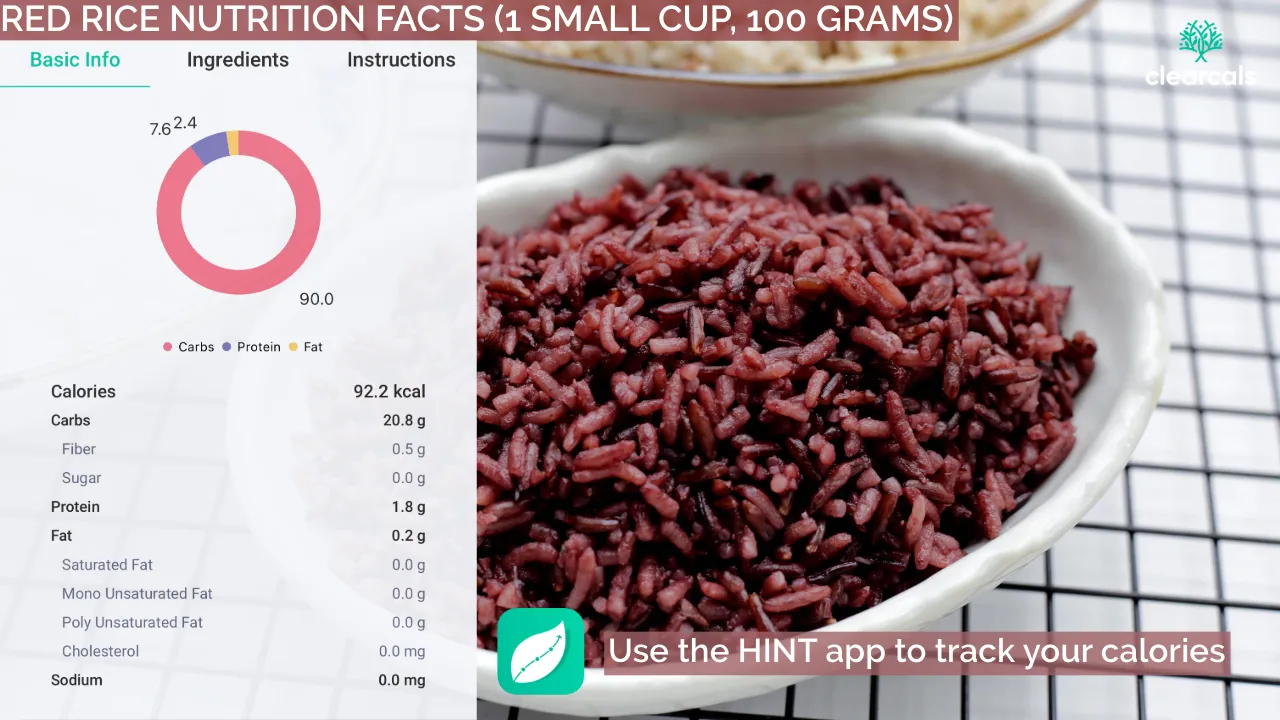
Red Rice Red rice (92 kcal/100g) is slightly higher in calories than white rice but has a significantly lower glycaemic index, higher antioxidant content (from anthocyanins), and more fibre. It is one of the best rice choices for diabetes management and heart health.
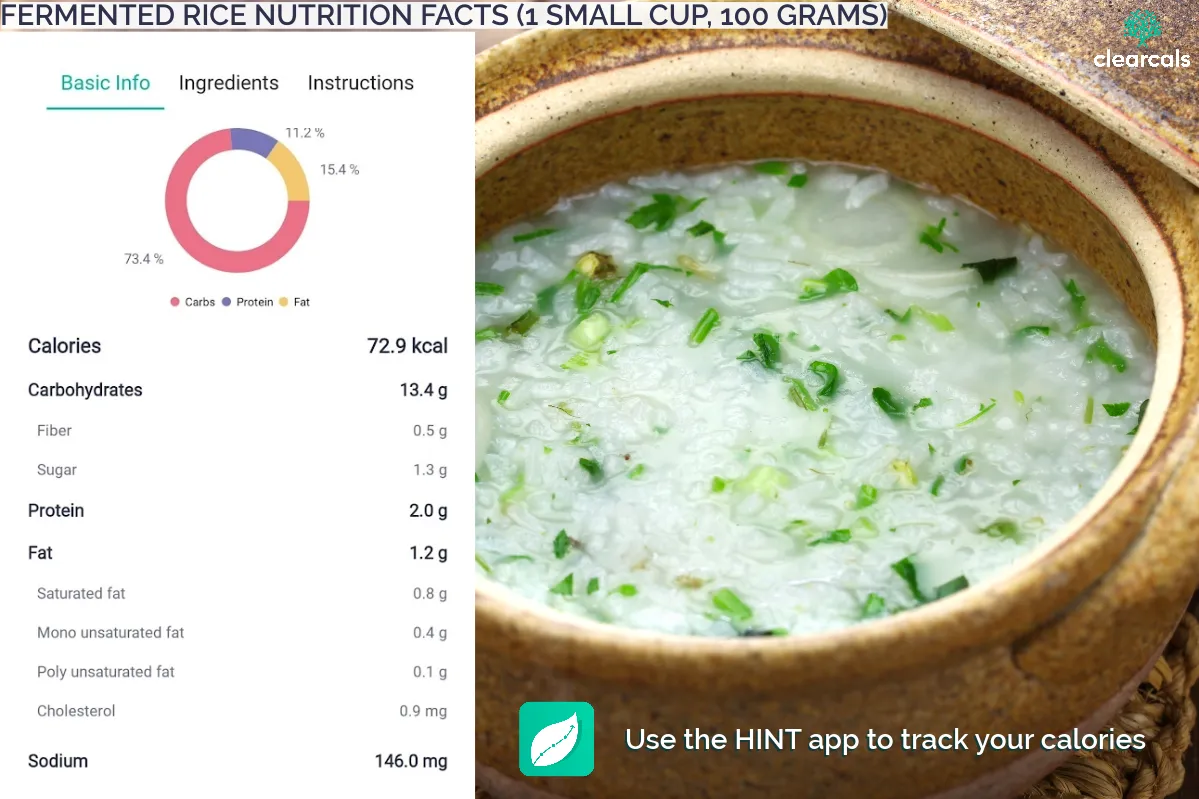
Fermented Rice Fermented rice (73 kcal/100g) is lower in calories and rich in probiotics from the fermentation process. It supports gut health and improves the bioavailability of B vitamins, magnesium, and iron. Popular in South India as a breakfast dish.
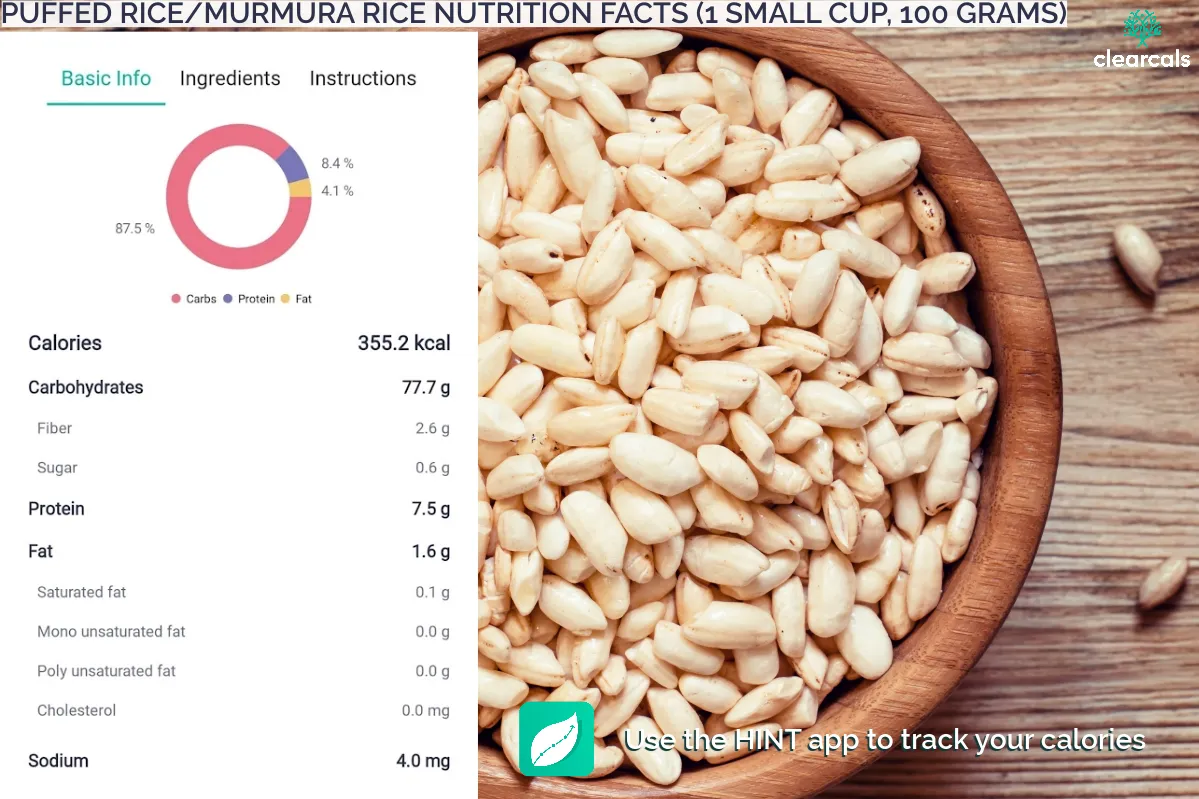
Puffed Rice (Murmura / Muri) 100g of dry puffed rice has 355 kcal, but 100g of puffed rice is a very large volume (several cups). A realistic serving of puffed rice — 20g or a medium bowl — has approximately 71 kcal, making it one of the lowest-calorie snack options by volume.
Rice Dish Calories (per 100g)
Popular Indian rice dishes vary significantly in calories depending on the preparation method and added ingredients.
Rice Dish Calorie Comparison (per 100g)
| Rice Dish | Calories (per 100g) | Notes |
|---|---|---|
| Plain cooked white rice | 87 kcal | No added oil |
| Curd rice | 86 kcal | Light; probiotics from curd |
| Brown rice | 87 kcal | Higher fibre |
| Basmati rice | 85 kcal | Lower GI |
| Red rice | 92 kcal | High antioxidants |
| Fermented rice | 73 kcal | Probiotics, gut-friendly |
| Sambar rice | 119 kcal | Protein, fibre, potassium |
| Lemon rice | 119 kcal | Good source of copper, manganese |
| Egg fried rice | 99 kcal | Protein-rich |
| Corn fried rice | 96 kcal | — |
| Garlic fried rice | 96 kcal | — |
| Vegetable fried rice | 116 kcal | Fibre, beta-carotene |
| Paneer fried rice | 110 kcal | Higher protein |
| Mushroom corn fried rice | 101 kcal | — |
| Chicken fried rice | 122 kcal | Good protein source |
| Prawns fried rice | 113 kcal | — |
| Schezwan paneer fried rice | 136 kcal | Higher fat and calories |
| Schezwan chicken fried rice | 146 kcal | Highest calorie fried rice |
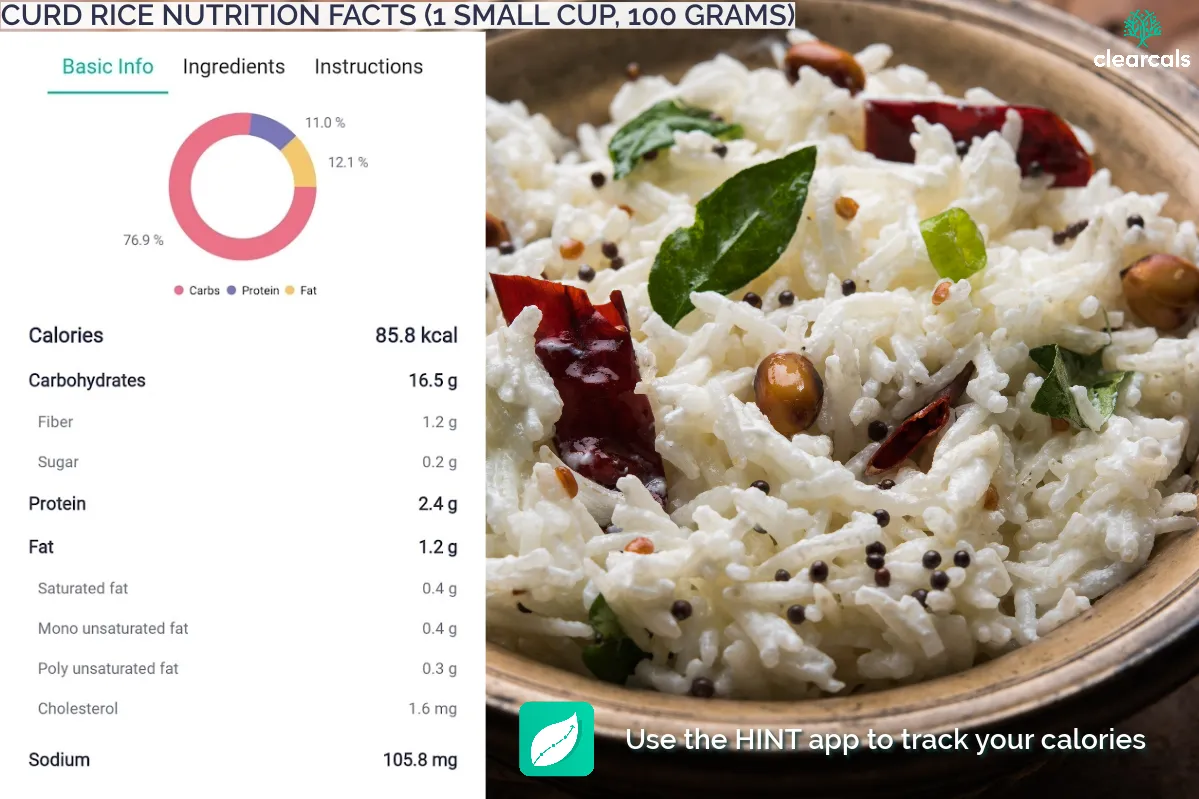
Curd Rice (86 kcal / 100g) Curd rice has 76.9% carbohydrates, 11% protein, and 12.1% fat. It is a light, refreshing dish rich in probiotics that support gut health and digestion. It also provides manganese, beta-carotene, and vitamin D for bone health and immunity. A good choice for those looking for a low-calorie rice meal.
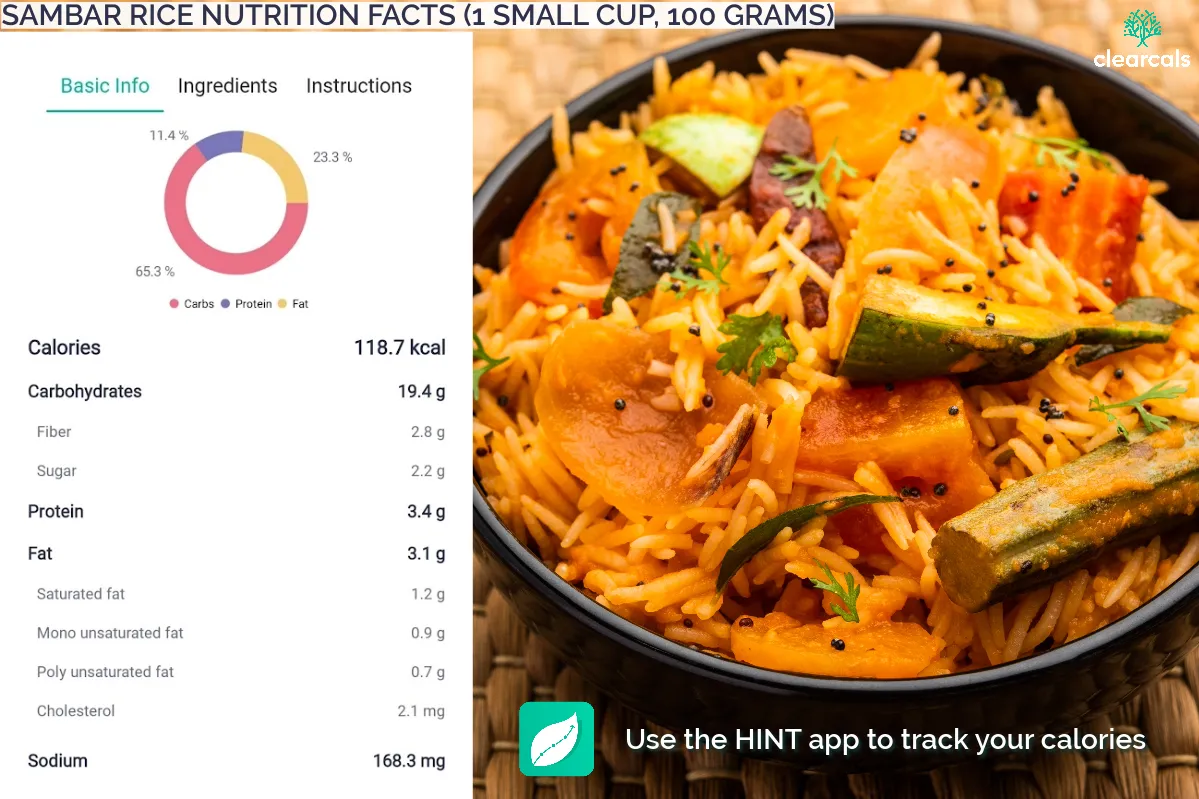
Sambar Rice (119 kcal / 100g) Sambar rice has 65.3% carbohydrates, 11.4% protein, and 23.3% fat. It is a good source of protein, dietary fibre, potassium, phosphorus, magnesium, and manganese, and contains beta-carotene and vitamin D. Its protein and fibre combination makes it more filling than plain rice — suitable for weight management.
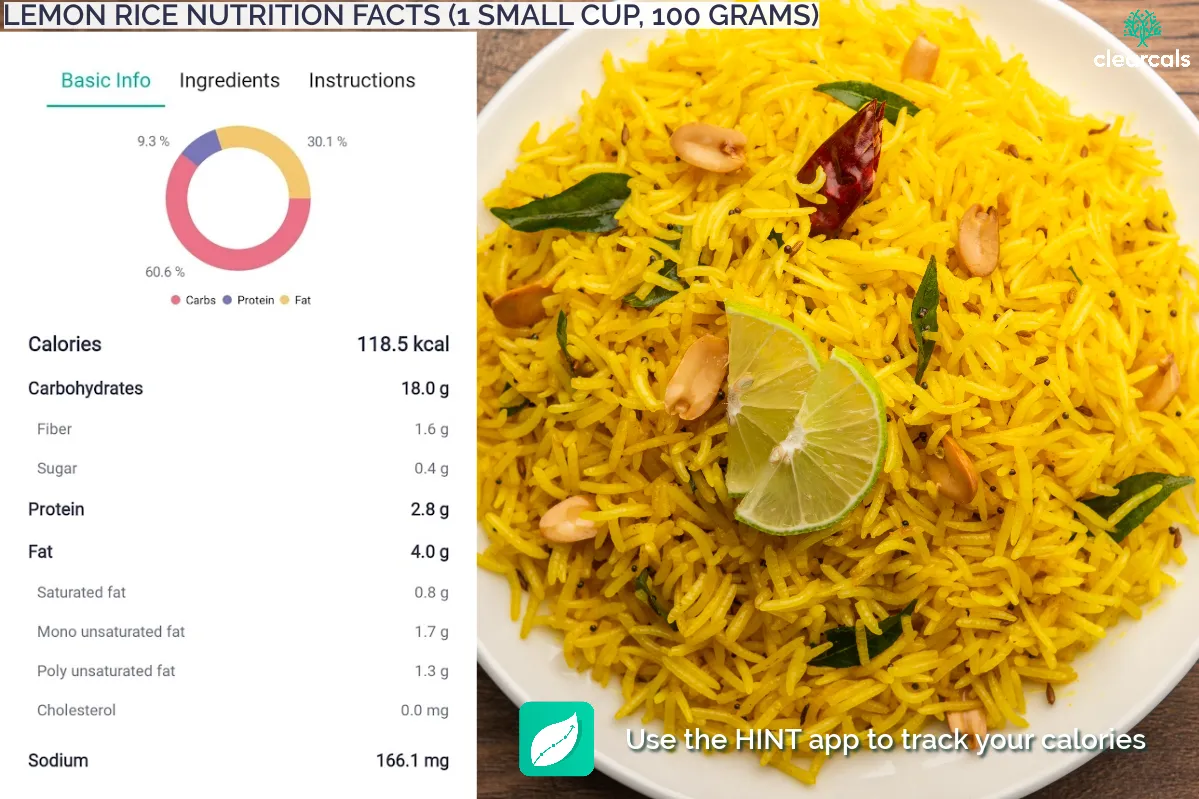
Lemon Rice (119 kcal / 100g) Lemon rice has 60.6% carbohydrates, 9.3% protein, and 30.1% fat. It is a good source of copper and manganese and is rich in beta-carotene, lutein, vitamin E, and vitamin D. The higher fat content comes from the tempering oil used in preparation.
Fried Rice Calories
Fried rice is a popular dish across Indian households and restaurants. It is made by stir-frying cooked rice with oil, vegetables, eggs, or meat, which increases the calorie content compared to plain rice. The type of protein and the quantity of oil used are the primary drivers of calorie variation between fried rice varieties.
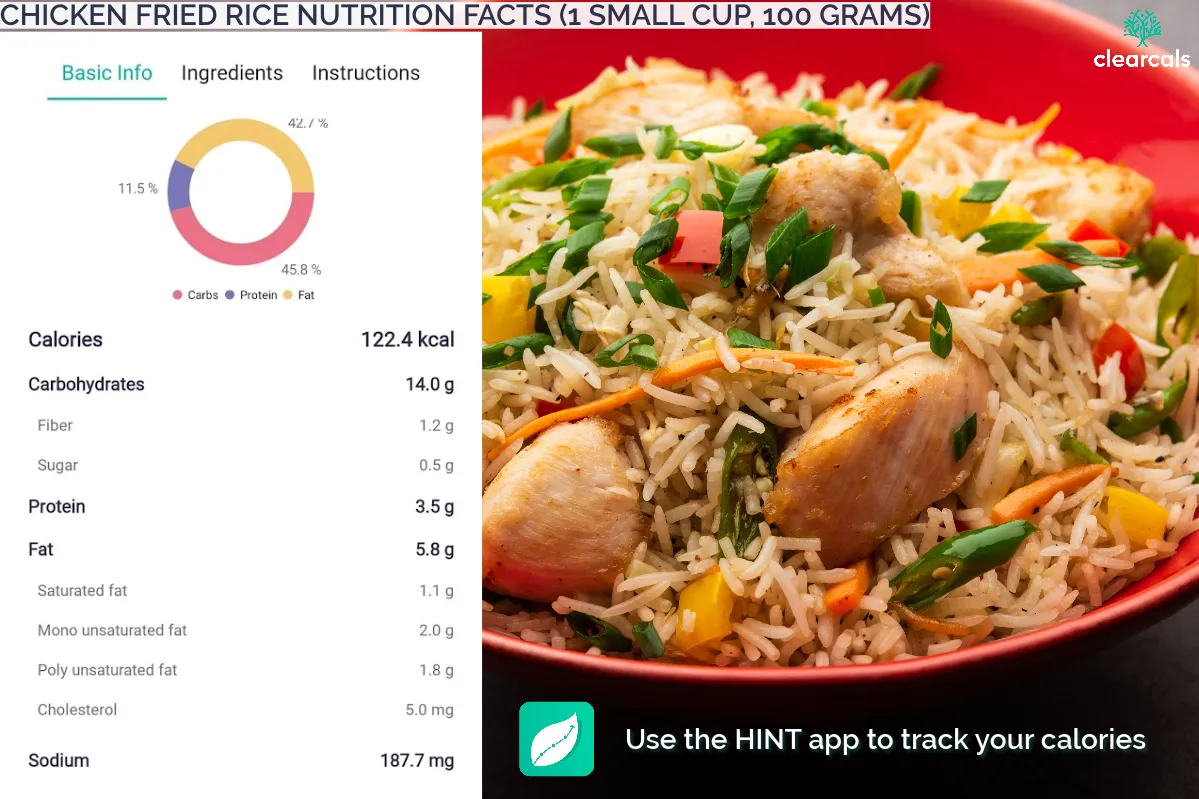
Chicken Fried Rice (122 kcal / 100g)
Chicken fried rice has 46% carbohydrates, 11% protein, and 43% fat per 100g. It is a good source of protein, vitamin C, niacin, copper, vitamin B5, vitamin B6, beta-carotene, and vitamin E. The protein from chicken makes it one of the more nutritionally complete fried rice options.
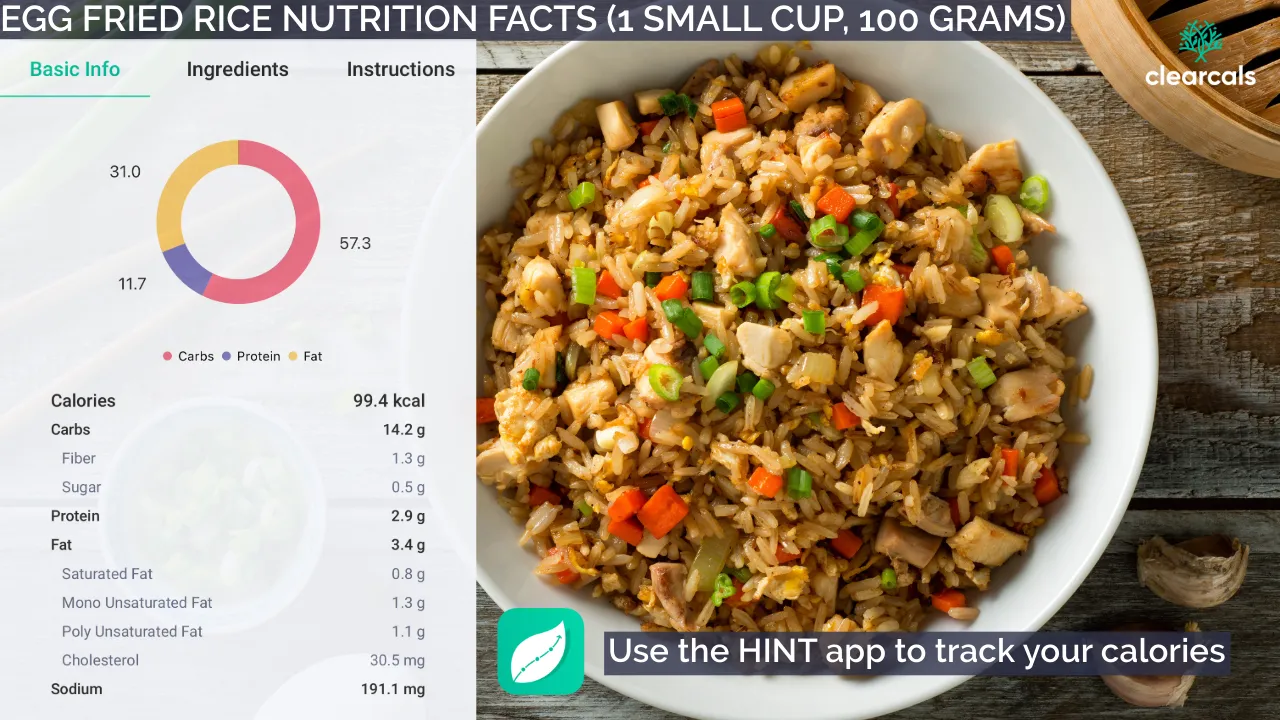
Egg Fried Rice (99 kcal / 100g)
Egg fried rice has 57% carbohydrates, 12% protein, and 31% fat per 100g. It is a good source of vitamins B5 and B6, beta-carotene, vitamin C, and vitamin E. It is lower in calories than chicken fried rice while still providing meaningful protein from the egg.
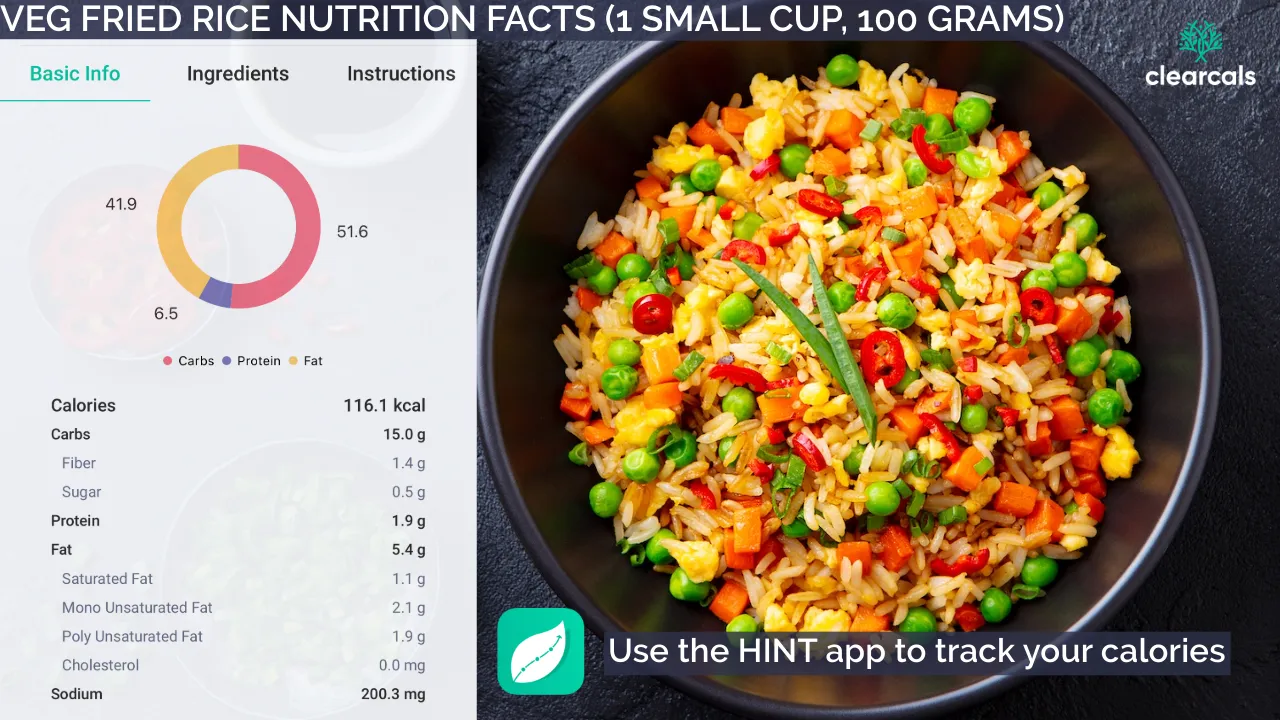
Vegetable Fried Rice (116 kcal / 100g)
Vegetable fried rice has 52% carbohydrates, 6% protein, and 42% fat per 100g. It is a good source of dietary fibre, manganese, beta-carotene, and vitamin C. The fat content comes primarily from the cooking oil used; the vegetable mix contributes fibre and micronutrients.
Fried Rice Calorie Comparison (13 Varieties, per 100g)
| Fried Rice Variety | Calories (per 100g) |
|---|---|
| Egg fried rice | 99 kcal |
| Corn fried rice | 96 kcal |
| Garlic fried rice | 96 kcal |
| Mushroom corn fried rice | 101 kcal |
| Paneer fried rice | 110 kcal |
| Vegetable fried rice | 116 kcal |
| Soya chunks fried rice | 116 kcal |
| Prawns fried rice | 113 kcal |
| Chicken fried rice | 122 kcal |
| Schezwan mushroom fried rice | 119 kcal |
| Schezwan paneer fried rice | 136 kcal |
| Schezwan egg fried rice | 140 kcal |
| Schezwan chicken fried rice | 146 kcal |
Schezwan variants are consistently higher in calories due to the chilli oil and sauce used in the preparation. Plain vegetable and egg fried rice are the lowest-calorie options among restaurant-style fried rice dishes.
Rice Benefits
Energy Source: Rice is rich in carbohydrates, the body's primary fuel. It provides steady energy and keeps you full through the day when eaten as part of a balanced meal with dal, sabzi, or curd.
Gluten-Free: All rice varieties — white, brown, red, basmati, and wild rice — are naturally gluten-free. This makes rice a safe and versatile staple for those with coeliac disease or gluten sensitivity.
Digestive Health: Brown rice, red rice, and fermented rice all provide meaningful dietary fibre and gut-supporting nutrients. Fermented rice adds probiotic benefits beyond what plain rice provides.
Heart Health: Whole grain rice varieties, such as brown and red rice, are associated with improved cholesterol levels and reduced cardiovascular risk. Their fibre, magnesium, and manganese content contribute to overall heart health.
Blood Sugar Management: Brown rice, basmati, and red rice all have lower glycaemic indices than regular white rice. They cause a slower and more gradual rise in blood glucose, making them better choices for those managing diabetes or prediabetes.
Frequently Asked Questions
How many calories are in one plate of rice? The answer depends on how much rice is on the plate. A small plate (150g of cooked white rice) has approximately 130 kcal. A medium plate (250g) has 218 kcal. A large plate (300g) has 262 kcal. The common assumption that "1 plate = 100g = 87 kcal" underestimates most realistic Indian servings significantly.
How many calories are in 1 bowl of rice? A medium bowl of cooked white rice (200g) has approximately 175 kcal and 4.0g protein. A small bowl (150g) has 130 kcal. Use the Hint app's serving size tools to adjust for the size of your bowl.
How many calories are in 1 katori of rice? One katori of cooked white rice (100g) has 87 kcal and 2.0g protein. This is the standard single-serving reference for nutritional data, but it is smaller than a typical plate or bowl serving.
How many calories are in half a plate of rice? Half a medium plate of rice (approximately 125g) has around 109 kcal and 2.5g of protein.
How many calories are in 500g of cooked rice? 500g of plain cooked white rice has approximately 437 kcal and 10g of protein.
How many calories are in 1 kg of rice? 1 kg of plain cooked white rice has approximately 874 kcal. 1 kg of raw (uncooked) white rice has 3,560 kcal.
Does rice make you fat? Rice itself does not cause weight gain — calorie surplus does. Plain cooked white rice is relatively low in calories (87 kcal per 100g) and fat.
Overeating or pairing large rice portions with calorie-dense sides is the more common cause of weight gain from rice-centred meals. Choosing brown or red rice provides more fibre, which promotes satiety and helps control overall intake.
👉 Read our weight loss diet guide →
Is rice good for weight loss? Yes, when eaten in appropriate portions. Rice provides filling carbohydrates at a moderate calorie density. Opting for brown or red rice, controlling portion size (1–2 katoris per meal), and pairing with protein-rich dal or sabzi makes rice a practical part of a weight loss diet.
👉 Read our weight loss diet guide →
Which rice is good for diabetes? Basmati rice, brown rice, and red rice are better choices for diabetes management due to their lower glycaemic indices compared to regular white rice.
Pairing any rice with protein (dal, curd, chicken) and fibre-rich vegetables further slows glucose absorption and reduces post-meal blood sugar spikes.
👉 Read our complete diabetes diet guide →
Is rice good for PCOS? Brown rice, red rice, and basmati rice are better choices for PCOS compared to white rice, as their lower GI supports insulin regulation, which is central to PCOS management.
Portion control and pairing rice with protein and fibre are more important than eliminating rice.
Is rice gluten-free? Yes. All varieties of rice — white, brown, basmati, red, wild, and parboiled — are naturally gluten-free, making them a safe staple for those with coeliac disease or gluten sensitivity.
What is the difference between white rice and brown rice? Brown rice is a whole grain — it retains the bran and germ layers that are removed in white rice.
This gives brown rice more fibre (1.8g vs 0.7g per 100g cooked), a lower glycaemic index, and higher levels of magnesium, B vitamins, and antioxidants. Calorie content is nearly identical (87 kcal per 100g for both).
Is rice good for muscle gain? Yes. Rice is a primary carbohydrate source that fuels workouts and replenishes glycogen after training.
For muscle gain, pair 2–3 katoris of rice with adequate protein (dal, paneer, chicken, or eggs) at each meal to meet both calorie and muscle-building nutrient needs. 👉 Read our muscle gain diet guide →
Final Thoughts
Rice is one of the most versatile and widely eaten foods in India — and it fits into virtually any health goal when portion size and rice type are chosen thoughtfully.
The Hint app makes it easy to log rice by Indian serving vessel (katori, plate, bowl) rather than grams, so you always get an accurate calorie and protein count for your actual meal — not a generic per-100g figure.
Download the free Hint app on the App Store or Google Play Store to start tracking.
Upgrade to Hint Pro for personalised Indian diet plans, weekly insights, and 300+ workout plans — or Hint Premium for unlimited dietitian consultations on top of everything in Hint Pro.
🎁 Free Hint with Every Watch Purchase
Garmin watches: Purchase any Garmin watch from the Clearcals Store and receive 1 month of Hint Premium (worth ₹1,999) free — including unlimited dietitian consultations, personalised diet and workout plans, and advanced nutrition tracking.
Apple Watch: Purchase any Apple Watch from the Clearcals Store and receive a free Hint Pro subscription — including personalised Indian diet plans, 300+ workouts, weekly insights, and more.
Read Next
- Indian Food Calorie Calculator — Free Online Tool
- Calories in Roti — Nutrition Facts & Health Benefits
- Banana Calories — Nutrition Facts & Health Benefits
- Weight Loss Diet Plan for Indians
- Diabetes Diet Plan India
- PCOS Diet Plan India
- Muscle Gain Diet Plan India
- Calorie Tracking in India — Beginner's Guide
About the Author
Asfia Fatima is the Chief Dietitian at Clearcals, with a Master's Degree in Dietetics and Clinical Nutrition and over a decade of experience in clinical nutrition and lifestyle management.
She specialises in evidence-based diet planning for weight loss, diabetes, and metabolic health.
At Clearcals, she leads the nutrition strategy behind the Hint app, helping users achieve their goals with science-backed guidance.
🔗 Connect with Asfia on LinkedIn