Track your nutrition and health goals

Low-Calorie Indian Lunch Ideas for Weight Loss (With Calorie Counts)
Low-Calorie Indian Lunch Ideas for Weight Loss (With Calorie Counts)
Building a Low-Calorie Indian Lunch Plate
Lunch is usually the biggest meal of the day on an Indian plate, which makes it the meal where portion size matters most. The good news is you don't need to give up roti, rice, or dal — a well-portioned thali with the right ratio of dal/protein, vegetables, and grain can land at 400-500 kcal, filling and balanced, versus 700-900+ kcal for a heavier version with extra oil, ghee, or oversized rice/roti portions. To see how lunch fits your whole day, find your daily target with our Calorie Deficit Calculator.
Low-Calorie Indian Lunch Combinations (With Calorie Counts)
| Lunch Combination | Approx. Calories | Notes |
|---|---|---|
| 2 roti + dal + sabzi + salad | ~400-480 kcal | A well-balanced, filling standard combination |
| 1 cup rice + dal + sabzi | ~380-450 kcal | Keep rice to 1 cup cooked (~150g) to control calories |
| Vegetable khichdi, 1 bowl | ~250-320 kcal | Combines protein (dal) and carbs in one dish, easy to digest |
| Grilled paneer/tofu with sautéed vegetables | ~300-380 kcal | High-protein, lower-carb option |
| Rajma or chole (1 bowl) + 1 roti | ~350-420 kcal | High protein and fibre from legumes |
| Large mixed vegetable salad with a light dressing | ~150-250 kcal | High volume, very filling per calorie — see our salad recipes for weight loss |
| Curd rice, 1 bowl | ~250-300 kcal | Light, cooling, easy on digestion |
| 2 jowar or bajra roti + sabzi | ~300-380 kcal | Millets add fibre for fewer calories than wheat roti |
| Vegetable or paneer roti wrap (kathi-style) | ~250-320 kcal | Portable, good for a packed lunch or dabba |
| Grilled chicken breast (100g) with sautéed vegetables | ~220-280 kcal | High protein, low carb |
| Egg curry (2 eggs) + 1 roti | ~280-330 kcal | High protein, widely available option |
Counts vary with oil and portion size — log your exact meal in the Hint app for a precise number.
High-Protein, Low-Calorie Lunch Options
A protein-forward lunch — dal, rajma, chole, grilled paneer, tofu, chicken, or eggs — tends to keep you fuller through the afternoon than a carb-heavy plate of similar calories. If you're building lunches specifically around protein targets, see our high-protein, low-calorie foods guide, our guide on which dal is highest in protein, and our broader daily protein requirement guide.
Non-Vegetarian, Low-Calorie Lunch Options
Grilled or curry-style chicken, egg curry, and fish are all solid low-calorie, high-protein lunch options if you eat non-vegetarian — a 100g portion of grilled chicken breast runs roughly 165 kcal on its own, and a light fish curry with vegetables is comparable to a chicken curry portion for calories while adding omega-3s. The same portion-control principles apply as with vegetarian options: keep the oil moderate, pair with vegetables or salad rather than extra rice or roti, and watch the gravy-heavy preparations (butter chicken, rich curries) that can push a dish well past 500-600 kcal for a similar-sized portion of a plainer preparation.
Low-Carb Lunch Options
If you're combining a lower-carb approach with your calorie target, several options above already fit well: grilled chicken or fish with vegetables, egg curry (light on the gravy), grilled paneer, and a large salad with protein added are all relatively low in carbohydrates while still being filling. Rice- and roti-heavy thalis are naturally higher in carbs — that's not a problem on its own, but keep portions moderate if you're specifically watching carb intake rather than just calories.
Meal-Prepping and Packing Your Lunch (Tiffin/Dabba)
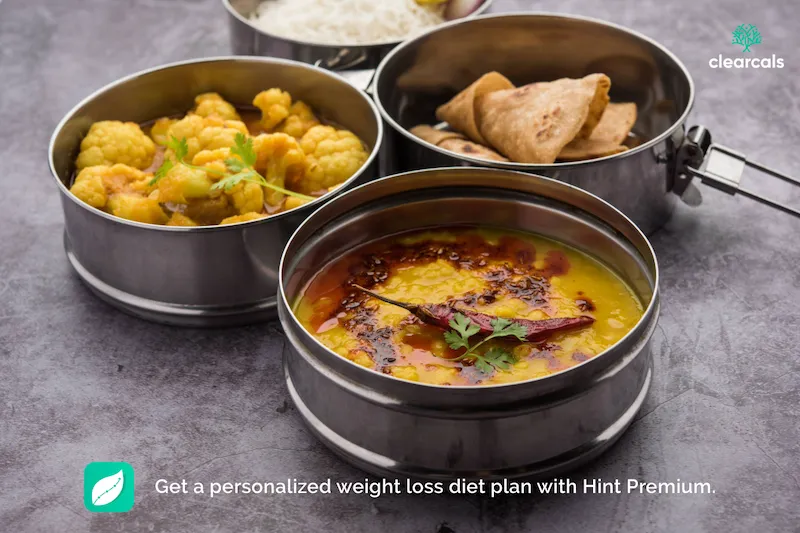
Lunch is the meal most people eat away from home, which makes prep-ahead planning especially useful. Dal, rajma, and chole all keep well in the fridge for 2-3 days and reheat easily, so cooking a larger batch once or twice a week covers several lunches. Rice and roti can be portioned and refrigerated similarly — pack rice slightly undercooked if you're reheating it later, since it softens further on reheating. For salads packed for later, keep the dressing separate until you eat to avoid sogginess, and add anything delicate (cucumber, tomato) just before eating rather than the night before. One caution worth flagging: don't pack an unrealistically small lunch to save calories — a lunch under roughly 200-250 kcal often isn't filling enough to prevent overeating later in the afternoon or evening, which usually costs more than it saves.
Practical Tips for a Lighter Lunch
- Fill half your plate with vegetables or salad first — it's the easiest way to reduce the calorie density of the whole meal without feeling like you're eating less.
- Measure rice and roti portions, at least until you have a feel for what 1 cup of rice or 2 rotis actually looks like on your plate — it's easy to underestimate.
- Go easy on the tempering (tadka). A little oil in dal or sabzi adds flavour; a lot adds 100+ calories without adding much satisfaction.
- Skip or minimize dessert immediately after lunch if you're targeting a deficit — it's often the easiest calories to trim without affecting how filling the meal feels.
Sample Low-Calorie Lunch Plan
- Standard: 2 roti + dal + sabzi + a side salad (~450-500 kcal)
- Lighter/protein-forward: Grilled paneer with sautéed vegetables + a small bowl of dal (~400 kcal)
- Quick/one-bowl: Vegetable khichdi with a side of curd (~350-400 kcal)
Track Your Lunch With Hint
Lunch is often the meal with the most day-to-day variation, so logging it consistently matters. The Hint app's Indian food database covers roti, rice, dal, and common sabzis, so you can log a typical thali quickly rather than skipping it because it feels complicated to estimate.
FAQs
What is a good low-calorie Indian lunch? 2 roti with dal, sabzi, and salad; 1 cup rice with dal and sabzi; or vegetable khichdi are all balanced options typically running 250-480 kcal depending on portion.
How can I make my lunch thali lower calorie without cutting out rice or roti? Control portion size (1 cup rice or 2 rotis is a reasonable baseline), go easy on oil in the tempering, and fill at least a quarter to half your plate with vegetables or salad.
What's a high-protein, low-calorie Indian lunch? Rajma, chole, dal, or grilled paneer/tofu with vegetables are strong options — legumes and paneer both add meaningful protein without a large calorie cost.
How many calories should lunch be for weight loss? It depends on your total daily target, but 400-500 kcal is a reasonable range for most people aiming for a calorie deficit, leaving room for breakfast, dinner, and snacks.
Is curd rice good for weight loss? In a moderate portion, yes — it's relatively light (~250-300 kcal per bowl) and easy to digest, though it's worth pairing with a vegetable side for a more complete, filling meal.
Can I skip lunch for weight loss? It's not generally recommended as a strategy — most people compensate by overeating later, similar to skipping breakfast. If you're intentionally doing fewer, larger meals as part of a structured approach and not overcompensating afterward, total daily calories still matter more than whether lunch specifically happens.
Is a 200-calorie lunch enough for weight loss? For most people, no — a lunch that light usually isn't filling enough to prevent overeating later in the day, which often costs more calories than it saves. A lunch in the 350-500 kcal range is more sustainable for most adults.
Does the time I eat lunch matter for weight loss? Not much on its own — total daily calorie intake matters far more than the exact time you eat. Eating lunch at a consistent time can help with hunger management and reduce impulsive snacking, but there's no special metabolic advantage to eating at any particular hour.
About the Author
Asfia Fatima is the Chief Dietitian at Clearcals, with a Master's Degree in Dietetics and Clinical Nutrition and over a decade of experience in clinical nutrition and lifestyle management. She specialises in evidence-based diet planning for weight loss, diabetes, and metabolic health, and leads the nutrition strategy behind the Hint app.
Connect with Asfia on LinkedIn