
Track your nutrition and health goals

Gulab Jamun Calories: 1, 2, 3, 4 Pieces | Per 100g | With & Without Syrup

By Asfia Fatima, Chief Dietitian at Clearcals
Gulab jamun is one of India's most beloved desserts — and one of the most calorie-dense. A single small piece (30g) contains 97 kcal, most of which comes from fat (54%) and carbohydrates (35%). Understanding the exact calorie count helps you enjoy gulab jamun mindfully without derailing your health goals.
Track your gulab jamun intake alongside your full diet with the Hint app.
Gulab Jamun Calories: Quick Reference Table
| Size | 1 Piece | 2 Pieces | 3 Pieces | 4 Pieces |
|---|---|---|---|---|
| Small (30g) | 97 kcal | 193 kcal | 290 kcal | 387 kcal |
| Medium (40g) | 129 kcal | 258 kcal | 387 kcal | 516 kcal |
| Large (50g) | 161 kcal | 322 kcal | 483 kcal | 644 kcal |
1 Gulab Jamun Calories
1 small gulab jamun (30g) has 97 kcal. A medium piece (40g) has 129 kcal, and a large piece (50g) has 161 kcal. These figures include the sugar syrup absorbed during soaking, which contributes a significant portion of the carbohydrate content.
| Size | Weight | Calories |
|---|---|---|
| Small | 30g | 97 kcal |
| Medium | 40g | 129 kcal |
| Large | 50g | 161 kcal |
2 Gulab Jamun Calories
2 small gulab jamuns (60g) contain 193 kcal. Two medium pieces total 258 kcal; two large pieces total 322 kcal. Two medium-sized gulab jamuns after a meal is one of the most common Indian dessert portions — at 258 kcal, this is equivalent to roughly one medium paratha.
3 Gulab Jamun Calories
3 small gulab jamuns (90g) contain 290 kcal. Three medium pieces total 387 kcal; three large pieces total 483 kcal. At this quantity, the sugar intake (approximately 24–30g) approaches the WHO's recommended daily limit of added sugars for most adults.
4 Gulab Jamun Calories
4 small gulab jamuns (120g) contain 387 kcal. Four medium pieces total 516 kcal — roughly equivalent to a full restaurant meal in calorie terms. The Hint app can help you log any quantity and see the impact on your daily totals instantly.
Gulab Jamun Calories Per 100g
100g of gulab jamun contains approximately 323 kcal. This is based on the standard 97 kcal per 30g small piece (with syrup). The macronutrient breakdown per 100g is approximately:
| Nutrient | Per 100g |
|---|---|
| Calories | 323 kcal |
| Carbohydrates | ~28g |
| Protein | ~9g |
| Fat | ~19g |
| Sugar | ~26g |
Gulab Jamun Calories Without Syrup
A gulab jamun ball without sugar syrup contains approximately 65–75 kcal per 30g piece. The standard 97 kcal figure includes calories from the sugar syrup absorbed during soaking. The fried khoya-and-flour ball itself, before soaking, is lower in carbohydrates but higher in fat as a proportion. If you consume gulab jamun immediately after frying (before syrup absorption), expect approximately 30% fewer calories. However, traditionally served gulab jamun always includes syrup — the 97 kcal figure is the practical reference.
Calories in one gulab jamun with syrup vs without:
| Small (30g) | Medium (40g) | |
|---|---|---|
| With syrup (standard) | 97 kcal | 129 kcal |
| Without syrup (estimated) | ~68 kcal | ~90 kcal |
Gulab Jamun Nutrition Facts
Gulab jamun is rich in carbohydrates (35%), moderate in protein (11%), and high in fat (54%). It is also a source of selenium and biotin from the khoya (milk solids) content.
| Nutrient | 1 Small (30g) | 1 Medium (40g) | Per 100g |
|---|---|---|---|
| Calories | 97 kcal | 129 kcal | 323 kcal |
| Carbohydrates | ~8.5g | ~11.3g | ~28g |
| Protein | ~2.7g | ~3.5g | ~9g |
| Fat | ~5.8g | ~7.7g | ~19g |
| Sugar | ~8g | ~10.5g | ~26g |
Gulab Jamun Sugar Content
One small gulab jamun (30g) contains approximately 8g of sugar, primarily from the sucrose in the sugar syrup. A medium piece contains ~10.5g of sugar. The sugar syrup in which gulab jamun is soaked is the primary source of its carbohydrate content and high glycemic impact.
| 1 Small | 1 Medium | 1 Large | |
|---|---|---|---|
| Sugar | ~8g | ~10.5g | ~13g |
| Carbohydrates | ~8.5g | ~11.3g | ~14g |
For diabetics and those managing blood sugar, gulab jamun's high sugar content and elevated glycemic index make it a food to consume only in very small amounts and infrequently.
Gulab Jamun Protein
1 small gulab jamun (30g) contains approximately 2.7g of protein, primarily from the khoya (dried whole milk) used in the recipe. A medium piece contains ~3.5g protein and a large piece ~4.4g protein. Gulab jamun is not a significant protein source — its calorie content comes predominantly from fat and sugar.
Gulab Jamun Glycemic Index
The glycemic index (GI) of gulab jamun is approximately 75–80, which classifies it as a high-GI food. This is due to the sugar syrup and refined flour used in its preparation. The high GI means gulab jamun causes rapid blood glucose elevation — particularly relevant for individuals with diabetes or insulin resistance.
Gulab Jamun Nutrition
Gulab jamun is a dessert high in sugar and saturated fat. Here's what you need to know:
Is Gulab Jamun good for weight loss? Gulab jamun is calorie-dense — even one small piece is 97 kcal. In the context of a calorie-controlled diet, one small piece occasionally is manageable. Regular consumption makes it difficult to maintain a calorie deficit.
Is Gulab Jamun good for diabetes? No, it's high sugar content and high glycemic index make it unsuitable for regular consumption by diabetics. Even one piece causes a rapid blood sugar spike.
Is gulab jamun good for loose motion/diarrhea? The sugar syrup in gulab jamun can worsen diarrhea by drawing water into the intestines. There is no clinical evidence supporting gulab jamun as a remedy for loose motions. Plain foods like rice and curd are more appropriate during digestive distress.
Benefits of gulab jamun: Gulab jamun provides selenium and biotin from its khoya content, which support thyroid function and cell growth, respectively. These benefits are modest — the sugar and saturated fat content outweigh the nutritional positives for most people.
Watch: How to Track Gulab Jamun Calories on the Hint App
Hint Pro users can personalise calorie and macronutrient goals, while Hint Premium offers dietitian guidance on fitting sweets into a balanced diet. Use the Add Your Own Recipe feature to track homemade gulab jamun with your exact ingredients.
Popular Indian Sweets: Calories Comparison
Many Indian sweets are calorie-dense. Here is a breakdown of the most popular ones.
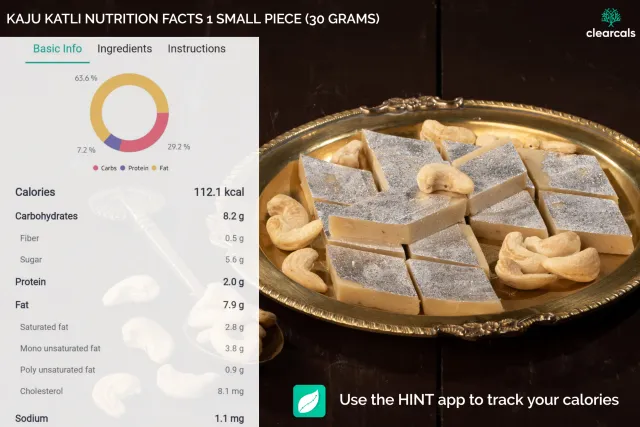
1. Kaju Katli Calories
One small piece (30g) of kaju katli has 112 kcal — 29% from carbohydrates, 7% from protein, and 64% from fat. 100g of kaju katli has 370 kcal. Eat in moderation as it is high in calories, sugar, and saturated fat.
| Kaju Katli Size | 1 Piece | 2 Pieces | 3 Pieces | 4 Pieces |
|---|---|---|---|---|
| Small (30g) | 112 kcal | 224 kcal | 336 kcal | 448 kcal |
| Medium (40g) | 150 kcal | 300 kcal | 450 kcal | 600 kcal |
| Large (50g) | 187 kcal | 374 kcal | 561 kcal | 748 kcal |
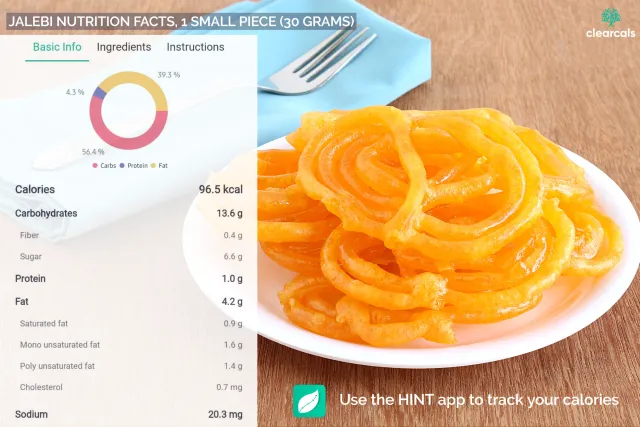
2. Jalebi Calories
One small piece (30g) of jalebi has 97 kcal — 56% from carbohydrates, 4% from protein, and 40% from fat. 100g of jalebi has 370 kcal. Jalebi is deep-fried in refined flour with no essential nutrients; enjoy sparingly.
| Jalebi Size | 1 Piece | 2 Pieces | 3 Pieces | 4 Pieces |
|---|---|---|---|---|
| Small (30g) | 97 kcal | 194 kcal | 291 kcal | 388 kcal |
| Medium (40g) | 129 kcal | 258 kcal | 387 kcal | 516 kcal |
| Large (50g) | 160 kcal | 320 kcal | 480 kcal | 640 kcal |
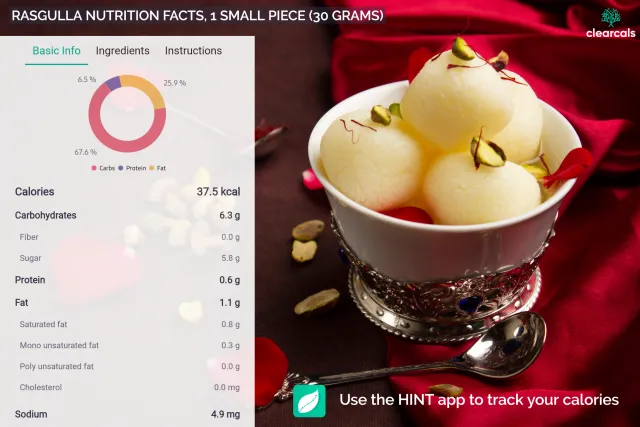
3. Rasgulla Calories
One small piece (30g) of rasgulla has 38 kcal — 68% from carbohydrates, 7% from protein, and 26% from fat. 100g of rasgulla has 130 kcal. Rasgulla is one of the lightest Indian sweets by calorie count, though its sugar content still warrants moderation.
| Rasgulla Size | 1 Piece | 2 Pieces | 3 Pieces | 4 Pieces |
|---|---|---|---|---|
| Small (30g) | 38 kcal | 76 kcal | 114 kcal | 152 kcal |
| Medium (40g) | 50 kcal | 100 kcal | 150 kcal | 200 kcal |
| Large (50g) | 63 kcal | 126 kcal | 189 kcal | 252 kcal |
4. Boondi Ladoo Calories
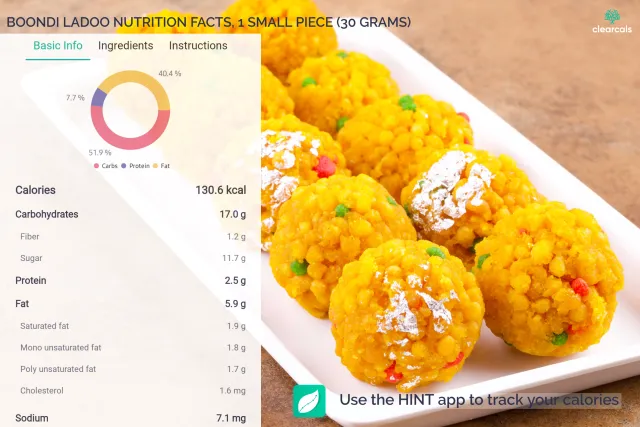
One small piece (30g) of boondi ladoo has 131 kcal — 52% from carbohydrates, 8% from protein, and 40% from fat.
| Boondi Ladoo Size | 1 Piece | 2 Pieces | 3 Pieces | 4 Pieces |
|---|---|---|---|---|
| Small (30g) | 131 kcal | 262 kcal | 393 kcal | 524 kcal |
| Medium (40g) | 174 kcal | 348 kcal | 522 kcal | 696 kcal |
| Large (50g) | 218 kcal | 436 kcal | 654 kcal | 872 kcal |
Ladoo varieties and calories (per small piece, 30g):
| Ladoo variety | Calories |
|---|---|
| Murmura ladoo | 81 kcal |
| Rajgira ladoo | 95 kcal |
| Ragi oats ladoo | 107 kcal |
| Ragi ladoo | 122 kcal |
| Til ladoo | 126 kcal |
| Boondi ladoo | 131 kcal |
| Coconut ladoo | 132 kcal |
| Moong dal ladoo | 132 kcal |
| Besan ladoo | 141 kcal |
| Dry fruits ladoo | 152 kcal |
5. Rasmalai Calories
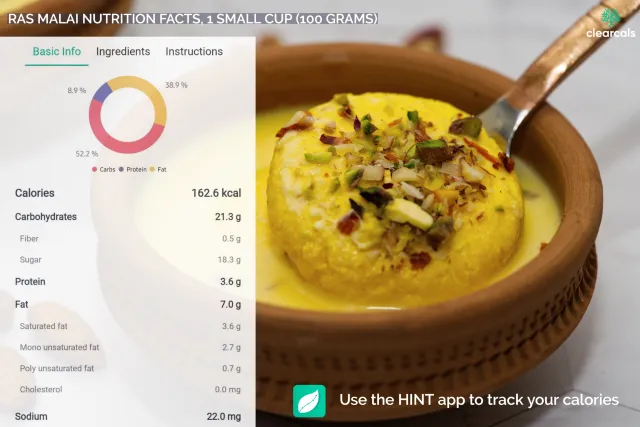
One small cup (100g) of rasmalai has 163 kcal — 52% from carbohydrates, 9% from protein, and 39% from fat. Rasmalai is a good source of vitamin E. Eat in moderation due to high sugar content.
| Rasmalai Serving | Calories |
|---|---|
| Small cup (100g) | 163 kcal |
| Medium cup (200g) | 325 kcal |
| Large cup (300g) | 488 kcal |
6. Halwa Calories
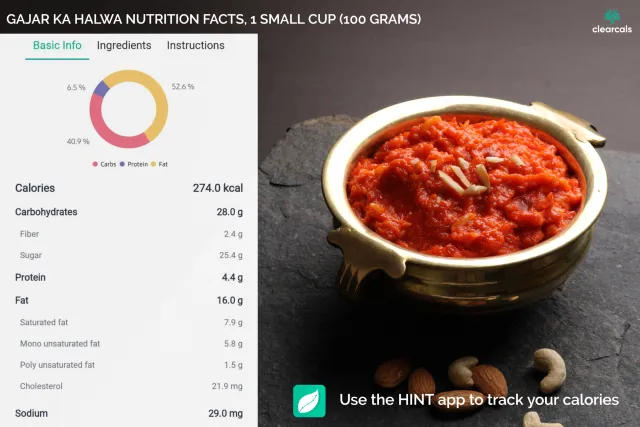
One small cup (100g) of gajar ka halwa has 274 kcal — 41% from carbohydrates, 7% from protein, and 53% from fat. It is a good source of calcium, phosphorus, alpha-carotene, beta-carotene, and vitamin E. Eat in moderation due to high sugar and saturated fat content.
| Gajar ka Halwa Serving | Calories |
|---|---|
| Small cup (100g) | 274 kcal |
| Medium cup (200g) | 548 kcal |
| Large cup (300g) | 822 kcal |
Halwa varieties and calories (per small cup, 100g):
| Halwa variety | Calories |
|---|---|
| Lauki ka halwa | 174 kcal |
| Pumpkin halwa | 178 kcal |
| Beetroot halwa | 183 kcal |
| Gajar ka halwa | 274 kcal |
| Wheat halwa | 281 kcal |
| Ragi halwa | 282 kcal |
| Sooji ka halwa | 301 kcal |
| Chana dal halwa | 328 kcal |
| Moong dal halwa | 332 kcal |
| Dry fruits halwa | 499 kcal |
| Badam ka halwa | 503 kcal |
7. Peda Calories
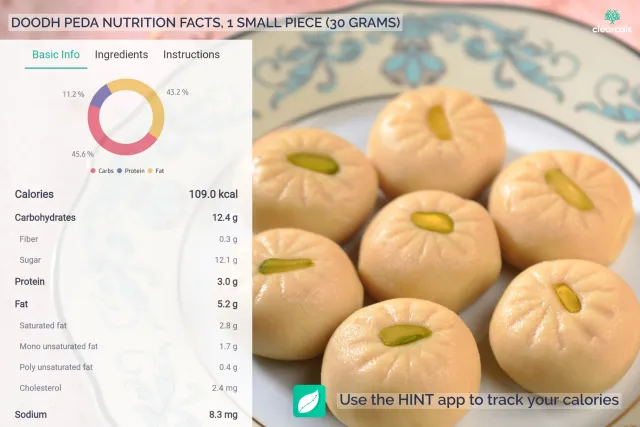
One small piece (30g) of doodh peda has 109 kcal — 46% from carbohydrates, 11% from protein, and 43% from fat. 100g of doodh peda has 360 kcal. Peda is a good source of biotin, calcium, and selenium.
| Doodh Peda Size | 1 Piece | 2 Pieces | 3 Pieces | 4 Pieces |
|---|---|---|---|---|
| Small (30g) | 109 kcal | 218 kcal | 327 kcal | 436 kcal |
| Medium (40g) | 145 kcal | 290 kcal | 435 kcal | 580 kcal |
| Large (50g) | 182 kcal | 364 kcal | 546 kcal | 728 kcal |
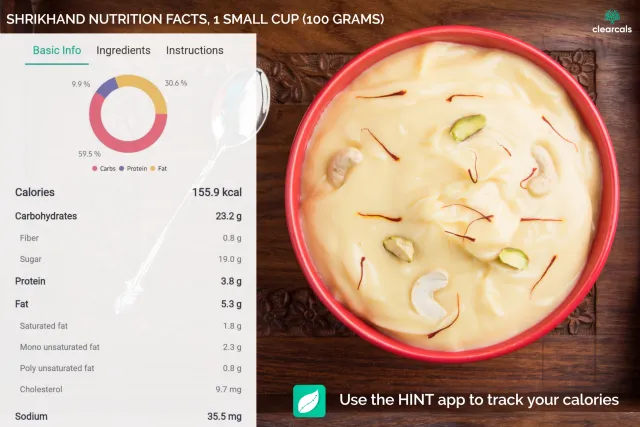
8. Shrikhand Calories
One small cup (100g) of shrikhand has 156 kcal — 60% from carbohydrates, 10% from protein, and 30% from fat. Shrikhand is a good source of calcium, phosphorus, vitamin B12, probiotics, and vitamin E.
| Shrikhand Serving | Calories |
|---|---|
| Small cup (100g) | 159 kcal |
| Medium cup (200g) | 312 kcal |
| Large cup (300g) | 468 kcal |
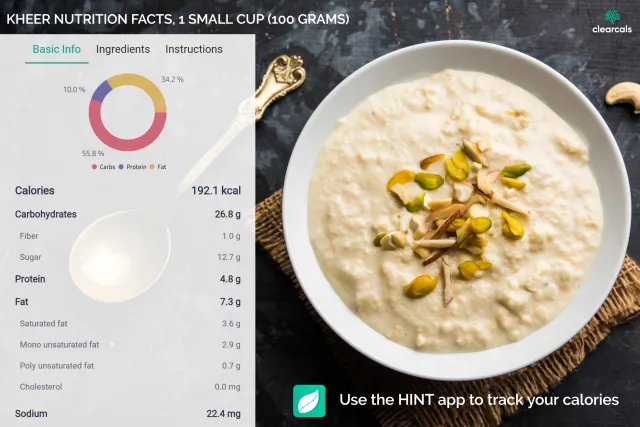
9. Kheer Calories
One small cup (100g) of kheer has 192 kcal — 56% from carbohydrates, 10% from protein, and 34% from fat. Kheer is a good source of vitamin D, phosphorus, manganese, and vitamin E.
| Kheer Serving | Calories |
|---|---|
| Small cup (100g) | 192 kcal |
| Medium cup (200g) | 384 kcal |
| Large cup (300g) | 576 kcal |
Kheer varieties and calories (per small cup, 100g):
| Kheer variety | Calories |
|---|---|
| Kheer | 192 kcal |
| Sabudana kheer | 194 kcal |
| Paneer kheer | 215 kcal |
| Kaddu ki kheer | 221 kcal |
| Dates kheer | 222 kcal |
| Vermicelli kheer | 272 kcal |
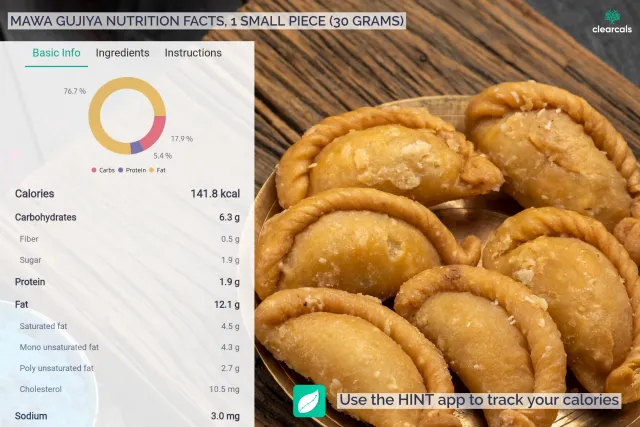
10. Gujiya Calories
One small piece (30g) of mawa gujiya has 142 kcal — 18% from carbohydrates, 5% from protein, and 77% from fat. 100g of mawa gujiya has 473 kcal. Gujiya is a good source of selenium and vitamin E.
| Mawa Gujiya Size | 1 Piece | 2 Pieces | 3 Pieces | 4 Pieces |
|---|---|---|---|---|
| Small (30g) | 142 kcal | 284 kcal | 426 kcal | 568 kcal |
| Medium (40g) | 189 kcal | 378 kcal | 567 kcal | 756 kcal |
| Large (50g) | 236 kcal | 472 kcal | 708 kcal | 944 kcal |
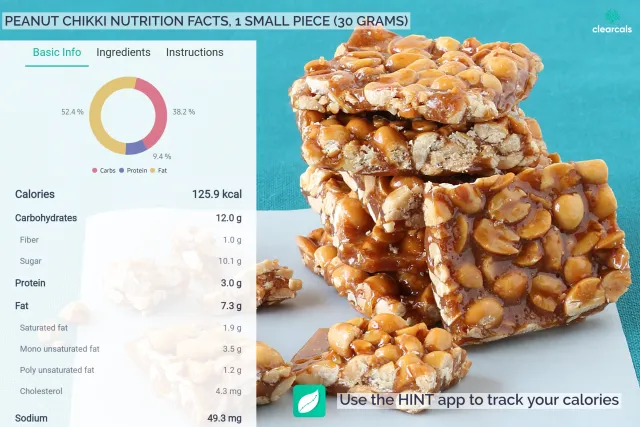
11. Peanut Chikki Calories
One small piece (30g) of peanut chikki has 126 kcal — 38% from carbohydrates and 52% from fat. 100g of peanut chikki has 420 kcal. Peanuts provide protein, healthy fats, fiber, potassium, calcium, and B vitamins.
| Peanut Chikki Size | 1 Piece | 2 Pieces | 3 Pieces | 4 Pieces |
|---|---|---|---|---|
| Small (30g) | 126 kcal | 252 kcal | 378 kcal | 504 kcal |
| Medium (40g) | 168 kcal | 336 kcal | 504 kcal | 672 kcal |
| Large (50g) | 210 kcal | 420 kcal | 629 kcal | 839 kcal |
| Chikki variety | Calories (per 30g) |
|---|---|
| Til chikki | 123 kcal |
| Peanut chikki | 126 kcal |
12. Balushahi Calories
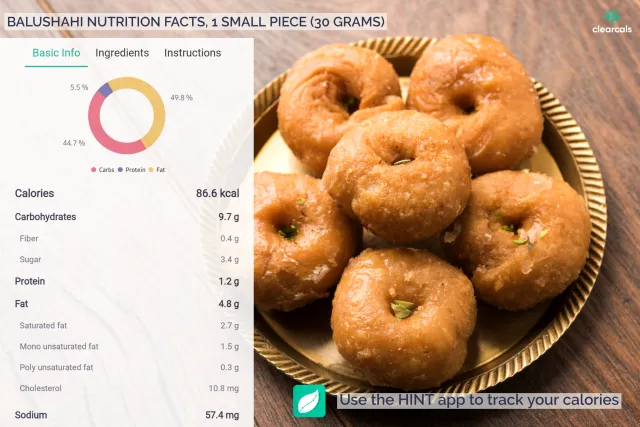
One small piece (30g) of balushahi has 87 kcal — 45% from carbohydrates, 5% from protein, and 50% from fat. 100g of Balushahi has 289 kcal. Balushahi is a deep-fried dessert made with refined carbohydrates and no significant micronutrients.
| Balushahi Size | 1 Piece | 2 Pieces | 3 Pieces | 4 Pieces |
|---|---|---|---|---|
| Small (30g) | 87 kcal | 173 kcal | 260 kcal | 346 kcal |
| Medium (40g) | 115 kcal | 231 kcal | 346 kcal | 462 kcal |
| Large (50g) | 144 kcal | 288 kcal | 433 kcal | 578 kcal |
13. Kulfi Calories
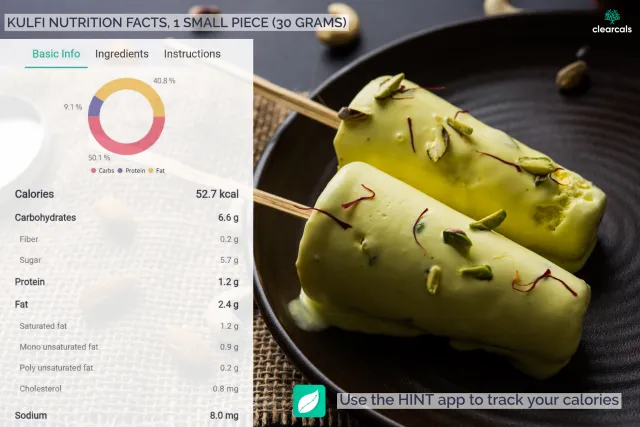
One small piece (30g) of kulfi has 53 kcal — 50% from carbohydrates, 9% from protein, and 41% from fat. 100g of kulfi has 176 kcal. Eat in moderation due to high sugar and saturated fat content.
| Kulfi Size | 1 Piece | 2 Pieces | 3 Pieces | 4 Pieces |
|---|---|---|---|---|
| Small (30g) | 53 kcal | 105 kcal | 158 kcal | 211 kcal |
| Medium (40g) | 70 kcal | 140 kcal | 211 kcal | 281 kcal |
| Large (50g) | 88 kcal | 176 kcal | 264 kcal | 352 kcal |
Are Sweets Good for Weight Loss, Diabetes, or Overall Health?
Sweets are high in sugar and saturated fats, making it important to consume them mindfully:
- Weight loss: Most Indian sweets are calorie-dense. One small gulab jamun is 97 kcal — manageable as an occasional treat within a calorie-controlled diet, but problematic if consumed frequently or in large quantities.
- Diabetes: Indian sweets typically have a high glycemic index (gulab jamun: ~75–80), causing rapid blood sugar spikes. The Hint app's Diet Summary feature helps monitor daily sugar intake.
- Muscle gain: Sugar does not contribute to muscle gain and can cause muscle inflammation in excess. Focus on protein-rich foods and track workouts with the Hint app's Pro Workouts feature.
How the Hint App Enhances Your Nutrition Tracking
The Hint app makes it effortless to track Indian sweets alongside your full diet:
- Personalized calorie and macronutrient goals — tailored for weight loss, muscle gain, or diabetes management
- Instant diet plans — customized meal plans that account for occasional indulgences
- Pro Workouts — track 300+ workouts to offset sweet consumption
- Add Your Own Recipe — log homemade gulab jamun with your exact ingredients and quantities
Final Thoughts
Gulab jamun, jalebi, kaju katli, and other Indian sweets can be part of a balanced diet when consumed mindfully. With the Hint app, tracking calories, managing macronutrients, and staying within your health goals becomes simple.
Whether you're indulging occasionally or adjusting your diet for weight loss or diabetes management, Hint Pro and Hint Premium provide the tools to stay on track.
References
🎁 Free Hint with Every Watch Purchase
Garmin watches: Purchase any Garmin watch from the Clearcals Store and receive 1 month of Hint Premium (worth ₹1,999) free — including unlimited dietitian consultations, personalised diet and workout plans, and advanced nutrition tracking. 👉 Browse Garmin watches →
Apple Watch: Purchase any Apple Watch from the Clearcals Store and receive a free Hint Pro subscription — including personalised Indian diet plans, 300+ workouts, weekly insights, and more. 👉 Browse Apple Watches →
About the Author
Asfia Fatima is the Chief Dietitian at Clearcals, with a Master's Degree in Dietetics and Clinical Nutrition and over a decade of experience in clinical nutrition and lifestyle management.
She specializes in evidence-based diet planning for weight loss, diabetes, and metabolic health.
At Clearcals, she leads the nutrition strategy behind the Hint app, helping users achieve their goals with science-backed guidance.
🔗 Connect with Asfia on LinkedIn


