Track your nutrition and health goals

Potassium Rich Foods in India: High & Low Potassium Food List
Potassium-Rich Foods in India: High and Low Potassium Lists, Daily Need and Safety
By Dr. Sumedha Verma, Consultant Physician at Clearcals
The short answer
Potassium comes mostly from fruits, vegetables, pulses, dairy and fish, and most Indian diets can get a good share of it. The best everyday sources are banana, coconut water, potato and sweet potato, tomato, spinach and other greens, rajma, chana and dals, curd and milk, orange, guava, and dried fruit. Potassium helps your heart, muscles, nerves, and blood pressure, and it offsets some of the effect of salt.
But potassium is a nutrient to be careful with, not to push. If you have kidney disease, or take certain blood pressure or heart medicines, too much can be dangerous, and your doctor or renal dietitian should guide you.
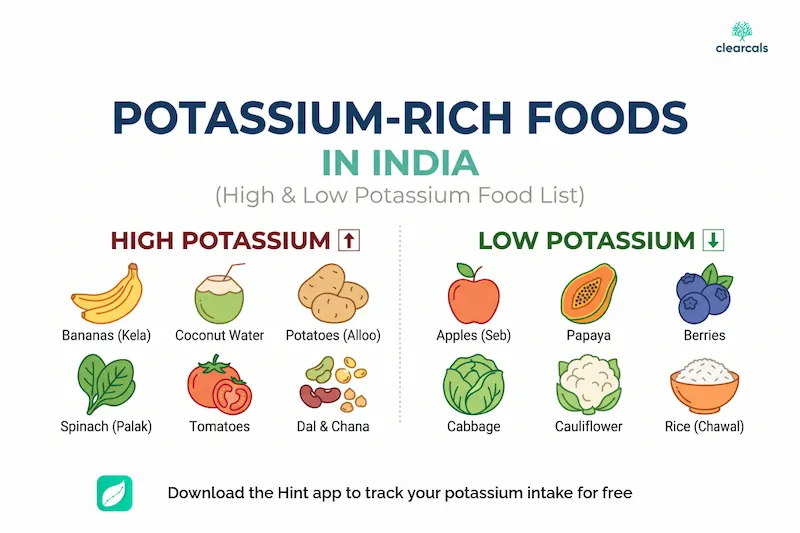
- High-potassium foods: banana, coconut water, potato, sweet potato, spinach, tomato, rajma, chana, dals, milk, curd, dried fruit, avocado.
- Lower-potassium foods: apple, grapes, berries, cabbage, cauliflower, cucumber, onion, bottle gourd, white rice.
- Kidney disease or on BP medicines (ACE inhibitors, ARBs, spironolactone)? Don't raise your potassium on your own. Ask your doctor first.
- Supplements and "low-sodium" salt substitutes can contain a lot of potassium and are not for self-use.
Why potassium matters
Potassium helps your heart beat steadily, your muscles contract, your nerves send signals, and your body balance fluids. A diet rich in potassium, together with less salt, is linked to lower blood pressure. This is a key part of the DASH diet. See our guides to the DASH diet for high blood pressure and the hypertension hub.
How much potassium do you need?
Indian guidance (ICMR-NIN) puts adult needs at roughly 3,500 mg a day, from food. Many people eat less. Your doctor may set a different target if you have kidney disease, heart disease, or take medicines that affect potassium. You don't have to reach this number with tablets: aim for it through meals.
Potassium-rich foods: Indian list
The numbers are rough amounts per typical serving. They vary by variety and cooking, and boiling in a lot of water lowers the potassium in vegetables.
| Food | Typical serving | Roughly how much potassium |
|---|---|---|
| Banana | 1 medium | about 350 to 420 mg |
| Coconut water | 1 glass (200 ml) | about 400 to 600 mg |
| Potato, boiled | 1 medium (150 g) | about 500 to 600 mg |
| Sweet potato, boiled | 1 medium | about 400 to 500 mg |
| Spinach, cooked | 1 katori | about 500 to 600 mg |
| Amaranth leaves, cooked | 1 katori | about 400 mg |
| Tomato | 1 medium | about 250 mg |
| Rajma, cooked | 1 katori (150 g) | about 500 to 600 mg |
| Chana or chole, cooked | 1 katori | about 400 mg |
| Dals (masoor, moong, toor), cooked | 1 katori | about 300 to 400 mg |
| Milk | 1 glass (250 ml) | about 350 to 400 mg |
| Curd | 1 katori (100 g) | about 150 mg |
| Orange | 1 medium | about 230 mg |
| Guava | 1 medium | about 250 mg |
| Pomegranate | 1 medium | about 500 mg |
| Dates | 3 | about 200 mg |
| Raisins | 30 g | about 220 mg |
| Peanuts | 30 g | about 200 mg |
| Fish | 100 g | about 300 to 400 mg |
| Chicken | 100 g | about 250 to 350 mg |
Banana is the best-known source, but potato, spinach, rajma and coconut water each give as much or more per serving. For a broader look at calories and nutrients, see our pages on banana and potato.
Potassium-rich fruits
Good fruit sources are banana, coconut water, pomegranate, orange, guava, papaya, melon and dried fruit such as dates, raisins and apricots. Fruit is a healthy way to raise potassium for most people, but check with your doctor if you have kidney disease.
Low potassium foods
Some people need to limit potassium, usually because of kidney disease or certain medicines, and this should be on a doctor's or renal dietitian's advice. Foods that are generally lower in potassium include:
- Fruits: apple, grapes, berries, pineapple, watermelon (small portions), pear, mandarin.
- Vegetables: cabbage, cauliflower, cucumber, onion, bottle gourd (lauki), ridge gourd (turai), carrot, green beans.
- Grains: white rice, white bread, rotis in moderation.
- Other: some boiled and rinsed vegetables, since potassium leaches into the water.
If you have kidney disease: do not use this list to design your own diet. Your safe potassium level depends on your kidney function, your blood test results and your medicines, and it can change. Ask your nephrologist or renal dietitian. Coconut water, bananas, potatoes and "healthy" salt substitutes are common surprises.
Medicines and potassium
Some medicines raise potassium, and some lower it:
- Can raise potassium: ACE inhibitors and ARBs (such as telmisartan), spironolactone and other potassium-sparing diuretics, some anti-inflammatory painkillers, and potassium supplements. See our guide to amlodipine, telmisartan and diet.
- Can lower potassium: diuretics such as furosemide and thiazides, some laxatives and steroids.
Never start potassium supplements or high-potassium diets on your own if you take any of these medicines. Tell your doctor about all your medicines.
Signs of low potassium
- Muscle weakness and cramps
- Tiredness
- Constipation
- Palpitations or an irregular heartbeat
- Tingling or numbness
Low potassium usually happens because of vomiting, diarrhoea, sweating, water tablets or certain medical conditions, not diet alone. A blood test confirms it. See a doctor promptly for palpitations or severe weakness.
Signs of high potassium
High potassium often has no symptoms until it is serious. When it does, you can feel muscle weakness, palpitations, nausea or tingling. It can cause dangerous heart rhythm changes, so it is a medical emergency in some cases. It mostly happens in people with kidney disease or on potassium-raising medicines.
What is a normal potassium level?
Blood potassium is usually reported as roughly 3.5 to 5.0 mmol/L (mEq/L). Labs differ slightly, so discuss your report with your doctor.
How to get more potassium (if your doctor says it is safe)
- Eat more vegetables and fruit each day, and add pulses and dairy.
- Cook vegetables with less water, such as steaming or sautéing, and use the cooking liquid for dals and soups.
- Cut back on salt, which is as important for blood pressure as adding potassium.
- Don't rely on supplements or salt substitutes.
A sample day of potassium-rich Indian eating
This is an example, not a prescribed plan, and the amounts are approximate. It is for healthy adults. If you have kidney disease or take any of the medicines above, check with your doctor first.
| Time | Example | Approx. potassium |
|---|---|---|
| Breakfast | Oats or ragi porridge with milk and a banana | 900 to 1,000 mg |
| Mid-morning | A glass of coconut water | 400 to 600 mg |
| Lunch | Roti, rajma or chana, spinach or amaranth sabzi, tomato-cucumber salad, curd | 1,300 to 1,600 mg |
| Evening | A guava or orange, and a handful of roasted chana | 400 to 500 mg |
| Dinner | Dal, mixed vegetable sabzi, roti or rice | 500 to 700 mg |
| Day total | roughly 3,500 to 4,400 mg |
Track your potassium with Hint
It is hard to know whether your usual meals reach your potassium target, or how it compares with your salt intake. Hint lets you log your Indian meals and track your potassium intake, along with sodium, calories, protein and the essential vitamins and minerals, for free. After a week, you can see which days fall short, and which foods, such as a banana, coconut water or a bowl of rajma, would close the gap. If you have been told to limit potassium, bring your food log to your doctor or renal dietitian. Hint estimates your intake from food and cannot replace a blood test or medical advice. You can also try our free Indian food calorie calculator.
Frequently asked questions
Which food has the most potassium? Among everyday Indian foods, potato, spinach, rajma, coconut water, banana, pomegranate, dals, and milk are the top choices.
Is banana the best source of potassium? It is a good source, but potato, spinach, rajma, and coconut water provide as much or more per serving.
Which fruit is rich in potassium? Banana, coconut water, pomegranate, orange, guava, papaya, and dried fruit such as dates and raisins.
What are low potassium foods? Apple, grapes, berries, cabbage, cauliflower, cucumber, onion, bottle gourd, and white rice. If you need a low-potassium diet, your doctor or renal dietitian should guide you.
How much potassium do I need per day? About 3,500 mg for most adults, from food. Your doctor may advise differently.
What are the symptoms of low potassium? Muscle weakness and cramps, tiredness, constipation, and palpitations.
Can I take potassium tablets? Only on a doctor's advice. Too much can cause dangerous heart rhythm problems.
Is coconut water good for potassium? Yes, it is rich in potassium, but people with kidney disease or on potassium-raising medicines should check with their doctor first.
Can potassium help lower blood pressure? A diet rich in potassium and low in salt is linked to lower blood pressure, but it isn't a substitute for your BP medicine.
Medical disclaimer. This article is for general education and is not medical advice. Do not start, stop, or change a potassium supplement, salt substitute, or diet for kidney disease based on this article. If you have kidney, heart, or other medical conditions, take BP or water tablets, or you are pregnant, speak to your doctor or a registered dietitian.
Related reading and tools
Start here: calorie tracking for Indian food if you are new to logging meals.
Other vitamin guides:
- Vitamin B12 foods for vegetarians
- Vitamin D foods and sunlight
- Vitamin A rich foods
- Vitamin C rich foods
- Vitamin E rich foods
- Vitamin K-rich foods
- Calcium-rich foods
- Magnesium-rich foods
- Zinc-rich foods
- B-complex vitamin foods (B1, B2, B3, B5, B6, B7, B9)
Related reading:
- Hypertension: normal blood pressure by age, DASH diet and foods to avoid
- Top 10 fruits for high blood pressure
- Daily protein requirement in India
- High-protein Indian instant diet
Free tools:
- Indian food calorie calculator
- Protein calculator
- Hint, the Indian food calorie and vitamin tracking app
About the author
Dr. Sumedha Verma is a Consultant Physician at Clearcals with extensive experience in clinical medicine and healthcare services.
She has significant expertise in managing chronic conditions such as diabetes, thyroid disorders, PCOS, infertility, and other gynecological health concerns.
Known for her patient-centered approach, Dr. Verma focuses on improving patient compliance and helping individuals achieve better health outcomes through personalized medical guidance and long-term care.
Connect with Dr. Sumedha on LinkedIn